Wednesday, June 28, 2006

 
Bishop Duncan starting to see the light? A big day
[updated below]

I have always maintained that my beef with the Nigerian "same sex marriage" legislation (pdf) was not over theology, nor even over whether gay marriage should be institutionalized in Nigeria, but over the Anglican Church of Nigeria's endorsement of legislation that goes beyond banning gay marriage to the point of abolishing even the most basic civil rights for gay and lesbian Nigerians.

I have been consistent in my criticism of the Anglican Communion Network, and its moderator Bishop Robert Duncan of Pittsburgh. They have been equivocal (see here also) about whether they stand by their ally Archbishop Peter Akinola's endorsement for political reasons or because they in fact believe that gay and lesbian Nigerians should be put in prison for, say, organizing meetings.

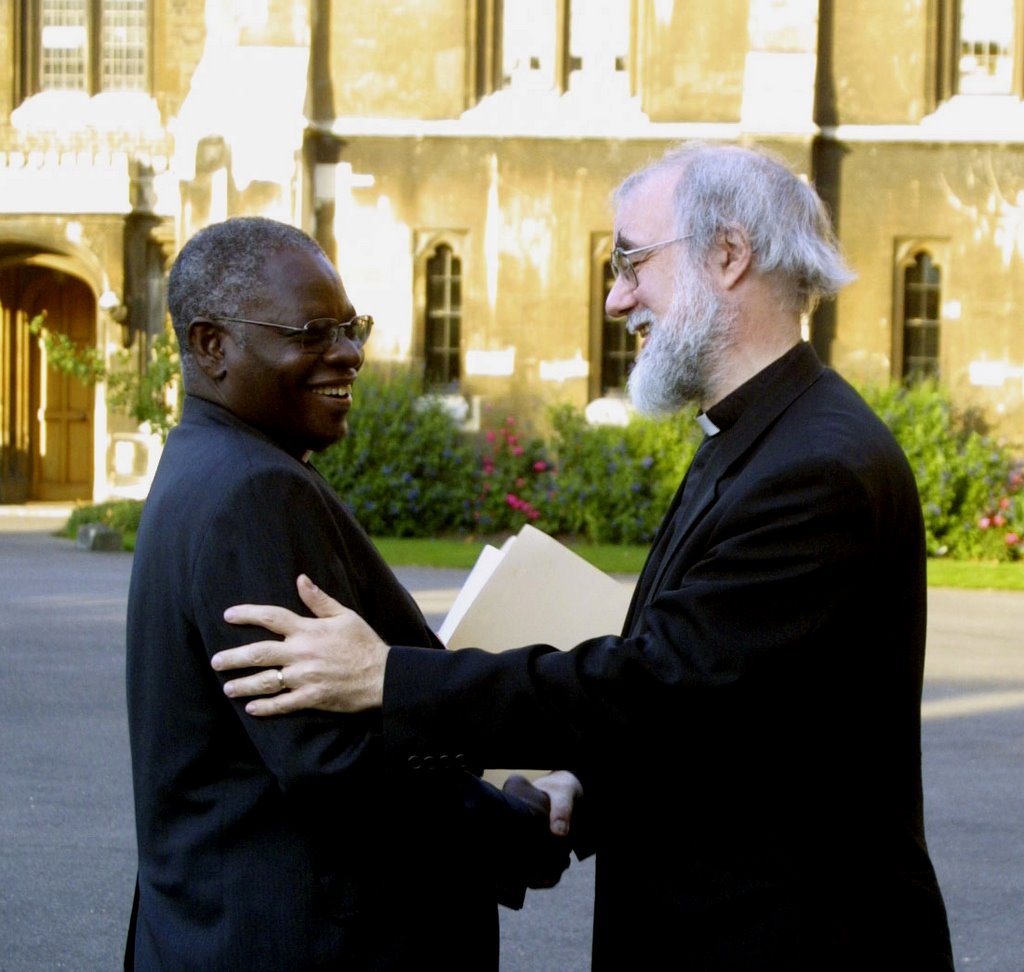
So, I was delighted to see the Archbishop of Canterbury, Rowan Williams, make a clear statement about the need to protect the civil rights of gay and lesbian churchgoers, followed by clear agreement from Bishop Duncan [emphasis mine]:
Bishop Duncan also lauded Archbishop Williams' call to the church to "give the strongest support to the defense of homosexual people against violence, bigotry and legal disadvantage." "I, of course, could not agree more with the Archbishop in calling for the protection of those whose affections are toward the same sex. Discrimination or violence against them as persons should be abhorrent to Christians, regardless of our understanding of what the church can and cannot bless," said Bishop Duncan.
I'm still waiting for a clear call from the Network and from Archbishop Williams for Archbishop Akinola to withdraw his endorsement -- but this a wonderful start. Perhaps more talk of Schism will give them the political cover to further loosen their tongues.

UPDATE 2:15 pm: The American Anglican Council's response to Archbishop Williams' "reflection" does match the grace of Bishop Duncan's.

Tuesday, June 27, 2006

 
I hope Archbishop Akinola caught this ...
In the Archbishop of Canterbury Rowan Williams' "reflection" on the aftermath of the Episcopal Church's General Convention, and the implications that decisions there will have for the Anglican Communion, he made this vital point [emphasis mine]:
It's true that the election of a practising gay person as a bishop in the US in 2003 was the trigger for much of the present conflict. It is doubtless also true that a lot of extra heat is generated in the conflict by ingrained and ignorant prejudice in some quarters; and that for many others, in and out of the Church, the issue seems to be a clear one about human rights and dignity. But the debate in the Anglican Communion is not essentially a debate about the human rights of homosexual people. It is possible --– indeed, it is imperative --– to give the strongest support to the defence of homosexual people against violence, bigotry and legal disadvantage, to appreciate the role played in the life of the church by people of homosexual orientation, and still to believe that this doesn't settle the question of whether the Christian Church has the freedom, on the basis of the Bible, and its historic teachings, to bless homosexual partnerships as a clear expression of God's will.
I couldn't write a better summary of what I believe to be the fundamentals of my position. I have no stake in how the Episcopal Church or the Anglican Communion at large decides the issue of the homosexuality. My concern is that conservatives in the Church, some of whom I know and am very fond of, are failing to make the proper distinction between a theological dispute, which Williams goes on to say has to be decided "on the common basis of Bible and historic teaching," and a dispute over the abrogation of the most fundamental of civil rights for gay and lesbian Nigerians, as endorsed by Archbishop Peter Akinola, Primate of All Nigeria.

Archbishop Williams makes this distinction, and he makes it clearly. He says to liberals:
Unless you think that social and legal considerations should be allowed to resolve religious disputes -- which is a highly risky assumption if you also believe in real freedom of opinion in a diverse society --– there has to be a recognition that religious bodies have to deal with the question in their own terms.
At the same time, he says to conservatives:
... this is not and should never be a question about the contribution of gay and lesbian people as such to the Church of God and its ministry, about the dignity and value of gay and lesbian people.
I've been frequently frustrated by the claim of conservative Anglicans that "rights" of gays and lesbians mean nothing if their behavior is sinful. See here for an example. There are few arguments with less intellectual meat than that one. Why's that? Well, if it isn't sinful, then we have taken away someone's civil rights for something that person did not believe in the first place. Not a good thing for "freedom of opinion in a diverse society."

And, I have to admit, I've been frustrated by the claim of liberal Anglicans that external concepts of human rights can occasionally trump Scripture. I feel like they've been reading a different Bible (though I agree with them in their position on human rights).

So, I hope that Archbishop Akinola is reading Williams' reflection carefully. Because in the same Anglican Communion where liberals are letting human rights guide an evolution in the historical beliefs of the Church, conservatives are letting "orthodoxy" steal away the most basic protections that civil society can offer those in an aggrieved minority: speech, assembly, the press, and free exercise of religion. (See here for more details on the "gay marriage" situation in Nigeria.)

I hope Akinola's American supporters (i.e., the Institute on Religion and Democracy, The American Anglican Council, and the Anglican Communion Network, headed by Bishop Robert Duncan of Pittsburgh) are reading Williams' reflection, too.

Sunday, June 25, 2006

 
Where have I gone? (and an update on Nigerian same-sex marriage bill)
Sorry if I've disappeared lately.

I'm working on a grant proposal to the National Science Foundation for funding to explore the anatomy of the sugar-transporting vasculature in plants -- otherwise known by its term-of-art the "phloem."

The word phloem comes from the Greek word phloios, which means bark. The phloem is responsible for transporting carbohydrates, amino acids, and minerals from leaves, where they're produced with energy from the sun, to everywhere else in the plant. On the right is a confocal laser scanning micrograph (CLSM) of an Arabidopsis thaliana (or thale cress) root that has been genetically modified to synthesize a green fluorescent protein (GFP) only in the phloem, marking the path by which "plant food" is moved to the growing root tip. [Image lifted shamelessley from Stadler et al.'s article in The Plant Journal.]

The grant proposal I'm writing aims to light up the phloem of Arabidopsis, but in a more subtle way. In the image to the right, the GFP is just floating around in solution -- I want to tether the GFP to the membranes surrounding the phloem conduits. Doing so would allow me to measure accurate the dimensions of the conduits.

Why bother, you ask? Well, with that data, it will be possible to predict a lot about how the phloem works over long distances. I won't go into details (you can read the abstract of my most recent paper on the subject here), but suffice it to say that if I can convince the funding panel to drop me some cash, then I'd be able to go a long way toward integrating the molecular biology and fluid mechanics of phloem biology, and I'd be able to help answer broad questions about how plants direct resources to different organs at different developmental stages.

My deadline is July 12, so don't expect too much from this blog until then.

A final word, however, and an important one before I semi-disappear:

I have received word from a human rights activist in Nigeria that the Nigerian Federal is in recess until August. My understanding is that if they don't get to the Same Sex Marriage (Prohibition) Bill 2006 (pdf) by the fall, it may not get signed into law until well after the presidential election in May, 2007, if at all. I've also heard from others that Archbishop Akinola is plenty p!$$ed that the President Obasanjo hasn't made the bill a higher priority.

Honestly, this is good news. But the good Archbishop gets a black eye unless he changes his position (I don't think he will), and his conservative Anglican supporters in the US get a whole bunch of black eyes for being unable to distinguish an honest civil rights issue from an equally serious theological dispute. Still not a peep from any of them outside of the occassional comment on titusonenine that they have reservations. Shame on them.

Frankly
, I'm kind of excited about the possibility that this bill will go away, at least for a while. There was so much I wanted to write about before that little monstrosity came along.

And finally
, thanks to The Salty Vicar for the link. Stay tuned -- I'm not going away forever.

Tuesday, June 20, 2006

 
NG photojournalist released
I had reported earlier on the arrest by the Nigerian Navy of National Geographic photojournalist Ed Kashi, and his fixer Elias Courson. They were released earlier today after a three-day detention.

The Nigerian Navy claimed they were arrested for photographing gas flares from a Bayelsa State oil facility without a permit. Two journalists in Port Harcourt were reported as saying that they knew of no such permitting process.

The Committee to Protect Journalists has more.

(In an odd bit of small-world trivia, Kashi was a college classmate of Episcopal Diocese of Washington's Director of Communications Jim Naughton.)

[Photo from Committee to Protect Journalists website]

 
Hawking: Solve climate change with space travel!
After publically heaping scorn on Steven Hayward of AEI for repeating a suggestion by engineers that global warming could be ameliorated by putting mirrors in space to reduce incoming radiation, he asked me:
May I assume your scorn for my mention of the idea applies equally to Marty Hoffert and the other authors of the Science piece?
To which I responded, "yes":
I am constantly amazed at scientists who don't give proper attention to even the most cursory analysis of the implications of their suggestions, if only on the back of an envelope. It took me 20 minutes to do my calculation ... . I've been in plenty of meetings where people will brainstorm fanciful ideas on the off-chance that something makes sense, but we don't publish the proceedings of those meetings in Science.
Last week, Stephen Hawking (yes, that one) added his name to my "scorn" list by suggesting that the human race needs to [emphasis mine]:
... spread out into space for the survival of the species. ... Life on Earth is at the ever-increasing risk of being wiped out by a disaster, such as sudden global warming, nuclear war, a genetically engineered virus or other dangers we have not yet thought of.
I have never understood this argument. Cost aside -- and Hawking makes no quoted estimate of that -- if we can't handle those threats over a century time scale, what makes him think that we could put a significant human population on another planet?

Much of what Paul Ehrlich's Population Bomb predicted has not come to pass, but Ehrlich was axiomatically correct when he said that there's no a priori reason to believe another planet (i.e., more space) would help us solve our social and environmental crises, nor is there any reason to reason to believe those problems wouldn't follow us if we left.

So why does Hawking say stuff like this? Naivete? Possibly. A desire to sell the children's book he's writing with his daughter? Could be.

Honestly, I just don't get it. This is the only planet we have, and pie-in-the-sky schemes that rely on leaving are insane.

[Image from British Council]

Sunday, June 18, 2006

 
Nigeria roundup, cont'd, 6/18

 
Nigeria roundup, 6/18
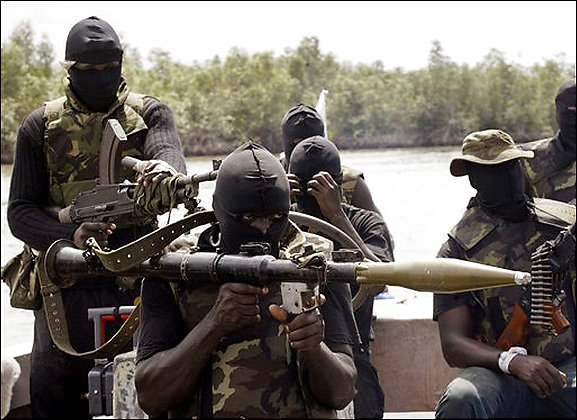
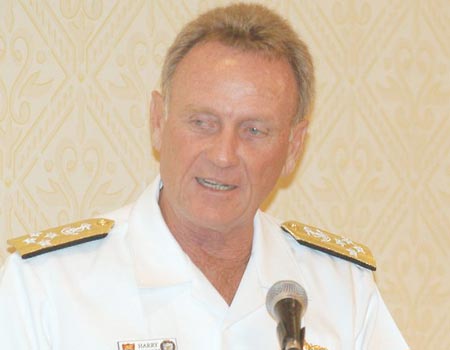
[Gunboat/AP Photo/George Osodi and Ulrich/Tribune Review/Michael Henninger]

 
"Manufacturers" as critics of climate change
The lobbying group, the National Association of Manufacturers (NAM) -- which has a blog, believe it or not -- for some reason thinks it's in their best interest to poke holes in the arguments of those warning of the possible impacts of global warming. This, from an organization that lists among its priorities the development of satisfying employment opportunities, investments in the future, and the improvement of US competitiveness in international markets.

So, why they don't embrace climate change and work to realign US manufacturing toward the next green revolution? (See the ApolloAlliance for more.) Oh wait, I know! They represent entrenched US manufacturers, not the ones that take the risks that will keep the US competitive in a global market.

Note to self: whenever someone says that responding to climate change is "bad for business," make that "bad for established business interests."

 
An admission from a Nigerian cleric
In The Tide, Nigeria (today), Rev. Akuruse-Okike Omubo of Port Harcourt writes of his three-year stint as a Pastoral Theology student in Canada. He candidly discusses the theological and cultural differences between the Nigerian and western Anglican churches, and makes this important admission [emphasis mine]:
... my number one view about the gay issue is that our culture here in Africa does not permit it and anyone who is a gay in Africa will not come out openly to claim that he is a gay because he is going to be an outcast in the society.
I am currently working to establish a working account of the Church of Nigeria's response to Changing Attitude's presence in Nigeria, and the most important issue for me, as someone who has never visited Nigeria, is why Davis Mac-Iyalla, director of Changing Attitude Nigeria [see here and scroll down] and a professed Anglican, never visited the Church of Nigeria offices in Abuja to make his presence known. Such a step, early on, would have dispelled much of what made and continues to make the Church of Nigeria's response to Changing Attitude so difficult to judge.

Of course, Rev. Omubo's words come as no surprise. Africa is a notoriously difficult place to be openly gay or lesbian, and the Church makes it no easier. But would a visit to the Church of Nigeria have put Davis's life in danger? I welcome comments, especially from Nigerians who visit this blog.

 
Hello, irony! Bishop Duncan suddenly recognizes the need for minority protections
From an interview by Newsweek's Elise Soukop with Bishop Robert Duncan (Episcopal), of Pittsburgh, and Moderator of the Anglican Communion Network [emphasis mine, h/t D. C. at titusonenine]:
Q: Some say that the average lay person doesn't even care about consecrating gay priests. Is this all much ado about nothing?

Duncan: The average layperson may very well not care, but that doesn't make it right or true. The savior of our world stood alone against the whole world and, remarkably, within two centuries the entire empire submitted. A majority opinion doesn't make it right.
Here's Bishop Duncan in defense of Nigerian Archbishop Peter Akinola's decision to endorse legislation that would deny free speech, press, assembly, and exercise of religion to Nigeria's gay and lesbian citizens:
It is jarring, to say the least, to see church leaders [meaning Bishop Chane], who claim to champion the primacy of local understanding and culture, demanding that foreign sister churches give up their own local understanding and culture and be judged by an American understanding of individual rights. There is a word for the one-way imposition of values -- colonialism.
Arghh!! It is not an "American understanding of individual rights" but a universal understanding that recognizes the need to protect minorities. Nigeria's own constitution (Sections 38-40) recognizes minority rights. And as Bishop Duncan said to Newsweek, the "majority opinion does not make it right."

If Bishop Duncan believes that minority protections are important, he should immediately write or call the Church of Nigeria office to ask Archbishop Akinola to withdraw his endorsement of legislation that silences an antagonistic minority. Contact info: the Rev. Canon Akintude Popoola, Communications Director, Church of Nigeria, +234 9 5236950, 5230987, 5230989, and email.

[My earlier comments on Duncan's note are found here]

Friday, June 16, 2006

 
Climate change roundup, 6/16

 
Jim Naughton's thoughts on the General Convention
Naughton, the communications director for the Episcopal Diocese of Washington, has some interesting thoughts (6/16) on what's happening at a very high level at the Episcopal General Convention [emphasis mine]:

John Sentamu, the Archbishop of York, who seems like a smart and subtle fellow, is pressing our bishops to enact full moratoria on the consecration of non-celibate gay bishops and on the blessing of same-sex relationships. He is meeting with various bishops, in smallish groups, I think, to press his case.

Those of us who were in the second floor bar of the Hyatt last night along about midnight (that was ginger ale in my glass) saw him walk through in the company of Bishop Jon Bruno of Los Angeles, an interesting site because Bruno is built like a tight end, and Sentamu like a marathoner.

His argument, as I understand it, goes something like this:

(A caution here: I haven’t heard this directly from the Archbishop, and some of what people are portraying as his argument may be their own developments on his thinking).

If you don’t enact full moratoria, several things might happen, none of them good: either you will be marginalized within the Communion, or the Communion will have to cope with intra-provincial splinters as the Akinolians attempt to assemble an orthodox international fellowship.

On the other hand, if you vote for moratoria, you will be on the right side of Windsor [pdf] whereas Akinola of Nigeria, Orombi of Uganda and Venables of the Southern Cone, among others who have crossed your provincial boundaries to lay claim to parishes or start churches, will be on the wrong side, and then they will be the ones subject to whatever discipline it is that the Communion can muster.

In addition, if we accept the moratoria, we buy ourselves time, the argument goes. Akinola won’t be a primate forever, and Orombi’s has a weak hold on his bishops’ loyalty (north-south tensions in Uganda). If the Communion outlives their tenures, perhaps the storm will pass.

Looking at this argument strictly in tactical rather than moral terms, I don’t find it persuasive.

Read the whole thing to find out why.

 
Anglican roundup, 6/16

Thursday, June 15, 2006

 
Anglican roundup, 6/15
[Akinola rumor updated below]

If anyone out there wants to know what stories interest a non-Anglican about the Episcopal Church's General Convention going on right now in Columbus, Ohio, here goes:

 
Bush's numbers and statistical nearsightedness
First, take a close look at this picture:


Then, tell me that it makes sense -- in the wake of al-Zarqawi's death and Bush's surprise 5-hr visit to Baghdad -- to pay any attention to:
(Note, these are the only post-Zarqawi numbers.) When his approval jumps 10 points in as many days, as it did when Saddam Hussein was captured in December 2003, then we'll talk. Otherwise, we've gotta take the long-view. The short-term ups and downs of single polls by single polling firms mean next to nothing. So, Democrats and Republicans alike: stop yer yakkin'. A "bump" exists if all the polls agree, the bump is large, and it's sustained.

Joe in DC at AmericaBlog has comments, as does Tim Grieve at Salon.com.

See PollingReport.com for the numbers.

Monday, June 12, 2006

 
Bush Sees Oil as Key to Restoring Stability in Iraq
I did a double-take when I saw that headline from the New York Times' David Sanger, but nearly fell out of my chair when I read his first paragraph:
President Bush proposed today that Iraq create a national fund to use its oil revenues for national projects, as part of a strategy to build loyalty to the new government of Prime Minister Nuri Kamal al-Maliki.
Really!? Sanger goes on [emphasis mine]:
This is not the first time that Mr. Bush and his aides have suggested that oil could be a solution to many of Iraq's problems: Before the war, Paul D. Wolfowitz, then the deputy secretary of defense, suggested that oil revenues could pay for Iraqi reconstruction. So far, that has not happened.
I'm getting really frustrated. This plan could have been executed a long time ago, and Bush is fully to blame. See Naomi Klein's September 2004 Harper's piece for more.

 
Space Mirrors: AEI's solution to climate change
[updates below]

Yes, Steven Hayward of the American Enterprise Institute now appears to be willing to admit that climate change is a going concern.

But rather than tackle the intertwined problems of energy consumption, energy supply, global conflicts, and a fast-growing developing world, Steven Hayward offers this solution (and I'm not kidding):
... we should consider climate modification. If humanity is powerful enough to disrupt the climate negatively, we might also be able to change it for the better. On a theoretical level, doing so is relatively simple: we need to reduce the earth’s absorption of solar radiation. A few scientists have suggested we could accomplish this by using orbiting mirrors to rebalance the amounts of solar radiation different parts of the earth receive. Right now this idea sounds as fanciful as Ronald Reagan’s Strategic Defense Initiative seemed in 1983, but look what that led to. New York University physicist Martin Hoffert points out that the interval between the Wright brothers’ first flight at Kitty Hawk and Neil Armstrong’s first step on the moon was a mere sixty-six years. It is entirely reasonable to expect vast changes in our technical capacity before the century is out.
OH ... MY ... GOD.

Let's see, to reduce insolent radiation by, say, 10%, would require that something on the order of 5-10% of the equatorial land area between 30 S and 30 N be covered by mirrors

... from space.

To minimize penumbras -- those half-shadows that surround the full shadows cast by objects due to the very large size of the Sun -- the mirrors would have to be solid sheets stretching over enormous areas. And at an orbital altitude of at least 400 miles, this massive, unbroken mirror would require an area of at least 6 million square miles (assuming a 3936 mile Earth radius, and 5% coverage of the area between 30 S and 30 N).

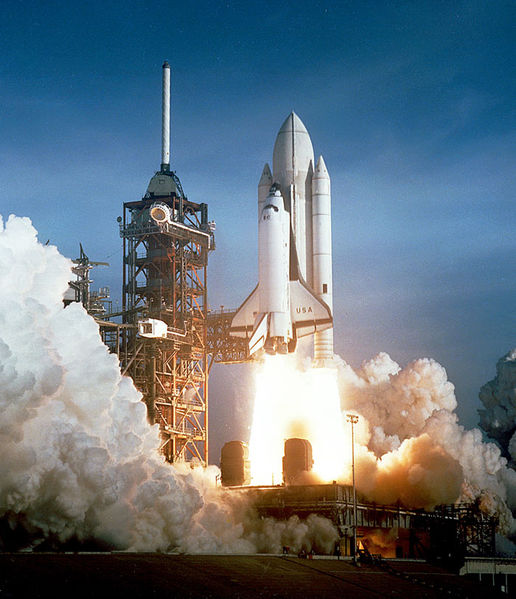
Light weight reflective mylar weighs about 50 tons per square mile. Forgetting for the moment that the Space Shuttle's maximum payload weight is only 25 tons, an effective mirror would require over 300 million tons of mylar, and therefore about 10 million space shuttle launches.

And don't forget space junk. The only reason the shuttle doesn't get hit is because it's small. A 6 million square mile mirror is another story.

Finally, Ronald Reagan's SDI? Please.

Hayward's piece just goes to show: AEI folks have no sense of scale.

UPDATE: I made a serious boo-boo. I calculated area as 4 pi R^3, rather than 4 pi R^2. All corrections are reflected above. Thanks to phillies at DailyKos for catching the math error. I used to work on global carbon cycling models and was familiar with things like the surface area of the Earth, but that was ten years ago -- yet, I knew something didn't add up.

The mylar would cost about $5 trillion dollars, assuming a 90% volume discount on 12 micron PET from commercial sources such as McMaster-Carr, and that's just to buy the film -- never mind the structural supports.

Ten million launches would use a lot of fuel. If each launch consumes the equivalent of 2 minutes worth of gas at current US gasoline consumption rates (equivalent to 445,000 gallons of gas), then 10 million launches would consume about 380 years worth of gas at current US gasoline consumption. This would cost global taxpayers on the order of $11 trillion at $2.50 a gallon.

So far, then, my conservative estimate suggests that production and deployment of the space mirrors would more than double our national debt.

And I thought the AEI was supposed to be fiscally conservative. So much for their stand against government entitlements.

UPDATE II (11:00 AM, 6/13/2006): Steven Hayward has contacted me with his source for the Space Mirror program. He is right to make clear to me that it was not his idea, but that it instead originated in an article in the journal Science. The article, entitled "Advancing technology paths to global climate change stability: energy for a greenhouse planet," was published in 2003 (Science 298: 981-987) with Martin I. Hoffert at NYU's Department of Physics as the lead author.

Hoffert et al.'s conception of the space mirrors is different from what I had conceived:
Perhaps most ambitious is a proposed 2000-km-diameter mirror of 10-micron glass fabricated from lunar materials at the L1 Lagrange point of the Sun-Earth system [i.e., stationary between the Earth and Sun, at about 1 million miles from the Earth and thus 4 times the distance between the Earth and Moon]. The mirror’s surface would look like a permanent sunspot, would deflect 2% of solar flux, and would roughly compensate for the radiative forcing of a CO2 doubling. Climate model runs indicate that the spatial pattern of climate would resemble that without fossil fuel CO2.
In an accompanying figure, the mirror is shown as a Fresnel mirror, which would diffract, not reflect, incoming solar radiation. Hoffert et al. go on [emphasis mine]:
It is only prudent to pursue geoengineering research as an insurance policy should global warming impacts prove worse than anticipated and other measures fail or prove too costly. Of course, large-scale geophysical interventions are inherently risky and need to be approached with caution.
In the interest of fairness to Hayward, let me just say that Hoffert et al.'s concept is looney. A 3 million square kilometer Fresnel mirror (i.e., carefully etched glass) would still require manned space flights until kingdom-come. I don't feel it's necessary for me to do the calculations needed to give a cost estimate (Hayward, or perhaps an enterprising National Review reader, should do it), but shame on Hoffert et al. for not even considering, let alone comparing, potential costs. If a Fresnel mirror at the L1 Lagrange point costs anything like the mirror I envisioned above, it would be far more cost effective to cut our fossil fuel consumption, or plant a trillion trees. We need to get over our all-to-eager embrace of "Star Trek" technology.

On the other hand, technological advances, like some of those proposed by Hoffert et al., are exactly what could make a new "green revolution" economically attractive for both business and labor. People at the ApolloAlliance are leading the way (hopefully), but they're keeping it simple. And their suggestions don't require a permanent base on the Moon.

(Image source NASA)


Sunday, June 11, 2006

 
Where things stand now - a resource for newbies and oldbies
[Constantly updated -- permalink here]

[UPDATE February 28, 2007 -- If you are reading this post for the latest news on the Nigerian gay marriage bill, then your information will be out of date. Please visit the top of the blog here for the latest information, as well as info on what you can do now to speak out against this terrible legislation. The bill could pass by the end of tomorrow, March 1, 2007 -- do something now!

However, everything you read below is still accurate and is a good introduction to the history and background to this legislation.]

In late February, 2006, John Bryson Chane, the Episcopal Bishop of Washington, DC, wrote an op-ed for the Washington Post. In it, he revealed to the WaPo's readership one of the many awful consequences that decades of conflict have brought to the Anglican Communion over the issue of homosexuality. Just days before, one of Chane's fellow bishops in the Anglican Communion, the Primate of All Nigeria and leader of the Anglican Communion's largest Province, Archbishop Peter Akinola, endorsed legislation that would ban most basic civil rights for gay and lesbian Nigerians, and enforce that ban with a 5 year prison sentence.

The Global Anglican Communion is in crisis mode (events in Columbus, Ohio, suggest it may be about to implode), struggling to salvage a broad though loosely affiliated organization from self-destruction under the pull of two strong forces. On the one hand, northern Anglicans in the US, Canada, and the UK are committed to a liberal stand on homosexuality, and to a Gospel of Inclusion (i.e., "The Episcopal Church Welcomes You"). On the other hand, the Provinces of the Global South, along with splinter organizations in the North (see the American Anglican Council, or AAC, and the Anglican Communion Network, or Network) are "orthodox" on the issue of homosexuality, and consider their purpose to be far more evangelical than that of the Episcopal Church, USA (ECUSA), or of other Northern Anglicans. The Provinces of the Global South claim moral authority because of their great and increasing numbers, while parish registries in ECUSA and elsewhere are stable or in decline.

The "splinter organizations" that have organized the conservative movement within ECUSA, and in the process have forged deep alliances with their Global South brethren, have their roots deep within the Republican Party. Jim Naughton of the Episcopal Diocese of Washington expertly outlines that relationship in his series "Following the Money." The AAC -- an umbrella group for American conservative Anglicanism -- has historical and present ties with the Institute on Religion and Democracy (or IRD), a deeply conservative group devoted to supporting politically consonant forms of Christianity within mainline Protestant denominations. The historical relationship between the IRD and the AAC is clear -- at one point, their websites were identically formatted, and their offices were in adjacent suites in an I St. office building in northwest Washington, DC. (The AAC is now headquartered in Atlanta.) The IRD has received considerable support ($4,679,000 between 1985 and 2005) from The Lynde and Harry Bradley Foundation, Richard Mellon Scaife via the Carthage Foundation, the Sarah Scaife Foundaiton, and the Scaife Family Foundation, the Randolph Foundation, the Castle Rock Foundation (the Coors family), and others. The IRD board is populated by such conservative luminaries as Mary Ellen Bork, Fred Barnes, author of "Rebel in Chief", Richard J. Neuhaus, Michael Novak, and is advised by conservative radio talk-show host Michael Medved. A source in the AAC tells me that a still large share of the AAC's budget comes from Howard Ahmanson, Jr., a major funder of Intelligent Design "research" at the Discovery Institute.

Support from the IRD has helped the AAC and the Network (the "orthodox" wing of ECUSA) get their feet on the ground, and establish ties to Global South Provinces, where the Network's brand of Anglicanism has found a far more sympathetic audience.

The groundwork was laid, then, for a massive right-wing reaction to the elevation -- at the ECUSA 2003 General Convention -- of V. Gene Robinson, an open and partnered gay priest, to be Episcopal Bishop of New Hampshire. Since then, it has been open warfare against the "creeping influence" of Western liberalism, with Archbishop Akinola leading the charge, and conservative American Anglicans more than eager to follow.

It is in this context that we must interpret the significance of the Nigerian gay marriage bill that Archbishop Akinola endorsed and Bishop Chane discussed. As much as Archbishop Akinola and the Church of Nigeria would like us to think otherwise, the bill is a direct reaction to the conflict over homosexuality in the Anglican Communion, and specifically a reaction to the presence of a gay and lesbian Anglican advocacy group that formed in Nigeria last year.

It is also in this context that we must interpret the inability civil libertarians among conservative Anglicans in the US to take action against what I know many of them believe to be a bad piece of legislation. One highly-placed cleric associated with the Network has been quite clear with me that he is very uncomfortable with the legislation -- he believes it is no longer ministry when you put gay and lesbian parishioners in jail over a theological disagreement. Because of clergymen like him, and because of his continued silence, I have become convinced that only a schism in the Communion could rescue gay and lesbian Nigerians from prison. That is, only when conservatives are freed from having to fight their liberal brethren and defend their hero Peter Akinola will they able to see the forest for the trees.

While the bill would affect millions of Nigerians (assuming conservatively that the background "homosexuality" rate among Nigerians is 1-3% out of a population of 120 million), the legislation's story begins and ends with Changing Attitude, an Anglican group in the UK determined to achieve full acceptance for gay and lesbian Anglicans. The following timeline will help illustrate why Changing Attitude and its Nigerian branch Changing Attitude Nigeria (see CA website for sources) are so important, and why it was that their presence in Nigeria precipitated the legislation's introduction:
Davis Mac-Iyalla believes the Church of Nigeria is behind the bill. Other human rights workers in Nigeria have confirmed this, saying that Archbishop Akinola has "spearheaded" the campaign to pass the legislation prior to the runup to next years' presidential elections.

Conversations between Church of Nigeria officials (notably Canon Akintude Popoola) and Changing Attitude occasionally pop up on the website Thinking Anglicans (for example here, here, and here; Canon Popoola goes by "Tunde"). Typically, Canon Popoola claims that homosexuals do not exist in Nigeria or that they exist in very small numbers (to which CA responded in the Church Times, posted here), and that Davis is defrauding his foreign supporters and attempting to trick them into sponsoring his asylum in the EU. The most recent defense of Davis by CA can be found here.

I will publish a compendium of Canon Popoola's comments (in context!) sometime in the near future.

Since the publication of Chane's op-ed -- which you must read if you haven't already -- the issue has only grown in strength. The US State Department has denounced the legislation. Nearly 20 human rights organizations have called for President Obasanjo -- historically a friend of Peter Akinola -- to drop the bill. Sixty members of the European Parliament have condemned the legislation. While currently in committee, the legislation is expected to go up for a vote in July, 2006.

When reading the bill, it is important to keep in mind that sodomy is already illegal in Nigeria. Chapter 24, Section 214 of Nigeria's criminal code penalizes consensual homosexual conduct between adults with fourteen years’ imprisonment (Human Rights Watch). Sharia, as practiced in northern Nigeria since 1999, calls for death by stoning for "sodomy" violations.

A copy of the "Same Sex Marriage (Prohibition)" bill can be found here. The bill has not yet passed. A summary of bill follows (I've emphasized those parts of the bill that, in my view, "cross the line"):
Sections 1-5 of the Nigerian bill would formalize restrictions on gay marriage that are similar to what are found in many states in the US. Twenty-one states still have sodomy laws on their books, and most ban gay marriage or civil unions either constitutionally or by statute. If the Nigerian bill had stopped here, it would have imposed a situation no different than that found throughout the US.

But this bill goes much further. Sections 6-8 above restrict the right to free speech, free press, free assembly, and the free exercise of religion, and enforces that restriction with a jail sentence.

This week, the Episcopal Church heads into its General Convention. I hope that anyone reading this will use it as a resource when speaking to the press, or working to convince our Conservative friends that abridging basic civil rights is not the way to minister to sinners.

Please send me any links to other resources you would like to have posted here. I don't have time to be exhaustive on my own -- I need help.

I recommend the following "talking point" when discussing the legislation with its supporters:
Don't let ministry turn to persecution.
Most conservatives I've spoken with either have nothing to say in response to this, or become quite willing to say all sorts of awful things in order to save face.

The following is a summary of Political Spaghetti posts in order of advancing date (I would be interested in linking to posts from other bloggers -- please send those links if you have them -- I will post them!):

March, 2006
April, 2006
May, 2006
June, 2006
Here is a list of relevant news on the gay marriage legislation, going back further than my time blogging on the subject.

[Image of Archbishop Peter Akinola, left, and Archbishop of Canterbury Rowan Williams, right, from Jim Rosenthal/Anglican World]

Friday, June 09, 2006

 
Unbelievably bad news for Nigeria's oil sector
According to an AP story reported by the Houston Chronicle, Nigerian officials are now admitting production losses in their oil sector due to violence and unrest in the Niger Delta were much deeper than previously reported [emphasis mine]:
A Nigerian government official said Friday that 800,000 barrels a day of oil production are shut in at the country's Niger Delta, higher than previously reported.

Speaking at an industry event in Lagos, Tony Chukwueke, director of Nigeria's Department of Petroleum Resources, said "This is a huge loss to Nigeria and we don't know what to do about it."

Until now it was thought that attacks by the region's militants, who are fighting for regional control of Nigeria's oil resources, had cut the country's crude oil output by more than 500,000 barrels per day, most of it from a joint venture operated by Royal Dutch Shell PLC .

This elevates Nigeria's fraction of lost oil production due to violence from between 20% and 25% to well over 30%.

Why was this not reported earlier? Were they hiding how bad the violence has been?

I argued in an earlier post that the production crisis in the Delta leads to a bifurcated set of incentives. Certainly, Royal Dutch Shell, which is the most exposed oil major in Nigeria, will be hurt the most -- but Shell's risk is spread far beyond Nigeria's borders.

Nigeria itself is not so lucky. While heading into a presidential campaign that promises to be particularly nasty, the new figures on the drop in their oil production capacity prefigures a serious budget shortfall that could only exacerbate internecine struggles, and broader geographic struggles between the North and Deltan states.

How these new numbers will affect incentives to meaningfully remedy social and environmental damage in the Niger Delta (the source of the conflict) is anybody's guess.

(Image AAAS)

 
6/9, Friday roundup
(I'm overloading the blog, so I'm going to start roundups to keep things more streamlined. There's a lot to cover on Nigeria. I'll post "long" when it's necessary.)

Thursday, June 08, 2006

 
S Korean hostages to be freed today
Apparently, Mujahid Dokubo-Asari himself called for the NDPVF to let them go. And no apparent effect on oil markets. Read about it as the Washington Post and BBC.

This abduction and the one last weekend of the American, Canadian and Brit rig workers were quickly resolved, and this most recent one was resolved without affecting oil prices. I think the militias are becoming much less centralized in recent months, with splinters acting on their own and claiming responsibility for their actions in the name of the organizations from which they've splintered. Perhaps oil traders are starting to see this.

But one worrying idea from the BBC:

Our correspondent says that many armed groups in the Niger Delta have links to competing local politicians and have been used to help win elections in the past.

So the fear is that violence in the Delta will rise as armed groups, political or otherwise, strive to exert their power, as campaigning starts for elections due next year.
(Image BBC)


Wednesday, June 07, 2006

 
Nigerian "gay marriage" bill NOT DEAD
I had reported earlier that a group of human rights activists has formed to work against the passage of the Same Sex Marriage (Prohibition) bill (pdf). For those new to this blog, the bill would do more than prohibit same-sex marriage -- it would also deny the most basic of civil rights to gay and lesbian Nigerians. They would be banned from speaking out on their own behalf, as well as banned from organizing meetings or processions of any kind. Violators would be subject to 5 years' imprisonment.

The Anglican Church in Nigeria has been very supportive of this legislation, and I have now heard from two independent sources that the bill was spearheaded by Archbishop Akinola, the Primate of the Church of Nigeria (Anglican), following the emergence of Changing Attitude Nigeria, an organization dedicated to getting the Anglican Communion to accept their presence within the Church (hardly an affair into which the Nigerian government ought to insert itself). The Church of Nigeria, mirroring the sentiment of many Africans, believes that homosexuals do not exist in their midst. (See this by Colin Coward of Changing Attitude UK.)

According to an email I received from Dorothy Aken'Ova, a board member of INCRESE, the International Center for Reproductive Health and Sexual Rights, in Lagos, Nigeria, the bill is most definitely not dead [emphasis mine]:
The bill is at the comittee for human rights for any modifications. We anticipate that the bill may be presented for public hearing in July and then any amendments made and submitted for passing. ...

Since we had the strategic dialogue, we agreed to meet with the Chair of the committee. We are working out an appointment to that effect. He has also called on three other committees to deliberate on the bill with him, so we shall make an effort to see the members and chairs of these committees individually before meeting with them as a group.

We are hopeful that we shall succeeed in achieving a change however little.
We can do more than hope. To conservative Anglicans out there, I ask whether you think that Akinola's endorsement of legislation that would let ministry to gay and lesbian Nigerians turn to persecution is a good idea. It is your voice, and yours alone, that would ever have a chance of getting Archbishop Akinola to change his position. You're running out of time.

 
Slow response to climate change?
Clive Crook of the Atlantic is right:
Facing such huge but distant risks, the crucial thing is to think long term, the very thing that Washington does worst.
But he goes on to commit an error, I believe:
An initially moderate carbon tax, an initially gentle scheme of mandatory caps on greenhouse-gas emissions, and an honest plan to promote long-term energy efficiency could nudge the economy with minimal disruption on to a path of much lower climate-change risk. At the same time—anathema to many environmentalists—serious thought should be given to policies for adapting to climate change. Whatever happens, we will have to live with higher temperatures. And, above and beyond the warming that is already, so to speak, in the pipeline, it will make sense to tolerate some more, and adapt to it, rather than aim or hope to stop it altogether.
Why so slow? The typical answer is that a fast response is bad for business. But for which businesses? The entrenched ones? Or the ones we have yet to see?

I have not heard a "take it slow" argument that adequately addresses whether a fast response would be bad for business in general, or just for the very large and historically successful business interests already deeply entangled in Washington politics. This comes into sharper relief when we consider that the long-term costs of climate change are expected to be far, far greater than the short-term shocks that could result from quick changes. Gradual changes may do nothing to ameliorate climate change.

And he forgets one element of Washington politics -- panic will make Capitol Hill do just about anything.

 
MEND kidnaps five South Koreans, kills at least four soldiers
Only hours after a Niger Delta group with unknown affiliation kidnapped, then released, eight deep-sea oil rig workers 40 miles off the coast of Bayelsa State, Nigeria, the Voice of America was warning us all to expect further abductions and oil supply disruptions.

And sure enough ...

Reuters has the story:
Armed militants attacked a natural gas plant operated by Royal Dutch Shell in Nigeria's southern delta on Wednesday, killing at least four soldiers and kidnapping five South Korean contractors.

The Movement for the Emancipation of the Niger Delta (MEND) claimed responsibility and said the Koreans would be freed in exchange for a jailed militia leader who is on trial for treason and was denied bail by a Nigerian court on Tuesday.

The attack comes just three days after eight foreign oil workers were released by a different group of kidnappers, and is the latest sign of rising militancy across the oil heartland of Africa's top producer.

MEND, whose attacks have already forced the closure of a quarter of Nigerian oil output since February, had previously demanded the release of militia leader Mujahid Dokubo-Asari as one of several conditions for ending the violence.

The oil workers were kidnapped months after a Korean contractor (Korean National Oil Company, or KNOC) was awarded exploration rights in the Niger Delta in exchange for "billions of dollars in investment in Nigeria's decaying industrial infrastructure." Three of the workers are employed by Daewoo Engineering and Construction Co. and two by Korea Gas Corp.

Interestingly, Mujahid Dokubo-Asari is the leader of the Niger Delta People Volunteer's Force, not MEND, but lately these groups have begun to "umbrella" under the "Joint Revolutionary Council."

Monday, June 05, 2006

 
How to heal the Delta?
An interesting opinion piece in the Daily Champion (Lagos) on the history and future of environmental degradation in the Niger Delta.

... but interesting only because it appears to be a completely bald attempt at painting the Obasanjo administration as the savior of the Delta.

 
Will another general be president?
That's the quite reasonable question being asked by the Nigerian press.

And Wole Soyinka thinks that the "3rd term" efforts of President Obasanjo are not yet over.

 
Oil as blackmail
Ayatollah Ali Khamenei sees it as in bounds -- and oil prices rise $1 a barrel in response.

 
Follow the insurance companies
In my view, if you want to get a sense of whether global warming is a serious risk, or, to put in more neutral verbiage, if we're heading into a multi-decadal or century-scale period of severe weather, watch the insurance companies carefully.

From the Guardian (London):
Lloyd's noted that high sea temperatures are a key ingredient in wind storms, and that over the past century overall sea water temperature had risen by between 0.2ºC and 0.6ºC. Increased hurricanes, such as Katrina, which devastated New Orleans last year, should not have been a surprise since academics had warned in 2001 of this kind of weather pattern. "Recent temperatures are probably outside the range of past oscillations and seem to suggest we will be caught in an upward cycle for some time to come," Lloyd's predicted.
If it's something you gotta pay for, then it's something you gotta take seriously.

The NewsHour had an interesting story on insurance companies and climate change this evening.

(Image here)

 
"Nobody is thinking long-term"
Reuters predicts an escalation of violence in the Delta:
President Olusegun Obasanjo, pressured into action by this year's unrest, invited politicians, activists and traditional rulers from the delta to a series of meetings that resulted in pledges of investments in infrastructure for the region.

But these fell well short of the popular demand for "resource control" or greater local power over oil wealth.

"Resource control is a genuine cause for many in the delta, and if you created a mechanism where it could work and where people felt they had a stake, you could create a more stable environment," said Antony Goldman, an independent risk analyst.

"Unfortunately Nigeria has perfected crisis management but nobody is thinking long-term," he said.
What is violence in the Delta going to look like, and how can it be resolved? The biggest problem, no matter what happens, is the vast and intricate web of corruption that surrounds the illegal trade in stolen oil. Getting rid of corruption, and restoring the rule of law, while at the same time working for meaningful solutions of the Delta's problems seem like very tall orders. One might also ask if the forces that act on Nigeria and on its government -- which receives nearly all of its revenue from the petroleum industry -- make the country constitutionally incapable of seeking and finding justice in the Delta.

Nigeria has seen its oil production drop 20% to 25% since the beginning of the year. Yet, over the same period, and in no small part because of the drop in Nigerian production, the price of crude rose from about $62 to around $72.50 per barrel, a 16% increase. So, the increase in price partially ameliorates the effect of the drop in production on the Nigerian economy, but not completely. A naive multiplication of these rates -- without any information as to how revenue is shared between oil companies and the Nigerian Federal Government -- would suggest that the drop in production has led to a 7% to 13% drop in revenue to the Nigerian oil industry and government.

Oil companies, however, would see this differently. The drop in Nigerian production amounts to a 0.5 million barrel per day (mbpd) drop in global oil production out of the 80 mbpd consumed by the world's consumers (~2% drop). Combine this drop with the fact that spare petroleum production capacity is so low (discussed here), and a "risk premium" -- or the additional price oil traders are willing to pay in anticipation of future supply shocks -- emerges that is today on the order of $20 per barrel. Thus, the drop in production has led, in the aggregate, to an increase in global revenue to all oil producers (except for Nigeria).

It is here that a conflict of interest emerges. Of course, the enlightened among Nigeria's political establishment are highly motivated to return production to late-2005 levels. However, to do so meaningfully would require pumping a lot of money into the Niger Delta to build the currently non-existent schools, roads, and hospitals that residents so desperately need; enforcing the $1.5 billion dollar fine levied against Royal Dutch Shell by the Nigerian courts for environmental damage to the Delta; and establishing at least partial local control of oil revenue.

But Royal Dutch Shell, and other companies, will not see the peaceful and long-term restoration of production capacity as a high priority. Why should they pay out $1.5 billion in fines for environmental damage when the very bullish oil market is more than making up for the relatively small drop in Nigerian production? Far easier to follow the now all-too-common practice of bribing high-ranking officials to look the other way while they continue with business as usual.

I had written earlier that the high price of oil would generate an incentive for other world governments to seek out conflict resolution in the Delta. But don't count on the oil companies to be part of that process. As far as I can tell, and despite their claims to the contrary, Shell's behavior is that of a company trying very hard to let Nigerians take responsibility for their own security problems.

Shell has little short-term financial incentive to make the Delta a better place to live. Maybe they'll change their tune in the long-term. But I'm beginning to see major flaws in the nature of large multi-national corporations. By spreading their risk over large numbers of smaller markets, they are in a position to reap the benefits of supply shocks in ways that companies operating at much smaller scales are not.

For more on the Niger Delta from Voice of America, see here. An old anlaysis (March 5) from the Harvard Political Review can be found here.

Sunday, June 04, 2006

 
Scottish Firm's oil rig hostages released
OhMyNews published an AP report today indicating that all eight hostages kidnapped from an offshore oil rig in Nigeria were released early this morning:
''The hostages were released in the early hours of this morning,'' [police spokesman Haz] Iwendi said Sunday in the capital, Abuja.''They are on their way to Abuja.'' Police had said Saturday they were negotiating with the kidnappers and were hoping to make a breakthrough.

Iwendi declined to say whether a ransom was paid and did not say who was responsible for the hostage-taking.

The Movement for the Emancipation for the Niger Delta, the main militant group responsible for a wave of attacks and hostage takings this year in Nigeria's oil-rich southern delta, has said it was not responsible for the kidnappings.

... Presidential spokeswoman Remi Oyo had called the abduction a ''misunderstanding'' between local communities and the oil company but did not elaborate.

Saturday, June 03, 2006

 
Oil bullish for kidnappings
US crude oil prices jumped $2 a barrel to $72.33 yesterday on news of yesterday morning's Nigerian oil rig kidnappings.

But the kidnappings had no effect on oil production! The rig from which the hostages were taken was exploration-only. It's amazing that an event with no direct impact on supply would send skittish oil marketers into such a tizzy. On the other hand, according to Mike Guido, director of commodity strategy in New York for bank Societe Generale, trading volume wasn't particularly heavy. "It was a typical pre-weekend rally in oil," he said.

On the Nigerian side, MEND (the Movement for the Emancipation of the Niger Delta) has officially denied responsibility for the kidnapping. This is significant, since MEND has become the poster child for what I'm sure Admiral Ulrich would call "terrorism" in the Niger Delta, despite their rather just dispute with the Nigerian government and petroleum multinationals over environmental and economic rights. In an email today, MEND said that they believe the kidnapping was "purely a money-making scheme."

It is very important that the Western press avoid demonizing MEND. Wole Soyinka, Nigeria's first Nobel Laureate, in an interview with Democracy Now's Amy Goodman, said the following about the people of MEND:
They're very young, mostly, very highly motivated people who, however, have links with some of the elders, the progressive elders in the region, in Bayelsa, for instance, in Ijaw region, many belong to the Ijaw ethnic group, and from all indications, they're very articulate. The ones whom I’ve spoken to asked me to intervene in a number of ways in Nigeria, very articulate, and at the same time, they're reluctant rebels. Take, for instance, an email which one of them sent to me, said, "Prof, listen. We are people who would rather be with our families raising our children, sending them to school. We’re not happy sort of carrying out operations in the creeks. We want to be home. We want all this to be over so we can return to our families, but what future do our children have? There are no schools, there are no clinics. All the wealth in this region is going to Abuja, is going to sustain the rest of the nation, so it's about time that we took a stand. We want you to understand this." This is the kind of language which they use. It's not bravado; it’s not crude, thuggish kind of people, at least the ones whom I’ve spoken to.
MEND is not Al Qaeda. It is not the Taliban. For a better analogy, think of the Kurds or the marsh Arabs under Saddam. Don't let our military or the press get away with calling them terrorists.

(Image REUTERS/Luis Enrique Ascui)

Friday, June 02, 2006

 
What worries OPEC?
According to Forbes and just about every other business journal on the planet, OPEC decided on Thursday to keep oil production unchanged.

Call me crazy, but duh!

Global spare production capacity among all oil producing nations is now around 0.5 million barrels per day (mbpd). Before the Iraq War, spare capacity was around 6 mbpd. With no spare production capacity, OPEC has nowhere to go without inducing a catastrophic global supply crunch. (It is for this reason that many oil traders believe this is now a "supply" driven market, despite the fact that the steady, long-term increase in Chinese and Indian demand has been the principle reason excess production capacity has declined as much as it has.)

According to Forbes [emphasis mine]:
OPEC decided to keep pumping almost as much as it can, but the move may have little impact on soaring oil prices and didn't ease concerns that the global economy could be damaged.

The agreement by 11 oil-rich nations Thursday to keep crude production steady came despite lobbying by Venezuelan President Hugo Chavez for a production cut.

Leading oil company executives doubted the decision would prompt prices to fall.
Chavez's call for a cut in production is worth some exploration. Oil traders, encouraged by recent news that high gas prices have led to a small reduction in projected demand, especially in the US, believe that oil and gas inventories will build in the coming year, leading to a slackining in the market. Eager to nip that possibility in the bud, Mr Chavez has called for (1) a trim in production now, and (2) a $50 per barrel floor on oil prices for the future. According to Forbes, Chavez believes that an appropriate upper end on prices is "infinity."

But high oil prices make other OPEC nations very nervous. This is key. From Forbes:
While high oil prices mean big profits for oil producers in the near term, the longer-term risk is that they could cause a drop-off in economic growth and spur the development of alternative energy sources.
I didn't really understand OPEC's current quandary until I read this. In this very tight oil market, OPEC worries that very high oil prices will drive an economic incentive toward developing alternative energy sources.

Wouldn't that be awful?

 
Eight expats kidnapped from Nigerian oil rig
According to Reuters:
Gunmen abducted eight foreign workers in a night-time raid on an oil rig off the coast of Nigeria on Friday, raising new security fears after a series of militant attacks that cut output from Africa's top oil producer.

Some 20 to 30 attackers fired shots as they boarded the rig at 3 a.m. (0200 GMT) from four speedboats but no one was injured, security sources familiar with the situation said.

The abducted men are six Britons, one Canadian and one American, the owners and operators of the Bulford Dolphin rig said. There was no impact on oil output as the facility is an exploration rig that will not produce crude for years.
The New York Times carried the story, as did the UN news service, IRIN. All stories note that relative calm in Nigeria of the last several weeks is now broken, and that oil traders are once again refocusing their attention on potential supply disruptions out of Nigeria.

So far, no known militant group has taken responsibility for the attack. Attacks by MEND (the Movement for the Emancipation of the Niger Delta), which has been responsible for a series of attacks since January of this year, are typically followed minutes later by emails to press organizations. Instead Nigerian officials believe that, "the kidnappers were believed to have come from Ekeremor local government area in Bayelsa, a coastal state nearest to the rig." Nigerian officials are working in cooperation with the Bayelsan state government to release the hostages.

The hostage-taking is a big embarassment for the Nigerian government, coming right on the heels of a major inter-African conference on protection the sea-lanes from piracy and "terrorism", a conference attended by Admiral Harry Ulrich, commander of U.S. Naval Forces in Europe and Africa.

For a history of violence in the Delta since early January, see this summary from Reuters.

 
What healthy war-time media looks like
Amy Goodman of Democracy Now! conducted a brilliant interview with British Lieutenant Commander Steve Tatham on his experience as head of the British Royal Navy's Media Operations in the Northern Arabian Gulf.

Lt. Commander Tatham was responsible for coordinating war correspondents embedded with British troops, as well as for fielding media inquiries before, during and following the Iraq invasion (between November 2002 and May 2003). He and Amy Goodman discussed his new book, "Losing Arab Hearts and Minds: The Coalition, Al Jazeera and Muslim Public Opinion", which is now available in hardback via Amazon in the UK.

From the interview [emphasis mine]:
AMY GOODMAN: ... you describe how the British military spokespeople -- you all -- dealt differently with the British press corps each day, and how little information the U.S. military was giving out at CentCom.

STEVE TATHAM: Yes, and that was a source of frustration to the U.S. media, as well. I suppose that a result of the relationship that we've had -- we have perhaps one of the most intrusive and non-deferential media in the world, and it really is engaging with the media at a rough, tough boxing match at times. And what that's enabled us to do is build up a significant rapport with the key people from the media and, importantly, trust, and we understand the parameters in which they work, and they understand the parameters in which we exist. And so, we had that rather mature relationship, where we could say to elements of the British media, "Come on, I'm gonna give you a brief. This is off the record. You're not to broadcast this until such and such a time," and we knew, because of the long-term relationship that existed, that that trust would be honored. I'm not entirely sure that the U.S. military had quite the same relationship with, certainly the American media, and the international media. It was a much more formalized briefing style. They obviously relied on, obviously, visual imagery of events that were happening and didn't tend to develop into little closed huddles of discussions and debates, and I think that characterized the difference between the two.

It goes without saying that the Bush administration would have done well to have followed the British lesson -- honest and direct communication with the press builds trust. It was a model the American military had learned long before Bush took office. I suppose the military "unlearned" that model when the Administration decided, early on, that the war could not be sold to the American people if all the facts were on the table.

(Image from Transnational Broadcasting Studies)

 
Wole Soyinka in NYRB
The first African and Nigerian Nobel Laureate Wole Soyinka's new book, "You Must Set Forth at Dawn" was reviewed by Neal Acherson in the New York Review of Books:
No Nigerian ruler could afford to overlook an intellectual of Soyinka's stature. All the dictators, even Abacha, made overtures to him. Some of their invitations to talk were accepted, and Soyinka from time to time sought them out to ask for support for some social or cultural scheme, or to beg mercy for their victims. He has been criticized for this.
Acherson's review gives a concise account of Soyinka's place in the Nigeria's twisted dictatorial history -- a must read for the curious reader.

Thursday, June 01, 2006

 
US congratulates Nigeria on resolution of 3rd-term debate
March 26, from the US Embassy in Abuja, Nigeria:
The American people place in high regard the deeply held commitment of the Nigerian people to bring about change that is based on democratic values and practices.
If only the Nigerian government could recognize those same "democratic values and principles" for all basic civil rights.

 
William Jefferson
William Jefferson (D-LA), the congressman from New Orleans, is the kind of Democrat who makes party politics difficult for the progressive wing of the Democratic Party. His voting record -- highlights of which are laid out nicely by John Nichols of The Nation -- include:
What is most disturbing about Jefferson's record, and why it's relevant to this blog, is his urgent support, in 1998, of the African Growth and Opportunity Act (AGOA). According to Nichols [emphasis mine]:
Condemned by South African President Nelson Mandela and African trade unions that saw it as a move to make it even easier for multinational corporations to exploit the continent's workers and resources, AGOA was described by a leading foe, Rep. Jesse Jackson Jr., D-Ill., as the "Africa Recolonization Act."

During the House debate on the issue, Jackson pointed out, "The AGOA extends short-lived trade 'benefits' for the nations of sub-Sahara Africa. In exchange for these crumbs from globalization's table, the African nations must pay a huge price: adherence to economic policies that serve the interests of foreign creditors, multinational corporations and financial speculators at the expense of the majority of Africans."
But the FBI search of his office this weekend hasn't sparked a debate over congressional ethics -- instead, we are graced with the ironic symphony of Republicans whining about separation of powers, as if there are no circumstances under which a congressional office could be reasonably searched. According to the Times-Picayune (March 31, emphasis mine):

As lawmakers were venting their frustrations during a rare Capitol Hill hearing scheduled during a congressional recess, the Justice Department reiterated its view that the search was justified because Jefferson had not complied with a subpoena served last year seeking documents.

In various court filings the government has alleged that Jefferson received payments and corporate stock to push telecommunications deals in Nigeria and Ghana. The eight-term Louisiana congressman has not been charged and has denied ever receiving bribes in connection with his official duties.

Jefferson is not the kind of Democrat that I want in Congress. He's not the kind of congressman I want in Congress!

We should be furious that scandals like these even come up, regardless of party, and regardless of whether the FBI gets involved. (Although it is reasonable to ask why the FBI never searched Duke Cunningham's office last year when it was later found that he had what amounted to a "bribe menu" written out on congressional letterhead.)

If the House and Senate ethics committees had been functional, perhaps such scandals could have been avoided. Now, instead of an internal investigation carried out by House officials into Jefferson's ethical and perhaps criminal lapses, we get a "red, white, and blue" wall of silence, with Sensenbrenner demanding the same privileges for Congress as are enjoyed by the press.

Great.

 
War on Terror in Nigeria
From UPI [emphasis mine]:
The U.S. presence in the Gulf of Guinea is said to be a result of the U.S. Navy protecting Nigerian oil plants from terrorists ...
We're already there. However, the stated purpose of the Navy's presence in the Gulf of Guinea, according to Admiral Harry Ulrich, Commander U.S. Naval Forces Europe and Africa, is less sinister than it would seem. According to Reuters AlertNet:
Ulrich described the situation in African waters as "grim". He said an estimated $1 billion were lost annually to illegal fishing off Sub-Saharan Africa, and stopping this could increase the continent's gross national product by 3 to 9 percent.

Nigeria alone loses at least $1.5 billion per year in cargoes of stolen crude oil, Ulrich said. He also cited a report that ranked Somalia second in the world and Nigeria third for pirate attacks. Number one is Indonesia.

Ulrich said a big part of the problem was that African countries had little information about what went on in their territorial waters, and AIS [Automated Identification System] was a cheap way to solve this.

The system consists of radio receivers, worth between $2,000 and $5,000 each, that can pick up signals from ships at sea. Under U.N. and International Maritime Organisation rules, ships of 300 tonnes or more must carry AIS transmitters that continuously broadcast their position, destination and cargo.
Fair enough.

Ulrich's speech, at the Seapower for Africa Symposium held at the Hilton Hotel, Abuja, Nigeria, was followed by remarks from President Olusegun Obasanjo (Daily Sun), who "called for closer ties among African navies in order to put an end to the frequent threat to lives and economic activities, operations of sea pirates and crude oil thieves as well as all kinds of crime on the African waterways."

My not unreasonable concern is that naval cooperation in the hopes of generating "increased security" is code for calling Niger Delta militants "terrorists" and forever ignoring their needs.

Like I've said before, a tighter oil market makes dealing with the Delta's political and environmental problems economically feasible. Do that, and the crisis will fade.

But history tells us that shorter term solutions to the Delta are strongly favored by the Nigerian government, and far more violent.

 
Credit where credit's due
No fan of Nigerian Anglican Archbishop Peter J. Akinola am I, but I have to give him credit for a speech he gave at a service in honour of retiring Supreme Court Justice, Justice A. O. Ejiwunmi at All Saints' Church, Yaba, Lagos. From the Daily Champion (Lagos):
President, Christian Association of Nigeria (CAN), Most Rev. Peter Jasper Akinola, yesterday berated government's anti-graft agencies, Economic and Financial Crimes Commission (EFCC), the Independent Corrupt Practices and other Related Offences Commission (ICPC) and State Security Service (SSS), describing them as failure.

... The cleric carpeted the State Security Services, which he said has disappointed Nigerians by failing to release alleged dossier it kept on most personalities.

In a statement personally signed by Archbishop Akinola, who is also the Primate of the Anglican Church of Nigeria, said the failure of the agencies contributed to the nation's slow march to progress.

According to him, "government anti-corruption agencies, security organizations as well as the nation's religious and traditional institutions have failed in the fight against the cankerworm of corruption that is destroying the country and are therefore all contributing to the slow progress Nigeria is making towards development."

... The Archbishop also accused the operators of Poverty Alleviation Programme nationwide of helping themselves with public funds, thereby "worsening the impoverished downtrodden, widening and increasing the poverty gap and elevating the suffering of the less privileged."

The Archbishop makes no friends with these statements. Good for him, and good for Nigerians that they have a religious leader interested in the government being an instrument for the common good.

 
Chinese worried about newly acquired Nigerian oil plots
China recently acquired the rights to four oil blocks in Nigeria. Understandably, they are concerned that disruptive activities by groups such as MEND could damage the productivity of their investment.

Austin-Baby Chukwurah Sr., chief of Press Information and Culture for the Nigerian Embassy in Beijing, told Chinese officials [emphasis mine]:
There is nothing like a guarantee. There is no threat to production. Look, these little, I'll call them skirmishes, are in a very small part of Nigeria. If you know the size of Nigeria, you know there is no call for any concern or alarm. They do engage in oil piracy, small skirmishes that they inflict on an oil pipe or something. They cannot inflict major damage on the oil industry, as such. They are confined to a small area of the delta. They do, from time to time, strike like commandos and go back. They cannot sustain any continuous attack or harassment of the people or the installations.
I know nothing about Chukwurah, but he's clearly sweet-talking the Chinese. "Very small part of Nigeria"? Yeah, I guess he's talking about the Niger Delta, only the source of over 80% of the Nigerian Federal Government's revenue.

"Cannot inflict major damage on the oil industry"? In February, attacks by Niger Delta militants caused a 25% drop in total Nigerian petroleum production. This drop, at a time of very tight global spare production capacity, significantly contributed radical rise in crude oil prices over the last few months. All this without "sustained attacks."

 
Nigerian coalition forms against gay marriage bill
The News Agency of Nigeria (state run, no web presence) has reported on the formation of a coalition of Nigerian human rights activists against the Same Sex Marriage (Prohibition) bill (pdf) now before the Federal Assembly.

[Africa News Dimension has the story, but it will go behind a firewall shortly -- I will try to find another link as it becomes available]

Quote [emphasis mine]:
Rising from a two-day workshop on Wednesday in Abuja, the activists pledged to use every constitutional means to stop the bill, which they described as injurious to sexual minorities. They accused the sponsors of the bill of being sentimental and insensitive to the sexuality rights of a population.

Already, International Centre for Reproductive Health and Sexual Rights (INCRESE), Legal Defence and Assistance Project (LEDAP), Constitutional Rights Project (CRP) and Civil Liberties Organisation (CLO) have formed a consortium to pursue the case.

The News Agency of Nigeria (NAN) reports that three other organisations -- National Human Rights Commission, Alliance Rights and Global Rights -- also pledged their commitment to the stoppage of the bill at the workshop.

The alliance is to, among other things, ensure that a public hearing is held before the bill is passed, to afford them the opportunity to contribute to its provisions. They are also to sensitise members of the public on sexuality rights as it affects everybody to elicit attitudinal change toward them.

The Executive Director of INCRESE, Miss Dorothy Aken'Ova, told NAN that sexual minotiries [sic] in the country constituted a large and diverse population.

Unfortunately, the article does not mention the most disturbing part of the bill: it's ban on speech, assembly, and the press in advocacy of homosexuality. Also banned are private same-sex marriages of parties who have no wish to ask for an endorsement or legal protection from the state. This constitutes a clear violation of freedom of religion. All of these rights are spelled out in the Nigerian Constitution, yet they would be abrogated for gay and lesbian Nigerians, with violations earning a penalty of 5 years' imprisonment.

This is the first news I've seen in over a month that a legislative battle over the legislation may be in offing. I had begun to suspect that the bill was a 3rd-term campaign ploy. Well, I guess this means that the Church of Nigeria (Anglican Communion) and its leader Archbishop Akinola still have a chance to amend their endorsement of the bill. I mean, surely, they don't want to imprison those to whom they wish to minister?

Right, Canon Popoola?

Stay tuned.

 
Nigerian VP Atiku announces candidacy for Pres
Atiku Abubakar will run as the PDP (People's Democratic Party) candidate, the party currently led by President Obasanjo.

Reuters has the story:

Abubakar, 59, is a Muslim from a minority tribe in northeast Nigeria. He is a political veteran of more than two decades who has business interests in oil, insurance and pharmaceuticals.

He had been a leading Obasanjo supporter in the past, but his opposition to a third term for the president could harm his own ambitions. Analysts expect Obasanjo to try to undermine his campaign and stop him from getting the party ticket.

For an analysis of what a northern Muslim presidency might mean, see here.