Tuesday, March 07, 2006

AAC letter to Bishop Chane an embarrassment

Washington-based trustees of the American Anglican Council have delivered a letter to Bishop Chane regarding his Feb 26 op-ed in the Washington Post.

Far from answering substance with substance, and thus laying any issues of policy to rest, the AAC has decided -- as have many others -- to treat Chane's op-ed as an ill-behaved personal attack on Archbishop Akinola.

A copy of Chane's op-ed can still be found here. Below, the AAC letter to Chane, as published on VirtueOnline (so far, the only source of the letter):
March 7, 2006

An Open Letter in response to your op-ed piece titled "A Gospel of Intolerance"

Dear Bishop Chane:

In response to your op-ed piece titled "A Gospel of Intolerance" that appeared in The Washington Post on Sunday, February 26, the American Anglican Council of Washington views your comments as a deliberate and unwarranted attack on Archbishop Peter Akinola of Nigeria, and an attempt to discredit him for his supporting a new law in Nigeria that criminalizes same-sex marriage.

We find no evidence of any sort of a public statement by Archbishop Akinola in regards to these proposed laws. Nigerian Justice Minister Bayo Ojo announced the draft law last week, saying it is in response to President Olusegun Obasanjo's concern over homosexual relations and same-sex marriage encroaching on Africa's most populous nation. An on-line article from the newspaper Nigeria First said, "This progressive legislation is expected to put a check on homosexuality and lesbianism, a deviant social behaviour fast gaining acceptance in Western countries."

This is not the first occasion that you have attacked the recognized leader of the traditional Anglican movement, who is not seeking to victimize or diminish anyone.

Rather than speaking to the substance of statements and principled positions actually taken by Archbishop Akinola on homosexuality, your op-ed piece distorts and belittles his message and his standing as a Godly bishop. And, instead of seeking ways to find unity over the extremely serious issues that divide the Anglican Communion and the Episcopal Church, your public criticism of a respected Godly Christian leader is one of intolerance on your part and a deaf ear and blind eye to what Archbishop Akinola is saying to the decadent Western Anglican churches.

As members of this diocese, we look to our bishop to find unity in the body of Christ on the difficult issues that divide the Episcopal Church and the Anglican Communion. We pray you will amend the situation by making direct contact with Archbishop Akinola.

Faithfully,

The Trustees of the American Anglican Council of Washington, Inc.

Bradley Hutt, Wes Courtney, William Boniface, Rufus Peckham, James Brown, Robert England, John McKendrew, Emily Volz, David Bickel, Nancy Virts
What is particularly frustrating about this letter is that the claims made by Chane in his op-ed were factually correct. What's worse is that the AAC letter seems to suggest that the Nigerian Primate of the Church of Nigeria has no position on the legislation -- this is either factually incorrect, or, like the Kremlinologists who worked to decipher the inner workings of the Soviet Communist Party, we should take every statement coming out of the Archbishop's office with a grain of salt.

Before anything, I think it's important to address some misleading information in the AAC letter. First, a draft of the Nigerian legislation (pdf) was available on January 19, not "last week." Second, sodomy is already illegal and subject to a 14 year prison sentence. This raises questions as to the necessity of the legislation. Third, while the legislation would ban gay marriage and would imprison for five years anyone who engaged in or attended such a celebration, it further bans the advocacy of gay marriage, as well as the advocacy of homosexuality. In other words, it's not simply an empty ban on gay marriage; it also significantly abridges freedom of speech, assembly, and religion, all unambiguously protected by the 1999 Nigerian constitution.

Most important, to suggest that no public statement of the Church of Nigeria's stand on the new legislation can be found is a weasel of the highest order. The Voice of America on January 19, 2006, had this to say:
The spokesman for the Anglican church in Nigeria, Reverend Tunde Popoola [Director of Communications], says the proposed ban is appropriate. The Anglican community in Nigeria has long waged a vigorous campaign against homosexuals, as Reverend Popoola explains.
And Popoola, speaking to the Living Church, said the following on February 27, 2006:
A spokesman for the Church of Nigeria, Canon Akintunde Popoola, disputed this characterization, arguing Bishop Chane misconstrued the text of the bill and Archbishop Akinola’s role in the legislative process. "Archbishop Peter to my knowledge is yet to comment [publicly] on the bill. I have said we welcome it because we view homosexuality as 'against the norm'."
Let's be clear -- they feel the legislation is "appropriate" and they "welcome" it.

To claim that this is not an endorsement would be to suggest that Akinola is not in charge of his own Director of Communications, or that he has no idea of what comes out of his office. Popoola was the one who made the announcement that the Primate believed the legislation to be “appropriate”. He spoke on behalf of the Church of Nigeria, which, by proxy, includes his boss, Archbishop Peter Akinola. By analogy, Scott McClellan speaks before the White House press corps on behalf of the President. No one questions McClellan's credentials. Why would we question whether Popoola speaks for Akinola?

The problem for the AAC is that Chane's op-ed is factually correct, and in reality not objectively inflammatory. I know that Chane has not always been fair in his criticism, and that conservative Anglicans have a legitimate beef with liberal Anglicans over their near unilateral decision to permit blessings of gay marriages and the ordinations and consecrations of openly gay, non-celibate priests and bishops. For this reason, I understand why the AAC letter strongly responded to what they believed to be a personal affront to Archbishop Akinola.

However, the following facts in Chane's letter remain indisputable (a couple are at worst arguable):
  1. The Anglican Communion is in a bitter struggle.
  2. The February 2005 Lambeth Conference uanimously agreed to the following statement: "The victimization or diminishment of human beings whose affections happen to be ordered towards people of the same sex is anathema to us." I leave it to the reader to decide what "victimization" means in this case, but I would tend to think that 5 years' imprisonment for defending gay marriage or one's own homosexuality is victimization, especially if endorsed by the Church.
  3. Archbishop Akinola, a man of considerable resources and prestige, supported the legislation, which limits the power of the people to petition their government regarding homosexuality and which would curtail press freedoms should the press ever defend homosexuality in any way (the Vanguard online newspaper in Nigeria would become illegal).
  4. With respect to (3), Akinola's endorsement of the new legislation amounts to a state-sponsored restriction of speech and various other freedoms.
  5. Akinola has publicly stated his belief that the Anglican Communion will split, and that this split is largely over the issue of homosexuality (sadly, other issues of orthodoxy, such as the integrity of the Gospel message, is rarely mentioned).
  6. Akinola's endorsement crosses the church-state barrier.
  7. Thus, outsiders to the Anglican Communion (such as myself) should take notice, especially civil libertarians.
  8. The IRD, with donations from prominent conservatives, supports renewal movements in the Episcopal, Methodist, Presbyterian, and Lutheran Churches, as well as in the United Church of Christ.
  9. It is frightening (to Chane) to consider that if these renewal movements are successful here in the US, similar decisions could be made here that would curtail civil liberties at home. For instance. (NO MENTION OF FUNDING BY THE IRD OR THE AAC OF THE CHURCH OF NIGERIA .)
  10. There is disagreement about homosexuality throughout the world. Reasonable people can debate it.
  11. The Nigerian legislation crosses the line by curtailing speech, the press, and the right to assembly.
  12. The Archbishop's support of the law violates numerous Anglican Communion documents calling for a listening process (I'll let Anglicans debate this point -- I don't much care).
  13. The legislation violates Articles 18-20 of the UN Universal Declaration on Human Rights (true, it does, but the UN-UDHR is non-binding -- see here for other relevant human rights provisions).
  14. Liberals in the Episcopal Church, as well as conservatives, have been silent about the legislation.
  15. Supporters (high-profile or otherwise) have not dissociated themselves from the legislation and Akinola's support for it.
In its incautious wording, the AAC letter essentially endorses Akinola's support of the Nigerian anti-gay legislation, while only once addressing the substance of Chane's letter. What was that one instance? -- when they claimed that Akinola never publicly stated his support for the new legislation. This lame argument not only flies in the face of all available evidence, but worse it suggests that even if Akinola were to support the legislation, which they never once discuss in a substantive manner, they would support him.

Was it the cartoons?

I Just read an older blog entry on the Washington Post's website that shows just how many factors lead to the Muslim violence against Christians in the north, and Christian violence against Muslims in the south. Jefferson Morley, who covers the international online media for the Post, had this roundup. For instance:
The Daily Champion says the attacks in the city of Onitsha that killed 22 people today and in Bauchi on Monday were "separate religious crises" and does not link either to the Danish cartoon controversy.

"The Bauchi crisis erupted Monday over the alleged desecration of the Holy Quran by a female teacher in a public secondary school in the state," the Lagos-based news site said. "The attack in Onitsha was reportedly in response to violence against the Igbo in some parts of Northern states."
Morley goes on:

For the Nigerian online media, the cause of the latest outbursts is less the Danish cartoons than the legacy of Muslim-Christian tensions that began long before the European cartoonists caricatured the Prophet Muhammad.

The complexity of the Nigeria violence wasn't lost on one Reuters correspondent filing from Abuja who noted, "Cartoons of the Prophet Mohammad, rumours of a Koran desecration and opposition to constitutional change provided the catalysts for four days of fighting between Muslims and Christians in predominantly Muslim northern cities. Then there were revenge attacks in one mainly Christian southern city. But in Africa's most populous country the underlying causes of sectarian clashes are often political and observers say this round of violence is no exception."

Some in the Nigerian press claim that leaders of the Nigerian Federal and State Governments wish to spin the violence as a predominantly religious conflict without reference to 3rd-term politics of President Obasanjo. Today the Daily Independent (Nigeria) posted a press release (no date, but before 2/23) from the Lagos State Government, who took it a step further to blame the specifically religious conflict on the "unscrupulous and unpatriotic elements" that were instigating it.

From our vantage, it looks as though the Federal Government is more than happy to let people think that it was the Cartoons that caused the violence, and not the deep-seated sectarian tension that has been brewing for a very long time.

It seems to be working. This column from The Tide Online (Nigeria, 3/7/2006) blames the violence entirely on the Cartoons, calls for the Government to find the "masterminds" behind the plot, and neglects to mention the far more violent reprisals in the Christian south.

Monday, March 06, 2006

The Oscar Low Point

The slow-motion interpretive dance of "Matt Dillon" reaching up "Thandie Newton's" dress. It was so wrong on so many levels and for so many reasons -- the Three 6 Mafia interpretive dance didn't even hold a candle.

Brief Outage

Blogger.com has indicated that there was a brief outage during the 11 AM and 12 PM hours this morning and early afternoon. If you recieved a "forbidden" message, please note that this message was not of my doing.

Andrew Sullivan's Iraq War mea culpa

Andrew Sullivan in Time, finally taking some responsibility on behalf of the typewriter-class for leading us into the war:
The specter of Iraq teetering closer to civil war and disintegration has forced a reckoning. ... In retrospect, neoconservatives (and I fully include myself) made three huge errors. The first was to overestimate the competence of government, especially in very tricky areas like WMD intelligence. ... The second error was narcissism. America's power blinded many of us to the resentments that hegemony always provokes. ... The final error was not taking culture seriously enough. There is a large discrepancy between neoconservatism's skepticism of government's ability to change culture at home and its naiveté when it comes to complex, tribal, sectarian cultures abroad.
It is an unbelievable relief to see this in print from Andrew. I have tremendous respect for him, but that respect has always been tempered by his unrealistic belief that democracy can be brought by war, or the far more naive sentiment that regional Middle Eastern democracies will simply pull themselves up by their bootstraps once Iraq is firmly established down that road, like an absurdly strong (and thus virtually infinitely improbable) fit of Brownian motion of the sort necessary to cause dominos to fall in reverse.

Democracies are not stable. They require constant vigiliance, both against those who wish to consolidate power in just a few hands, and against those who wish to stifle the participation of others. To prop up a democracy, by the actions of a few and without the broad support or undersanding of the people, is like balancing a broom on your nose ... or wrapping a plastic bag around your head.

In contrast, non-agressive authoritarian regimes, if left unchecked, are more stable, not less. Had the National Socialist Party in Germany sat on its laurels after coming to power in the 1930s, had they restrained their flaunting of Versailles to just the Rhineland, and had they felt that a policy of "living space" (Lebensraum) was unnecessary for the recovery of German national pride, would the Allies have stepped in to stop them, even if a smaller, no less horrific Jewish Holocaust had ensued? No, authoritarian governments are the most likely to impose domestic order, the most likely to draw investment and speculation, and they constitute the "strange attractor" towards which all other governments tend.

It is for this that I still find some of Andrew's words frustrating:
What we do know is that for all our mistakes, free elections have been held in a largely Arab Muslim country. We know that the Kurds in the north enjoy freedoms and a nascent civil society that is a huge improvement on the past. We know that the culture of the marsh Arabs in the south is beginning to revive. We know that we have given Iraqis a chance to decide their own destiny through politics rather than murder and that civil war is still avoidable.
Don't get me wrong; I too wish to be optimistic. But I have and have had serious reasons to doubt that the Iraq War will ever lead to a systemic, regional, political makeover.

The Kurds now "enjoy freedoms and a nascent civil society that is a huge improvement on the past"; meanwhile, Sunnis look to be locked out of any meaningful control over regional oil revenues, and it looks as if the biggest benificiary of our war will be Iran. Has there been a net benefit? Can there be a net benefit? Will Maxwell's daemon, or some absurdly strong fit of Brownian motion, do the impossible?

The significance of the violence in Onitsha


(A Christian writing pro-Christian and anti-Muslim slogans in Onitsha, photo credit BBC)

Andrew Sullivan, on the Christian violence against Muslims in Nigeria:
In the West, the theocratic tendencies of the religious right have very rarely tipped into violence; and there is no equivalence with the terror of Islamists. But in the developing world, that may not be the case any more. Nigeria is Ground Zero for the new wars of religion.
I think we really have to dig through the dregs of 20th C history to find an instance where Christian-Muslim grass-roots violence has erupted on this scale, and in the midst of international crises over oil supply and civil liberties (I'm not counting all-out wars). But it is the first instance that I have ever read of closely that involved Christian rioters, armed with machetes, clubs, and knives, spraypainting "Jesus is Lord" on the walls of their victims' mosque.

The Rev Fleming Rutledge, one of the first women to be ordained to the Episcopal priesthood, speaks out on the "genuine theological emergency" this represents:
The use of the earliest Christian confession, Kurios Iesous (Jesus is Lord) in such a context simply staggers the imagination. Issues about sexuality are very important indeed but must be set aside in this genuine theological emergency. This is not about barbarous, primitive Africans. This is about the universal human capacity to move rapidly from relatively peaceful co-existence with others to murderous mob action in a matter of days when certain conditions are present, and to appropriate even the most sacred religious beliefs for lethal purposes. The 20th century is full of examples -- the Afrikaners in South Africa, Gentiles all over Europe in the Nazi era, segregationists in the American South, Serbs in the former Yugoslavia, the Hutu in Rwanda who murdered Tutsis in their churches with frequent cooperation from the clergy.

Even so, there is something particularly horrifying about this example from Nigeria. The use of the name of Jesus Christ to celebrate destruction and murder is beyond sickening. This is the Name of the One who voluntarily gave himself up to a tortured death to show us how to forgive our enemies and not to seek vengeance. Bishop Tutu of South Africa led his people in non-violence for more than thirty years under conditions of utmost provocation. Let us fervently pray that Archbishop Akinola is made of similar metal -- for the sake of Nigeria, for the sake of the Anglican Communion, for the sake of the Gospel around the world, for the sake of the Name of the Crucified One.

...

A friend has sent this link to a statement by Abp. Peter Akinola. I find it profoundly disappointing. ... I look in vain in this statement for any sign of a transforming cruciform theology. It has a truculent sound, as if he were saying: if you're going to beat us up, we're going to let loose our young men to beat you up. This is not encouraging. I am comparing it in my mind with something that any of the recent Popes might have written, for instance. I think of Lech Walesa in his great early days, Martin Luther King -- not to mention Desmond Tutu. There was no doubt about these leaders' strength and determination, but it was clear to everyone that they intended to rein in their troops. They were enabled to exhibit dauntlessness while at the same time still teaching us about what a distinctively Christian witness looks like. When a Christian leader speaks truth to power, it should have that unmistakable note of trust in an invincible unseen Power that arms its servants with alternative weapons. [her emphasis]
There you have it: a genuine theological emergency on top of a clear violation of human rights. The conservative Anglican communion needs to wake up to the fact that recents actions by the Archbishop of Nigeria represent a problem far beyond the distinctly American or northern struggles over orthodoxy.

In comments I've seen from conservative American Anglicans, I've been disappointed by the nearly complete lack of sensitivity to what Rutledge called the "invincible unseen Power that arms its servants with alternative weapons." If you've ever seen it in action, it gives you goosebumps, bristling with the power of actual righteousness, not the righteousness of mere orthodoxy. Romans 12 (and Proverbs 25):
20On the contrary: "If your enemy is hungry, feed him; if he is thirsty, give him something to drink. In doing this, you will heap burning coals on his head." 21Do not be overcome by evil, but overcome evil with good.

Sunday, March 05, 2006

Of cartoons and civil war

An excellent and balanced article from the Church of England Newspaper (Andrew Carey) on the link between violence, religious tensions, political instability, a coming census in the context of heated tribal struggles, and the statement of Archbishop Akinola that preceded Christian violence against Muslims in Onitsha. Money quote:
After several days of violence burned and charred bodies could be seen in the streets and over 30 were said to have died. "This cannot be Nigeria today. We have been living side-by-side with our Muslim brothers for so long. Why should a cartoon bring us to civil war?" asked one shocked pastor.
One thing I learned from the article that I did know before was that the Christian violence in Onitsha was prompted when "a busload of the bodies of Ibo victims killed in the north were returned home."

What are the "human rights" we're talking about?

I think it's important to spell out the nature of the international and domestic civil rights obligations that Nigeria must meet. It is in the context of these obligations, and according to our sensibilities as human beings, that we must judge the ethical or moral rightness of the decision of the Primate of the Church of Nigeria to support legislation that would ban public declarations or statements advocating homosexuality. Let me be very clear about this: Akinola can make whatever statements he wishes to his Church -- he has every right to declare the sinfulness of homosexuality. But to support what would amount to imprisonment for anyone who disagreed with him (let alone engaged in homosexual intercourse or same-sex marriage) might "shock the conscience" of anyone with eyes to see.

First, I wish to clarify one aspect of Bishop Chane's op-ed to the Washington Post. The United Nations Universal Declaration on Human Rights (UDHR, 1948) is not binding, as there are no signatories. It is not a treaty or convention in any traditional sense -- it is simply a statement of purpose on the part of the United Nations to direct attention to the need for protection against potential human rights violations, and Nigeria is under no obligation to follow it. Here are Articles 18-20 of the UDHR, just for reference (I don't think anyone's actually quoted these yet -- nor do I think that anyone will fundamentally disagree with the spirit of these provisions, as they apply to both Akinola and his Nigerian detractors):

Article 18


Everyone has the right to freedom of thought, conscience and religion; this right includes freedom to change his religion or belief, and freedom, either alone or in community with others and in public or private, to manifest his religion or belief in teaching, practice, worship and observance.

Article 19


Everyone has the right to freedom of opinion and expression; this right includes freedom to hold opinions without interference and to seek, receive and impart information and ideas through any media and regardless of frontiers.

Article 20

  1. Everyone has the right to freedom of peaceful assembly and association.
  2. No one may be compelled to belong to an association.
These are non-controversial -- they're like a Unitarian sermon; no reasonable person could disagree. In a post-WWII and Cold War-dominated world, this declaration was critical to developing a much needed sense of political "right" and "wrong." They also enumerate international rights that are consonant with our own American sense of what is and isn't acceptable in a civil society.

As I said above, the UDHR is non-binding -- but the International Covenant on Civil and Political Rights (CCPR, 1976) is, and Nigeria joined the Covenant on July 29, 1993. However, while the CCPR establishes a similarly worded, and even expanded, set of rights, as listed here in Articles 18-22 (sorry for the length, but it's worth reading), it lacks teeth. Specifically, as I've highlighted (bold) below, it protects a nation's right to limit certain enumerated rights "to protect public safety, order, health, or morals or the fundamental rights and freedoms of others." In other words, a nation may deem the rights of a group to be null if that group's activities endanger public morals. On the other hand, nations are further permitted to limit the rights of certain groups if the actions of those groups are perceived to endanger of the "fundamental rights and freedoms" of others. I don't know the history of the "public morals" clause and why it was included, and I don't know any of the legal opinion on how these two competing demands, but this qualification is ultimately a disappointment for those seeking unequivocal protection of all forms of speech, assembly, and otherwise, from the UN. I'll let you decide:

Article 18

  1. Everyone shall have the right to freedom of thought, conscience and religion. This right shall include freedom to have or to adopt a religion or belief of his choice, and freedom, either individually or in community with others and in public or private, to manifest his religion or belief in worship, observance, practice and teaching.
  2. No one shall be subject to coercion which would impair his freedom to have or to adopt a religion or belief of his choice.
  3. Freedom to manifest one's religion or beliefs may be subject only to such limitations as are prescribed by law and are necessary to protect public safety, order, health, or morals or the fundamental rights and freedoms of others.
  4. The States Parties to the present Covenant undertake to have respect for the liberty of parents and, when applicable, legal guardians to ensure the religious and moral education of their children in conformity with their own convictions.

Article 19

  1. Everyone shall have the right to hold opinions without interference.
  2. Everyone shall have the right to freedom of expression; this right shall include freedom to seek, receive and impart information and ideas of all kinds, regardless of frontiers, either orally, in writing or in print, in the form of art, or through any other media of his choice.
  3. The exercise of the rights provided for in paragraph 2 of this article carries with it special duties and responsibilities. It may therefore be subject to certain restrictions, but these shall only be such as are provided by law and are necessary:
    1. For respect of the rights or reputations of others;
    2. For the protection of national security or of public order (ordre public), or of public health or morals.

Article 20

  1. Any propaganda for war shall be prohibited by law.
  2. Any advocacy of national, racial or religious hatred that constitutes incitement to discrimination, hostility or violence shall be prohibited by law.

Article 21


The right of peaceful assembly shall be recognized. No restrictions may be placed on the exercise of this right other than those imposed in conformity with the law and which are necessary in a democratic society in the interests of national security or public safety, public order (ordre public), the protection of public health or morals or the protection of the rights and freedoms of others.

Article 22

  1. Everyone shall have the right to freedom of association with others, including the right to form and join trade unions for the protection of his interests.
  2. No restrictions may be placed on the exercise of this right other than those which are prescribed by law and which are necessary in a democratic society in the interests of national security or public safety, public order (ordre public), the protection of public health or morals or the protection of the rights and freedoms of others. This article shall not prevent the imposition of lawful restrictions on members of the armed forces and of the police in their exercise of this right.
  3. Nothing in this article shall authorize States Parties to the International Labour Organisation Convention of 1948 concerning Freedom of Association and Protection of the Right to Organize to take legislative measures which would prejudice, or to apply the law in such a manner as to prejudice, the guarantees provided for in that Convention.
What of the Nigerian Constitution? I've talked about the 1st Amendment of the US constitution in other posts, but that's ultimately irrelevant to Nigerian law, as many have pointed out. But Sections 38-40 of the Nigerian Constitution enumerate the same protections as our 1st Amendment with no mention of the need occasionally abridge those rights to protect "public morals":

Section 38

  1. Every person shall be entitled to freedom of thought, conscience and religion, including freedom to change his religion or belief, and freedom (either alone or in community with others, and in public or in private) to manifest and propagate his religion or belief in worship, teaching, practice and observance.
  2. No person attending any place of education shall be required to receive religious instruction or to take part in or attend any religious ceremony or observance if such instruction ceremony or observance relates to a religion other than his own, or religion not approved by his parent or guardian.
  3. No religious community or denomination shall be prevented from providing religious instruction for pupils of that community or denomination in any place of education maintained wholly by that community or denomination.
  4. Nothing in this section shall entitle any person to form, take part in the activity or be a member of a secret society.

Section 39

  1. Every person shall be entitled to freedom of expression, including freedom to hold opinions and to receive and impart ideas and information without interference.
  2. Without prejudice to the generality of subsection (1) of this section, every person shall be entitled to own, establish and operate any medium for the dissemination of information, ideas and opinions: Provided that no person, other than the Government of the Federation or of a State or any other person or body authorised by the President on the fulfilment of conditions laid down by an Act of the National Assembly, shall own, establish or operate a television or wireless broadcasting station for, any purpose whatsoever.
  3. Nothing in this section shall invalidate any law that is reasonably justifiable in a democratic society:
    1. for the purpose of preventing the disclosure of information received in confidence, maintaining the authority and independence of courts or regulating telephony, wireless broadcasting, television or the exhibition of cinematograph films; or
    2. imposing restrictions upon persons holding office under the Government of the Federation or of a State, members of the armed forces of the Federation or members of the Nigeria Police Force or other Government security services or agencies established by law.

Section 40


Every person shall be entitled to assemble freely and associate with other persons, and in particular he may form or belong to any political party, trade union or any other association for the protection of his interests: Provided that the provisions of this section shall not derogate from the powers conferred by this Constitution on the Independent National Electoral Commission with respect to political parties to which that Commission does not accord recognition.
This is the constitutional law in Nigeria as it stands.

According to the Nigerian Same Sex Marriage (Prohibition) Act 2006 (pdf), the following would become illegal:
  1. Same sex marriage (well, homosexual intercourse is already illegal, so the whole purpose of this legislation appears clouded, until I read the following set of prohibitions)...
  2. The performance of private same-sex marriages in any place of worship, no matter the denomination.
  3. The public or private establishment of gay organizations (Spokesman Popoola said that the law does not prevent private clubs -- he was factually incorrect).
  4. Advocacy in print and electronic media.
All of this is subject to 5 years' imprisonment if those accused of these acts are found guilty. And let's not forget the law that sentences offenders to 14 years' imprisonment for "sodomy."

The Ethics and Morals I'll leave to you, but I would hope, at least, that most would state unequivocally that the rights of disagreeing parties to advocate their respective positions must not be abridged, especially with a prison sentence. It is that protection that allows to have this debate in the first place -- we must allow that debate to occur freely elsewhere, lest we make a mockery of our own principles.

Some conversations I've had regarding Nigeria

Some conservative Anglicans I've conversed with since I started blogging on Nigeria have felt that the UN Universal Declaration on Human Rights, let alone our own 1st Amendment, is irrelevant to any obligation we may have to protect the civil rights of homosexual Nigerians. (I should note that even a non-homosexual advocate of their rights, such as myself, would be put in prison for five years if he or she spoke out while visiting the country.) Some, such as the Rev. Martyn Minns (and here), couch their support of Archbishop Akinola's endorsement of the new Nigerian legislation in terms of the different civil rights "contexts" that Nigerians and Americans find themselves. When I object to that kind of moral relativism, others accuse me of hypocrisy (even though I've never had any position other than that human rights should always be protected) simply because those same conservatives have accused many in the Episcopal Church of moral relativism for supporting the ordination and consecration of non-celibate gay priests and bishops. (I should point out that this final argument regarding hypocrisy is exactly backwards -- if conservative Anglicans have historically argued against moral relativism, then they should maintain that argument in all cases.)

Enough! We are not having the right debate. The Nigerian legislation exceeds the bounds of this long-running and highly contentious struggle over orthodoxy. Now it has become a debate on the very nature of civil society, and whether that society can be made to support peace rather than strife.

Saturday, March 04, 2006

Some movement

The Rev Canon Martyn Minns of Fairfax, VA, and a member of the AAC's board, has just posted a letter to the orthodox Anglican blog TitusOneNine discussing the Chane letter.

The tone of some of the letter struck me as a bit off:
While I find some of the language of the proposed Nigerian law too harsh and unacceptable in our context, sadly there are many other situations that I find even more unacceptable. For example, in Saudi Arabia there are death penalties for women convicted of adultery or for any citizen who converts to Christianity. I suspect that all of us could add to the list of laws that we would deem deplorable – the good news is that in the United States we have the freedom not only to deplore them but to change them. Many in other countries are not permitted either choice.
The difference with the Nigerian legislation (which, by the way, has not yet passed!) and other human rights violations in other countries is that the Church of Nigeria is lending it direct support. There is no doubt that Akinola faces significant pressure -- (1) a restive northern Muslim population that wants control of the presidency, (2) a president (Obasanjo) that he denies is actively seeking to change the constitution to allow for a third four-year term, but who clearly is, and (3) a growing split in the worldwide Anglican community over orthodoxy. But he should speaking out against a law that would deny speech, assembly, etc., not for it.

HOWEVER -- I am really glad to see that there is some movement on this from affiliates of the AAC, and I hope that the dialogue continues. Hopefully, this will lead to pressure on the Church of Nigeria to pull its support. If it doesn't, what would that mean for the integrity of Akinola's American associates?

What are American Anglicans going to do about it?

I am now planning (unless something big comes up) to leave the subject of Nigeria, ECUSA, the AAC, the Network, Archbishop Akinola, Bishop Chane, The Anglican Communion, and others to the far better equipped. But I wanted to finish off (maybe) with a summary of the situation as I see it.

Homosexuality is broadly decried, if not outlawed, in Africa. The Nigerian Federal Government plans to ban not only homosexual sex, behavior, and marriage per se, but now also advocacy for homosexuality -- all with the expressed support of major Nigerian religious organizations, most notably that headed by Archbishop Peter Akinola, the Anglican Church of Nigeria.

Aside from issues of orthodoxy, on which I take no public position given my outsider status, this effort in Nigeria is not only, as Bishop Chane has said, a violation of UN standards to which Nigeria is a signatory, but also a violation of the spirit of American codes of conduct as codified in the Bill of Rights, specifically the 1st Amendment. (Not that Nigerians need to pay attention to our Bill of Rights -- I mean, standards of conduct should be defined relative to prevailing cultural norms, right?)

Alan Wisdom, the interim president at the Institute on Religion and Democracy spoke late this week to the Washington Blade:

The Institute on Religion & Democracy, a conservative Christian group based in Washington, D.C., is one member of the network that Chane decries.

Chane "raises a legitimate concern about the Nigerian law relating to sexual expression," said Alan Wisdom, interim president at the Institute on Religion & Democracy. "We would oppose a law like that."

However, Wisdom said, Chane, "tries to make Archbishop Akinola out to be this intolerant hateful person that we have not found him to be."

It is good to see that someone associated with the conservative Anglican community is willing to take a stand on this issue. Of course, it would be nice if Wisdom had said that he "does oppose a law like that," rather than hide behind "would," hoping that the issue may never come up.

In the end, however, it's not his problem (he runs an umbrella group for Episcopalians, Presbyterians and Methodists). It's the problem of the Anglican Communion, and the Global South's bishops. And here in the United States, it's the problem of the American Anglican Council, and of the Anglican Communion Network.

Wisdom's defense of Akinola -- that Chane "tries to make ... Akinola out to be this intolerant hateful person that we have not found him to be" -- is ultimately irrelevant, because Chane's argument can be discussed outside the context of Akinola's personality. We can all, for the sake of argument, assume that Akinola is a man of great compassion and spirituality, and still say to him that his Church's perceived mission (and the mission of most other religious organizations) of eradicating homosexuality from Nigeria cannot trump the right to free expression.

Chane and others in ECUSA have raised the issue -- it's time for the AAC and the Network to take a stand.

It's also time for the global Anglican Communion to deal with the near-incitement to violence by Akinola's highly publicized (2/21) statement in the wake of anti-Christian violence in northeastern Nigeria, which said, "May we at this stage remind our Muslim brothers that they do not have the monopoly of violence in this nation" and that "C.A.N. [Christian Association of Nigeria] may no longer be able to contain our restive youths should this ugly trend continue." That day and the next, at least 80 northern Muslims (and some Christians) were killed in the southern Niger Delta city of Onitsha. Volunteer groups have called for ABpC Rowan to censure Akinola. That's not likely to happen without a serious food fight -- but perhaps the American churches, with which he has made cooperating agreements on doctrinal grounds, could have a say.

Friday, March 03, 2006

The Nigerian Taliban

(update below)

No, I'm not referring to Muslims. I'm not even referring to Christians -- here the guilty party appears to be all Nigerians, of any faith. I've reported on the Anglican Church of Nigeria's "welcome" of new legislation banning homosexuality in Nigeria with prison sentences of up to 5 years (pdf), but it's not just the Anglicans who are in favor of it: Muslims, Pentecostals, Church of God, Catholics, all of them appear to have put a stick in the fire. A new and extremely poignant article in the Nigerian Vanguard lays it all out. I quote heavily from that article (all emphasis mine), a must read, if only for its description of the recent gay rights movement under Changing Attitude Nigeria.

Dr. Lateef Adegbite, secretary-general of Nigerian Supreme Council of Islamic Affairs (NSCIA):
It [the new law] is a commendable thing to do. But I want to add that passing a legislation is not just good enough. We should be vigilant in monitoring the lifestyles of our people and their relationships to ensure that such practices are exposed in Nigeria and that offenders get their due punishment.

The practice is dirty. It's incredible. It's sinful and a crime against humanity and against God. It depicts the height of animalism in man and such should be tackled immediately so that the practice does not gain ground here in Nigeria.

Pastor Ayo Oritsejafor, National President of the Pentecostal Fellowship of Nigeria, PFN, as well as the General Overseer of World of Life Bible Church, Warri:
We must appeal to the federal lawmakers to expedite action and pass that law speedily because the unholy move by the gang of gays in this country can only drag this noble nation back several hundred years.

It is an ominous sign we can hardly accommodate at this moment of the nation’s development and we must do everything possible to nip it in the bud. The proponents of gay practices in this country know that it is unAfrican but because they are being sponsored from outside this country they will do everything to actualise their dreams.

We know that they are being sponsored from outside this country for obvious reasons.

...

Let’s face it, religion aside, homosexuality and lesbianism are practices that are alien to the African culture. For God’s sake, let us do things that will uplift the image of our families and the nation as a whole and not things that will bring reproach to our parents, families and indeed the nation.
Apostle Hayford, the spiritual leader of Saint Joseph’s Chosen Church of God:
It is a most wonderful thing that has happened in the country in the last couple of months. I have to congratulate the Federal Government for the ideal initiative and urge all Nigerians to pray that they see it to its logical conclusion.

God who created mankind did not ordain any of His creation to be involved in such despicable practice. Any minister of the gospel or even ordinary worshipper who involves himself or herself in such practices simply does not know what the scriptures say about such unholy practices.

...

We are Africans and must behave as Africans and most hold our traditional values high wherever we find ourselves.
Archbishop of Lagos, Cardinal Olubunmi Okogie (Catholic):
All these stories are geared towards destroying the marriage institution. It’s very strange, indeed very absurd. How could a man and a man or woman and woman be in a sexual relationship? It’s crazy. This is a curse. All they (gays and lesbians) want to do is destroy the human race.

It is the same thing that made them to start using the condom. They call it family planning. People now want to have less children. So, they brought in the condom. Actually, there is a company that produces condom that wants to be located in Nigeria. They want to start producing condoms in Nigeria! That is besides the abortions they commit on daily basis.

Haven’t you also heard about people doing sex exchange? Men transform into women and women can become men! These are all targeted at destroying human life.

...

But I thank God for the fastness of this regime to arrest the situation.

Rev. Francis Ekeanyanwu is the General Overseer of Bible Wisdom Ministries International in Egbeda, Lagos

In the light of the foregoing, human rights in Nigeria should be evaluated within the context of public morality and the religious sensibilities of the people and not just the legal considerations alone. If these social bridles of religion and morality are overlooked in the consideration of human rights, then we give free rein to moral anarchy. Since some human rights advocates in Nigeria only echo the pet ideas of their foreign sponsors, most of whom are libertarians, not minding the incongruities of such ideas in our social and cultural milieu, the government should intervene to ensure moral sanity.

When a government panders to the idiosyncrasies of people in the name of human rights, you will begin to see the base passions of men being brought to the fore for social acceptance. Before long we will hear of groups demanding the right to marry their children or sleep with their dogs, right to walk naked or sniff cocaine and such other outlandish, deviant behaviours as their animal instincts may crave. This could as well mark the beginning of the retreat to the Hobbesian state of nature.

This is why President Obasanjo must be highly commended for hurriedly forwarding before the Federal Executive Council a draft bill for an Act prohibiting sexual relations or marriages between persons of the same sex arguing that such practices are inconsistent with our religious beliefs and cultural values. The President was alarmed when a group of persons gathered in Abuja to advocate for same sex relationships in November last year, echoing the gay agitations in the West. So, he acted promptly to checkmate the ugly trend. That is what a responsible government should do.

Last year, the Nigerian Anglican Church severed its ecclesiastical relationship with its American counterpart because of the ordination of a gay bishop. It also threatened to withdraw its traditional loyalty to the British Anglican Church if it follows the example of the American Church.

The Anglican Bishop of Lagos, Dr. Ephraim Adebola Ademowo:
It is crazy, abnormal and is not promoted by any religion known to man. Islam condemns it, Christianity loathes it and there is no known religion that accommodates the practice. If you are asking the position of my church, I think it is very well known all over the world and we have not changed.

As a matter of fact, we commend the Federal Government for the bold step it has taken thus far on the issue and we hope it will go the whole hog to make the National Assembly complete the process by enacting it into law which will be completed to the letter.

It is an unhealthy practice and every normal human being will boldly tell you it is not part of the traditional African culture. But above all, the Bible is very clear on the issue. It described it as an abberation and should not be seen among men who are called of by the name of God.
We've already heard from Anglican Archbishop Akinola and from Bishop Onuoha yesterday.

None of these statements surprises the American ear (e.g., the slippery slope: "Before long we will hear of groups demanding the right to marry their children or sleep with their dogs, right to walk naked or sniff cocaine"). We've heard it all before. But no one here could ever hope to get away with sentencing declared homosexuals to 5 years' imprisonment.

The sense one gets from these excerpts is that prevailing views on homosexuality are African rather than explicitly or solely religious. The sense is also anti-Western. Pastor Ayo Oritsejafor says, "The proponents of gay practices in this country know that it is unAfrican," while Apostle Hayford calls "Africans ... [to] hold our traditional values high wherever we find ourselves." Dr. Ademowo declares, "It is an unhealthy practice and every normal human being will boldly tell you it is not part of the traditional African culture."

UPDATE: 3/4/2006, 11 AM. Something I forgot to say earlier (or in any other post), but which should definitely be made clear, is that homosexual sex is already illegal in Nigeria (according to the Nigerian Penal Code, "any person who has carnal knowledge of any person against the order of nature . . . is liable to imprisonment for 14 years"), as it is in much of Africa. The new legislation explicitly bars gay marriage (a bit moot if the sex is already illegal, don't you think?), among other things, but it also explicity denies the right to publicly declare your homosexuality in any way. The legislation (pdf) states quite clearly, "Publicity, procession and public show of same sex amorous relationship through the electronic or print media physically, directly, indirectly or otherwise are prohibited in Nigeria...[and] any person who is involved in the registration of gay clubs, societies and organizations, sustenance, procession or meetings, publicity and public show of same sex amorous relationship directly or indirectly in public and in private is guilty of an offence and liable on conviction to a term of 5 years imprisonment."

The reality of violence in Nigeria


The burnt body of a Nigerian caught up in Christian-Muslim violence in the southeastern town of Onitsha.

We don't know if the victim was Christian or Muslim, and we shouldn't care. All we know is that we're looking at the body of someone who died in sectarian violence (as part of a larger political struggle in the run-up to a possible term-limit extension by the Christian President of Nigeria, Obasanjo) following the widely publicized, yet couched, language of Archbishop Akinola's response to Muslim violence against Christians in the North. Is it not true that the Anglican Church has a history of peaceful reconciliation? I'm beginning to wonder if that history is now dwarfed by the fight for "orthodoxy," and polluted by the deep sectarianism of post-colonial Africa. (photo credit Time)

Archbishop of Canterbury Williams is asked to censure Akinola

Volunteers working recently in Nigeria have asked Williams to censure Akinola over his charged statement linked to Christian retaliatory violence against Muslims. An exclusive report can be found at The Church Times. Again, hat tip to Thinking Anglicans.

The is/ought distinction and the Nigerian Anglicans

For the record, I do not wish with any post made here to get involved in what a church decides is or is not "orthodox". But when the Church steps over the line into the Magisterium of the State, one has to speak up.

The Church of Nigeria has a new release on the "Absurdity of Same Sex Unions" by the Rt. Rev. David Onuoha. Here's the meat:
There is no doubt that advocates of gay marriage are motivated by the need to preserve the rights of those who are inclined to live perversely. There is nothing wrong in preserving ones right. Human right ensures that man lives as he ought to and not as he likes to.

It is very clear that if everyone is allowed to live as one likes to live, there will be chaos and anarchy. This is why the law is there to guide ones life as one ought to. Man, at creation, has his freewill which guarantees freedom of choice and action. He is free to choose between good and evil, right and wrong etc. [emphasis mine]
In other words, human rights are all well and good, as long as they're legal. It seems that the Church of Nigeria is going into apology mode, working to develop a rationale for its endorsement of recent anti-homosexual legislation (pdf) and its violation of internationally accepted standards of human rights, as well a logical framework for extending the Church's sphere of moral influence into the State. Hat tip to Thinking Anglicans.

Thursday, March 02, 2006

Nigeria, cont'd

A quick thanks to Andrew Sullivan for linking to my post on the compromised relationship that Western Anglican conservatives maintain with the Nigerian Anglican Primate, and on his role in recent violence in that country.

Sullivan believes I was too kind to the Archbishop. Indeed, I was concerned that it would be wrong of me, without more evidence, to make a strong connection between the Archbishop Akinola's statement and the subsequent retaliatory violence.

However, it now seems clear that Akinola's statement received considerable publicity, and that its release just preceded the retaliatory attacks. Despite claims by conservative Christian groups that the Church in Nigeria is under siege, and by the Archbishop himself that "it is no longer a hidden fact that a long standing agenda to make this Nigeria an Islamic nation is being surreptitiously pursued," Akinola owes both his God and his Church an explanation for the instigatory role he had in the violence of 2/21 and 2/22 in Onitsha.

A man of great compassion once said, "If the misery of our poor be caused not by the laws of nature, but by our institutions, great is our sin."

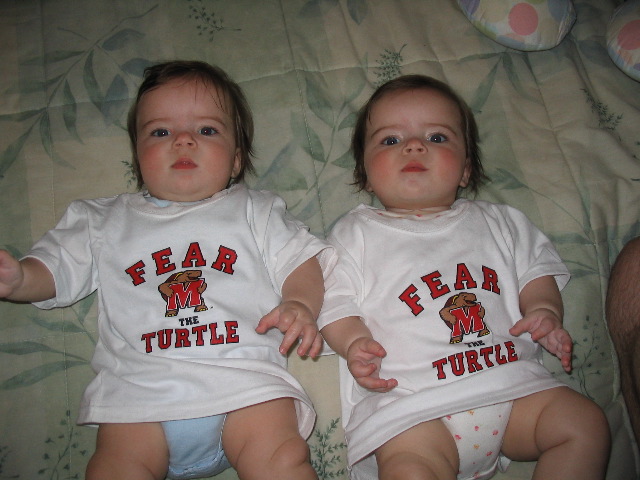
Fear the Turtles

Danielle and Haley, the nieces, striking turtle-fear in the hearts of all who see them.

Bush's numbers, UPDATE

A quick look at that polling data should lead anyone to pause the next time they hear pundits talk about week-to-week shifts in the polls. Even last week's 34% figure from CBS should be taken with a grain of salt. It's pretty clear that the 34% number is an outlier with respect to the broader cloud of data that precedes it. But I should add that any new poll that restores Bush's approval rating to near 40% should also be taken with a grain of salt for essentially the same reason: no one poll can indicate trends in public opinion, even if performed by the same outfit. For example, read this and laugh ... a lot.

Bush's numbers at a point of no return?

Bush is polling pretty badly right now. While it is not clear that he won't recover from this near-Nixonian plunge into the political abyss, it is natural to ask what factors might lead to a recovery, and whether those factors are likely to be in play. I am primarily interested in whether a 50% approval rate is now unachievable, even by the 2008 elections.

Bush's numbers rose dramatically after the attacks of 9/11 from between the 50s and 60s, to well into the 80s:

The two other times that Bush's numbers saw significant improvement were coincident with the initiation of the American and British ground assault in March, 2003, and with the capture of Saddam Hussein in December, 2003. Bush's numbers also saw a mild, arching surge prior to the 2004 election, but since Saddam Hussein's capture, his approval numbers have remained at or below 50%.

Since the beginning of 2005, in fact, his numbers have gone from hovering around 50% to hovering around 40%. The conventional wisdom is that this drop is due to the poor showing of his Social Security reform effort, the seemingly inexorable deterioration of the situation in Iraq, the very skeezy attitude of the Administration toward the acceptability of torture as employed by Americans or by our proxies overseas, the Federal Government's lack of preparedness for Hurricanes Katrina and Rita (and the metaphorical significance of that poor showing for their potential response to another major terrorist attack), the sour taste left in the mouths of many Americans by the NSA surveillance program, the Dubai ports deal, the Vice President shooting his friend during a hunting accident (in the face), the continuing scandal over the outing of a now proven undercover CIA operative for political purposes, massive congressional and administration corruption, spiraling national debt and the borrow-and-spend mentality of the Republican congress and administration (replacing the Democrats' earlier "tax-and-spend" addiction), and a growing sense that high gas prices, global change, and our dependence on foreign oil are all somehow related and all the President can do is declare our rather obvious addiction.

I can't help but recall Bill Safire's New Year's Op-Ed (12/30/2005) in the New York Times, entitled "The Office Pool, 2006". His Question 14:

As Bush approval rises, historians will begin to equate his era with that of: (a) Truman; (b) Eisenhower; (c) L.B.J.; (d) Reagan; (e) Clinton.

Well, the assumption has always been that Bush's numbers will in fact rise. But the only major bumps in Bush's numbers were after 9/11, after the invasion of Iraq, after the capture of Saddam Hussein, and during the heavy campaigning of the 2004 election.

My answer to Safire's question: (f) Nixon. Why? Barring the capture of Osama bin Laden (when's that gonna happen, anyway?), a major terrorist attack on US soil is the only event that historically would have any chance of raising his numbers, and yet it is entirely possible that such an attack would instead lead his numbers to plummet, after awakening in the American public the growing sense that this Administration has no idea how to manage our national security.

I hate to be cynical, but if the Administration guesses that terrorists pose a political as well as an economic and physical threat, can we now finally expect them to take national security seriously?

A preamble to an experiment, cont'd

I promise I'll get back to the experiment shortly, but I have some serious work left to do to get the "experiment" where I want it. For a week or so, I'm going to spend some of my spare time blogging on other subjects, such as the recent post on Nigeria.

Wednesday, March 01, 2006

Nigeria

Nigeria has arrived front and center on two major issues in the last two weeks -- East-West culture wars, as typified by violence between northern Nigerian Muslims and southern Christians (and more broadly the violence inspired by the publications of cartoons depicting the Prophet Mohammed); and the limitation or outright ban of homosexual marriage, behavior, and "speech". The two are related. Sitting near the epicenter of both issues, strangely enough, is the Anglican Church of Nigeria, and its Primate, Archbishop Peter Jasper Akinola.

Attention in this country was spasmodically (and ephemerally) drawn to Akinola over the weekend with an Op-Ed in the Washington Post by the Episcopal Bishop of Washington, John Bryson Chane. Chane has been an outspoken (and to some occasionally unfair) critic of the rise of a conservative movement within the Episcopal Church USA (ECUSA) over various issues within the Church, primarily the evangelical mission of the Church (i.e., its mission to spread the Gospel, versus ECUSA's "gospel of inclusion," as the conservative movement often derisively calls it), but spurred by the consecration of the openly gay Bishop of New Hampshire, V. Gene Robinson. Since that fateful event in 2003, the global Anglican Communion, with which ECUSA is affiliated, has undergone a radical reallignment. Bolstered by the deep social conservatism of the "Global South" (a term in common employ by the United Nations, and the name by which the Anglican Provinces of the southern hemisphere are known) and their rapid rate of growth, some American parishes, long stagnating under the load of ECUSA-malaise, have split from ECUSA to join diocese in Africa. One example, which was close to me personally, was the realignment of three parishes in the Diocese of Los Angeles with the Diocese of Luweero in the Anglican Province of Uganda, a move which inspired this pastoral letter from the Episcopal Bishop of Los Angeles, Jon Bruno. Other parishes in the US have left ECUSA to join the Diocese of Bolivia, Recife (Brazil), and Caledonia, among others.

The Anglican Communion is now in crisis mode, struggling to salvage a broad, though loosely affiliated, organization from self-destruction under the pull of two very strong forces. On the one hand, northern Anglicans in the US, Canada, and the UK are broadly committed to moderate stands on homosexuality and abortion, and to a sort of evangelicalism-lite, one that is less likely to make simple declarations of faith as those that are declared canonically in the Gospels. On the other hand, the Global South, and splinter organizations in the North (see the American Anglican Council, or AAC, and the Anglican Communion Network, or Network) are "orthodox" on the issues of homosexuality and abortion, and consider their purpose to be far more missionary than the stated purpose of ECUSA or other Northern Anglicans. The strength of the Global South is lent considerable credence by the fact that churches outside the traditional strongholds of the Northern Church are growing considerably faster. The correlation (to me, debatable) is then made between the rate of church growth in the Global South and the far more conservative positions taken on issues of orthodoxy.

American Christian evangelicalism, in the last several decades, has undergone a significant transformation, aligning itself with conservative American politics, most strongly with the national-defense / tough-on-crime / personal-responsibility politics of the Republican Party. Splintering parishes in the North are no exception, despite their "Mainline Protestant" background in ECUSA. One need only look at posts at the conservative Anglican blog VirtueOnline to see that this is the case. Though Virtue's blog and his readership are by no means representative of the broader American Anglican conservative community (TitusOneNine maintains balanced coverage of events relevant to "orthodox" Anglican readers), words like "liberal" and "conservative" are freely employed, and almost always mean the same thing whether applied to biblical orthodoxy or American politics, such as this apology for New Testament support of the death penalty, or this report on the 500+ scientists publicly proclaiming their doubt about evolutionary biology (never mind the 25,000+ scientists who signed a counter-petition). It is not worth our time to go through the many other websites and news venues that conflate conservative American politics with evangelicalism, because most of these have nothing to do with evangelical Anglicanism as it is practiced in the US or in the Global South.

However, it is important to keep in mind that the organizational roots of conservative Anglicanism in the US are deep inside the Republican Party. The AAC, mentioned above as an umbrella group for American conservative Anglicanism, has historical and present ties with the Institute on Religion and Democracy (or IRD), a conservative political group devoted to supporting evangelical Christianity as part of movement conservatism. The IRD has received considerable support ($4,679,000 between 1985 and 2005) from The Lynde and Harry Bradley Foundation, Richard Mellon Scaife via the Carthage Foundation, the Sarah Scaife Foundaiton, and the Scaife Family Foundation, the Randolph Foundation, the Castle Rock Foundation (the Coors family), and others.

This is not to say that all AAC members are hard-core conservative Republicans -- they may have no political affiliation at all. However, we must take for granted that the movement is driven (or at least heavily supported by in-kind contributions -- for example, the IRD and AAC websites used to be identically formatted, and their offices were in adjacent suites in an I St. office building in northwest Washington, DC) by a political and social agenda effectively separate from the movement of expanding evangelicalism in the Global South. The IRD board is populated by such conservative luminaries as Mary Ellen Bork, Fred Barnes, author of "Rebel in Chief", Richard J. Neuhaus, Michael Novak, and is advised by conservative radio talk-show host Michael Medved, a group that spends little time evangelizing in Kenya.

The radical conservative agenda of this melding of religion and politics dirties religion immensely. Like Tony Campolo has said,

When government and church begin to mix, you got a problem. It's like mixing ice cream with horse manure: You will not ruin the horse manure, but it will ruin the ice cream. I think to mix the church and state is to, in fact, put the church in a compromising position.

And where it gets really complicated, however innocently, is when the northern conservative Anglican movement, driven by political trends in the US, Canada, and the UK, affiliates itself with diocese in the Global South, which are "conservative" for sometimes completely different reasons. The Op-Ed by Bishop Chane discusses the decision by Archbishop Akinola, the Primate of Nigeria, to support new Nigerian legislation that effectively outlaws homosexuality. The law, which can be found here (pdf), states that "publicity, procession and public show of same sex amorous relationship through the electronic or print media physically, directly, indirectly or otherwise are prohibited in Nigeria," and that "any person who is involved in the registration of gay clubs, societies and organizations, sustenance, procession or meetings, publicity and public show of same sex amorous relationship directly or indirectly in public and in private is guilty of an offence and liable on conviction to a term of 5 years imprisonment."

Here is some of what Bishop Chane said:

It's no secret that the Episcopal Church and the Anglican Communion are engaged in a bitter internal struggle over the role of gay and lesbian people within the church. But despite this struggle, the leaders of our global communion of 77 million members have consistently reiterated their pastoral concern for gays and lesbians. Meeting last February, the primates who lead our 38 member provinces issued a unanimous statement that said in part: "The victimization or diminishment of human beings whose affections happen to be ordered towards people of the same sex is anathema to us."

We now have reason to doubt those words.

Archbishop Peter J. Akinola, primate of the Church of Nigeria and leader of the conservative wing of the communion, recently threw his prestige and resources behind a new law that criminalizes same-sex marriage in his country and denies gay citizens the freedoms to assemble and petition their government. The law also infringes upon press and religious freedom by authorizing Nigeria's government to prosecute newspapers that publicize same-sex associations and religious organizations that permit same-sex unions.

Were Archbishop Akinola a solitary figure and Nigeria an isolated church, his support for institutionalized bigotry would be significant only within his own country. But the archbishop is perhaps the most powerful member of a global alliance of conservative bishops and theologians, generously supported by foundations and individual donors in the United States, who seek to dominate the Anglican Communion and expel those who oppose them, particularly the Episcopal Church and the Anglican Church of Canada. Failing that, the archbishop and his allies have talked of forming their own purified communion -- possibly with Archbishop Akinola at its head.

Because the conflict over homosexuality is not unique to Anglicanism, civil libertarians in this country, and other people as well, should also be aware of the archbishop and his movement. Gifts from such wealthy donors as Howard Ahmanson Jr. and the Bradley, Coors and Scaife families, or their foundations, allow the Washington-based Institute on Religion and Democracy to sponsor so-called "renewal" movements that fight the inclusion of gays and lesbians within the Episcopal, Methodist, Presbyterian and Lutheran churches and in the United Church of Christ. Should the institute succeed in "renewing" these churches, what we see in Nigeria today may well be on the agenda of the Christian right tomorrow.

Many countries have laws restricting marriage on any number of grounds. Some of these, such as age, kinship and marital status, for instance, are prudent, while most of us believe other sorts of restrictions, including race and religion, are oppressive and indefensible. Our global community has certainly achieved no consensus on the issue of same-sex marriage or the related issues of civil unions.

But the Nigerian law has crossed the line in several important respects. Its most outrageous provision deals not with marriage but with "same-sex relationships" and prohibits essentially any public or private activity in any way related to homosexuality. It reads in part: "Publicity, procession and public show of same sex amorous relationship through the electronic or print media physically, directly, indirectly or otherwise are prohibited in Nigeria."

Any person involved in the "sustenance, procession or meetings, publicity and public show of same sex amorous relationship directly or indirectly" is subject to five years' imprisonment.

The archbishop's support for this law violates numerous Anglican Communion documents that call for a "listening process" involving gay Christians and their leaders. But his contempt for international agreements also extends to Articles 18-20 of the United Nations Universal Declaration on Human Rights, which articulates the rights to freedom of thought, conscience, religion, association and assembly.

The response of the Anglican conservative David Virtue (of VirtueOnline) to this Op-Ed was interesting. Far from dealing with the issue of the potential human rights violations that might evolve from the support of the highly influential Akinola, Virtue calls ECUSA's broader interests within the Anglican Communion "homoerotic," relying on the fact that homosexuality is a crime throughout Africa to argue that a complaint against Akinola's support of the legislation by Bishop Chane is somehow a call for increased homosexuality among Africans. Virtue then misleads, alleging that Chane claimed that Akinola is directly funded by the AAC or the IRD, relying on a "close personal friend of Akinola" and board member of the AAC, Rev. Canon Martyn Minns, to attest that "[t]he money thing is absolutely not true -- as far as I know the Church of Nigeria does NOT get funding from any conservative foundations nor do they victimize homosexuals -- they love them and pray for them." I'm sure he's right on both counts. But regardless of whether they love and pray for them, the fundamental character of the Nigerian legislation, is, as Chane says, in violation of Articles 18-20 of the United Nations Universal Declaration on Human Rights. This legislation, if it were enacted in the United States, would radically abridge 1st Amendment rights to free expression of religion, assembly, and the press, enforcing those bans with a punishment of up to five years in prison. It is one thing for Virtue to argue that the Anglican Church in Nigeria should in no way endorse homosexual relationships, but it is quite another thing if the Anglican Church were to support a criminal (and thus civil) ban on religious/personal behavior.

Not that he reads this blog, but I would certainly challenge David Virtue to reconsider his objection to Chane's words with respect to the potential human rights violations that would be imposed if this legislation were enacted. It's not as if Akinola hasn't come right out and said what Chane claims he said. Voice of America has the meat:

The Anglican Church in Nigeria Thursday said it welcomes government decision to push for legislation to outlaw homosexuality. The government said it will introduce legislation to punish homosexuality by up to five years in jail and ban same-sex marriages. A spokesman for Nigeria's Anglican Church described homosexuality as an abomination.

The spokesman for the Anglican church in Nigeria, Reverend Tunde Popoola, says the proposed ban is appropriate. The Anglican community in Nigeria has long waged a vigorous campaign against homosexuals, as Reverend Popoola explains.

"The Anglican church in Nigeria has been in the forefront of condemning the attitude because the church sees it as an aberration, in other words, we see it as against the norm. We see it as an abomination," he said.

Let's not mince words -- the Nigerian Church wants to outlaw not only gay marriage, but also homosexual behavior, free speech, freedom of assembly, free press, and freedom of religion. Bottom line: Chane is factually correct in his objection. Will Virtue argue from moral relativism to say that standards of conduct (in this case tolerance of those who are different from ourselves) must be allowed to vary on country-by-country basis? I doubt it.

Perhaps more interesting than Virtue's incomplete, and rather non-introspective review of Bishop Chane's OpEd is the response of the Nigerian Church. The Living Church, an Anglican newsletter, ran a news story about the OpEd and the subsequent response on Feb 27th:

A spokesman for the Church of Nigeria, Canon Akintunde Popoola, disputed this characterization, arguing Bishop Chane misconstrued the text of the bill and Archbishop Akinola’s role in the legislative process. "Archbishop Peter to my knowledge is yet to comment [publicly] on the bill. I have said we welcome it because we view homosexuality as 'against the norm'."

While banning 'gay clubs' in "institutions from secondary to the tertiary level or other institutions in particular" and "generally, by government agencies," the proposed law is silent as to the status of private gay clubs.

The proposed law should also be seen in light of the wider conflict between civil law and Shariah law in Nigeria, Canon Popoola said. Under existing "Islamic law" in effect in "some parts of the country," the acts covered by the proposed law currently "stipulate the death penalty," he said.

Here, Canon Popoola claims that Chane mischaracterized Akinola's role: "Archbishop Peter to my knowledge is yet to comment [publicly] on the bill. I have said we welcome it because we view homosexuality as 'against the norm'." Now, I'm not a professional parser, especially with respect to comments made by clerics in the Anglican Communion, but to "welcome it" usually does not indicate that you "deny it" any support. Besides, all Chane said was that "Akinola ... recently threw his prestige and resources behind a new law."

But of far greater interest is the suggestion by Canon Popoola that the Nigerian legislation should be seen in the context of the battle between civil law and Shari'ah. If so, he is providing cover for the legislation by saying, essentially, that, "well, at least the proposed legislation is not as severe as Shari'ah, which demands the death penalty for homosexuality of any kind" (my words).

But I am now quite suspicious of the meaning of the words coming out of the Archbishop's office -- for instance, in response to recent violence following the cartoons depicting the Prophet, and violent and aimless reprisals against Christians and Christian churches, Akinola said in a statement "may we at this stage remind our Muslim brothers that they do not have the monopoly of violence in this nation" and that "C.A.N. [Christian Association of Nigeria] may no longer be able to contain our restive youths should this ugly trend continue". That was Tuesday of last week (2/21), just as anti-Christian violence in the north over the previous weekend claimed at least 43 lives (some say at least 50) in the predominantly Muslim cities of Maidugiri and Bauchi. On Tuesday (2/21) and Wednesday (2/22), retaliatory attacks against Muslims in the southeastern Christian city of Onitsha claimed 80 more. (Numbers from ReliefWeb) The situation is ugly, folks (h/t Andrew Sullivan).

Of course, it is unclear from news reports whether the timing of Akinola's statement led directly in any way to the retaliatory attacks on southern Muslims, but the statement certainly offered no effort of reconciliation.

Chane closes his Op-Ed with a request that the "archbishop's many high-profile supporters in this country [ask themselves] why they have not publicly dissociated themselves from his attack on the human rights of a vulnerable population. Is it because they support this sort of legislation, or because the rights of gay men and women are not worth the risk of tangling with an important alliance?"

Good question. But I would also ask this: Can "orthodox" elements of the Anglican Communion afford to develop international affiliations that are for all the world based on violent conflict and discrimination? It is my view that they are putting themselves on the wrong side of a civil rights debate, but far worse they are eagerly seeking a place in the midst of a nasty Christian-Muslim political struggle in the Republic of Nigeria. On both counts, Akinola deserves some form of censure.

UPDATE: Grammatical errors fixed, 3/2/2006, 1 AM

UPDATE II: 3/2/2006, 1 AM. I had left this out before, because it doesn't directly relate to Northern Anglican involvement in Africa, but I think it's worth including if only to highlight the broad instability of the Nigerian government. It is broadly believed that the current Nigerian president, Olusegun Obasanjo, wishes to extend his presidency into a third term. Obasanjo is a self-proclaimed born-again Christian in a country whose presidency has traditionally been held, since the country's independence in 1960, by Muslims. A third term would require amending the Nigerian constitution. Such an amendment would lead to considerable unrest, as Muslims who feel their time has come would feel jilted, at best. According to US intelligence chief John Negroponte, the ensuing "chaos could lead to disruption of oil supply, secessionist moves by regional governments, major refugee flows, and instability elsewhere in West Africa."

UPDATE III: 3/2/2006, 7 AM. I fear I may have given the impression that Bishop Chane, of the Diocese of Washington, was the only to raise his voice in protest, or that I am somehow unique in laying this all out. The Rev. Mark Harris, a priest of the Diocese of Delaware, has provided an excellent analysis of the odd roll of Akinola in the Anglican Communion:

The Archbishop of Nigeria, The Most Rev. Peter Akinola, has emerged as a primary spokesperson for the collection of Provincial leaders, diocesan bishops, and other concerned Anglicans who constitute a movement within the Anglican family of churches to “realign” their various bodies into greater conformance with what they understand to be a biblically warranted or based internationally organized church.
On the AAC and the Network, and what Harris believes to be the coming reckoning:
Archbishop Akinola’s various remarks, papers, and official briefings give every indication that he clearly is his own man, save for his obedience to the Word of God as he has received it. It is not at all clear that he is willing to live again in a world where deference is given to a church leader simply because that person is leader of the English church.

Whether or not he is his own man in reality is yet to be seen. He is the chair of CAPA, the Council of Anglican Provinces of Africa, which he acknowledges has been underwritten by western donors to the present time. He is chair of the South to South Encounter which will meet in Egypt this month. Its funding is from its own members, but where they in turn get the funds is less clear. It is unclear how many of his international activities (which are considerable) are funded by Western conservative voices, particularly the AAC and the Network.

The effort to realign the Anglican Communion has given rise to the creation of a wide variety of agencies and organizations, some more a reality than others. All the meetings, travels, lectures, caucuses, consultations and encounters necessary to put this together costs a great deal, and there is considerable lack of clarity as to where the funding comes from.

There is no question that the funding of the AAC or the Network includes major donors whose concerns and objectives are not primarily about the Episcopal Church but about conservative agendas across ecclesial structures. There is also considerable concern that those non-church conservative agendas include paralyzing the ‘mainline’ denominations with such internal dysfunction that they cease to be able to carry out the progressive agendas of their own synods. So the question of AAC and Network engagement with the Archbishop of Nigeria and his agenda involves the question of funding, and the agenda of these outside funding sources.

On the Akinola's conception of homosexuality:
The Archbishop speaks his mind on many occasions, and what he says is often intriguing, sometimes hurtful, sometimes constructive and occasionally destructive.

He has said horrid things about gay persons:

"I cannot think of how a man in his senses would be having a sexual relationship with another man. Even in the world of animals, dogs, cows, lions, we don't hear of such things." (The Atlantic online)

And about gay and lesbian persons:

"God created two persons -- male and female. Now the world of homosexuals has created a third -- a homosexual, neither male nor female, or both male and female -- a strange two-in-one human."

"The acceptance of homosexuality and lesbianism as normal is the triumph of disobedience; the enthronement of human pride over the will of God. This lifestyle is a terrible violation of the harmony of the eco-system of which mankind is a part. As we are rightly concerned by the depletion of the ozone layer, so should we be concerned by the practice of homosexuality." (Both [quotes] from Why I object to Homosexuality and Same-sex Unions)

His arguments – that homosexuals are a "two-in-one human" and that homosexual lifestyle is somehow related to the eco-system -- are amazing in their profound misreading of both homosexuality and humankind’s role in the eco-system. His suggestion that not "even in the world of animals, dogs, cows, lions, we don't hear of such things" turns out not to be completely true, but worse it makes the dreadful hierarchical comparison where, as President Mugabe of Zimbabwe stated, gay people are "worse than dogs..."

I can only repeat the words of AAC boardmember, Rev. Martyn Minns, quoted by David Virtue as saying of the Nigerian Church, "they [don't] victimize homosexuals -- they love them and pray for them."

Those interested in a very important perspective on changes within the Anglican Communion, and for recent news and links on Archbishop Akinola should continue with a reading of Rev. Mark Harris's excellent blog.

UPDATE IV: 3/3/2006, 12:10 PM. I have received word from some in the Anglican community that my characterization of most conservative Anglicans as using language similar to that used by American political conservatives is misleading. I have changed the paragraph starting with "American Christian evangelicalism, in the last several decades..." to reflect the fact that not all conservative Anglicans reflect the conservative political perspective of someone like David Virtue.

Tuesday, February 28, 2006

A preamble to an experiment

I want to try an experiment. Like any good experiment, its strength will depend on the number of participants -- the more participants, the smaller the chance that the conclusions drawn from the experiment will be erroneous.

Political discourse in this country is heavily fettered by the mutual unacceptability of the premises of the other side. This will be true as long as arguments start from ideologically predilections, rather than from the facts on the ground. No one is immune from this disease. It takes tremendous effort to stay focused on details, and it requires considerable strength of mind to admit the potential efficacy of our opponents' prescriptions. As Orwell said, "To see what is in front of one's nose needs a constant struggle."

We need a group of people so desperate for common sense solutions, that they are willing to forgo standard partisan delineations, and to even see beyond religious or other moral commitments. How do we do this?

The answer is something I think we should call "materialism by committee." By "materialism" we don't mean "commercialism" or the love of money and possessions, but rather the philosophical expression of the belief that, at least at some level, the world can be explained solely by interactions between material objects. We want a "materialistic" explanation of political and social process that everyone can agree to, or, at the very least, one in which everyone's views get a fair hearing. How is this different from the endless, and seemingly pointless roundtable discussions of hopelessly swelled talking heads? First of all, this explanation will have no place for individual, larger-than-life statesmen and women -- the influence of the political bad guys and good guys does not interest us. These come and go, while the process remains. Tout change, tout passe, il n'y a que le tout qui reste. Bush-hatred and Hillary-hatred are irrelevant here -- we will make something that transcends personal animosity, and instead sees only what is in front of one's nose.

Political Spaghetti Lives

I'm sure all of my thousands of readers have been worried where Trumpetcell has gone off to. Well, kids, Trumpetcell was sent away to a nice country farm to play with other nice blogs. I'm sure it'll be fine, frolicking in the dewy, verdant meadows of Blog Heaven, chasing its tail, and eating its own poo.

Time and much reflection have led me to the conclusion that a brand new blog is needed -- not just for my own narcissistic tendencies, but for you, my vast audience -- a blog with a new format and title, and, more important, a clearly defined niche: how the world works.

Friday, October 14, 2005

Splintered GOP

For some reason, I'm on the mailing list of Manuel Miranda. This name may ring a bell as the Orrin Hatch staffer who was fired for stealing computer files from Senate Democratic computers regarding their plans to block Bush's more extreme judicial nominations. I've since maintained a sort of email conversation with Manuel, who I think is a personally decent guy, but in my opinion totally deluded about the GOP's current relationship to public opinion.

Our last email conversation related to the filibuster debate. He strongly supported the "nuclear option" and was in fact actively lobbying for its use should it come to that. The "Deal" that was struck between GOP and Democratic senators was very demoralizing to him, and I wrote him in response to an article he wrote about that demoralization, pointing out how the GOP's capacity to do whatever it wants is eroding.

Anyway, all this is a long preamble to a link he sent to me (and I'm sure to lots of other people) to an article he wrote in the conservative weekly Human Events.

This was my response:
Dear Manuel,

I got your link. I want to thank you for your views, which I found be of great practial and academic interest.

I would point out, however, that the loss of credibility of the GOP among the public is revealing a deep schism between the movement Republicanism that you, Brownback, Concerned Women for America, and Dobson represent and the aw-shucks Republicanism of those who voted for Bush in 2000 and 2004. Honestly, I don't think that the far right has ever held much more than a cynical sort of sway with Bush on issues of abortion and gay rights (two issues about which much of this maelstrom appears to spin), knowing as he and Rove do that to overturn Roe would significantly collapse their support among women and most moderates in the coming decades (so much for 40-year hegemony).

You guys have too long focused on the polling question, "Do you think abortion is ok?", and not enough on the question, "Do you think it should be made illegal?" Most people, including myself, answer "no" to both. The pro-life/pro-choice distinction is a false one -- I can think of no one in the pro-choice community who actually likes the idea of abortions, just as no one likes the idea of mastectomies (not that they're truly comparable surgical interventions).

A weighted 50-state poll (compiled 9/12/05) showed that most people are pro-choice by a 56%/38% margin. Only 10 states (Utah, Louisiana, Arkansas, Idaho, Alabama, Mississippi, West Virginia, Kentucky, Tennessee, Indiana) are 50% or greater pro-life, three states are still majority pro-life but at a less-than-50% rate (S. Dakota, Missouri, Oklahoma), while the rest are majority pro-choice, 18 of which went to Bush in 2004.

Another 50-state compilation (7/18/05) found that a majority in every state believes that neither the state government nor the federal government should have a say on the abortion question (Utah polled at 52% in the "government should have no say" while Mississippi polled at the next lowest level at 58%). Man, that's so libertarian it's not even Federalist anymore! Apparently, for most of us, it's something that should not be legislated at all, i.e., it's a personal right (right to privacy, whatever) that must not be abridged by legislation or even by the constitution as interpreted by you lot.

Yours is a fringe movement that has been very successful at convincing a large of number of people that you represent their views, when you don't. The President, in his currently weak position, recognizes this -- he doesn't want to let you out of the closet right now, so he nominated someone who was unlikely to be as radical as a some of the other women candidates on his short list. He says he doesn't pay any attention to polls, but right now you can bet he does.

This issue, in the context of the other problems faced by the GOP, reveals what we progressives have always thought was so unnatural about the current Republican alliance -- culturalism combined with libertarianism. Eventually that kind of ideological chimera must meet its Bellerophon, here in the form of an advancing dissonance between a spend-and-don't-tax/endless-war GOP drunk with its own power and mainstream concerns. The President knows that the chimera can only be shielded by hiding one of its many forms. I wonder if the Dems, provided Miers shows any level of competence in her hearings, wouldn't do well to uniformly support her (though I secretly loathe the idea, like anyone that hates cronyism), kicking up dust if only to get the hidden, naughty parts of the GOP to reveal themselves.

But even if she withdraws, the President chooses to nominate someone else (which would be out of character for this President), or she's denied confirmation (a possibility even in committee), the current climate dictates that he is unlikely to nominate someone of whom you would be significantly more likely to approve.

Good luck to you. Sincerely,

blah, blah, blah
It's odd for me to have said all this stuff, for the simple reason that late last year it looked like Movement Republicanism was real and lasting. Now, I'm just pissed that they've been working for over thirty years to convince people that the Federal government should never do anything (as Grover Norquist puts it, to make "government small enough that you can drown it in a bathtub"), when a set of very important problems that only the Federal government can address have only grown in strength, such as the industrialization of agriculture and the resulting social and environemntal costs, air and water pollution, global warming and the control of carbon emissions, nuclear proliferation, the widening deficit between our educational standards and those of other developed countries, conglomerated corporate ownership of media, our dependence on Middle East oil, globalization and the war on local farming, and, of course, poverty.

All this is made deeply ironic and frightening given how massive the annual federal deficit has become. Like $250 million to build a bridge to 50 people on an island off the coast of Alaska. If I lived there, I'd rather have $250 million / 50 = $5 million per person. Then I could buy a private jet. Or a private yacht to ferry me across the straights.

I just wish they would stop wasting our time. I'm getting gloomy here, folks! Mommy!