Sunday, April 30, 2006

 
Archbishop Peter Akinola among Time's top 100 most influential world figures
Time magazine has selected my favorite Anglican cleric, Archbishop Peter Jasper Akinola, Primate of all Nigeria, as one of the 100 most influential people in the world.

Megachurch pastor, and author of "The Purpose Driven Life," Rick Warren lays down some very thick demagoguery in his description of the Primate (emphasis mine):
Akinola personifies the epochal change in the Christian church, namely that the leadership, influence, growth and center of gravity in Christianity is shifting from the northern hemisphere to the southern. New African, Asian and Latin American church leaders like Akinola, 61, are bright, biblical, courageous and willing to point out the inconsistencies, weaknesses and theological drift in Western churches.

... Akinola has the strength of a lion, useful in confronting Third World fundamentalism and First World relativism. He has been criticized for recent remarks of frustration that some felt exacerbated Muslim-Christian clashes in his country. But Christians are routinely attacked in parts of Nigeria, and his anger was no more characteristic than Nelson Mandela's apartheid-era statement that "sooner or later this violence is going to spread to whites." I believe he, like Mandela, is a man of peace and his leadership is a model for Christians around the world.
According to Peter Boyer's New Yorker article two weeks ago, Warren was present at the 2005 meeting in Pittsburgh at which Akinola called on conservative Episcopalian to "s#!& or get off the pot" (my paraphrase; pardon the French), and pick the Network or the Episcopal Church. Warren made a similar call, saying "[w]hat’s more important is your faith, not your facilities ... The church is people, not the steeple. They might get the building, but you get the blessing."

I wonder if he knows about the famous legislation (pdf) that Akinola has endorsed? If not, he is directed here.

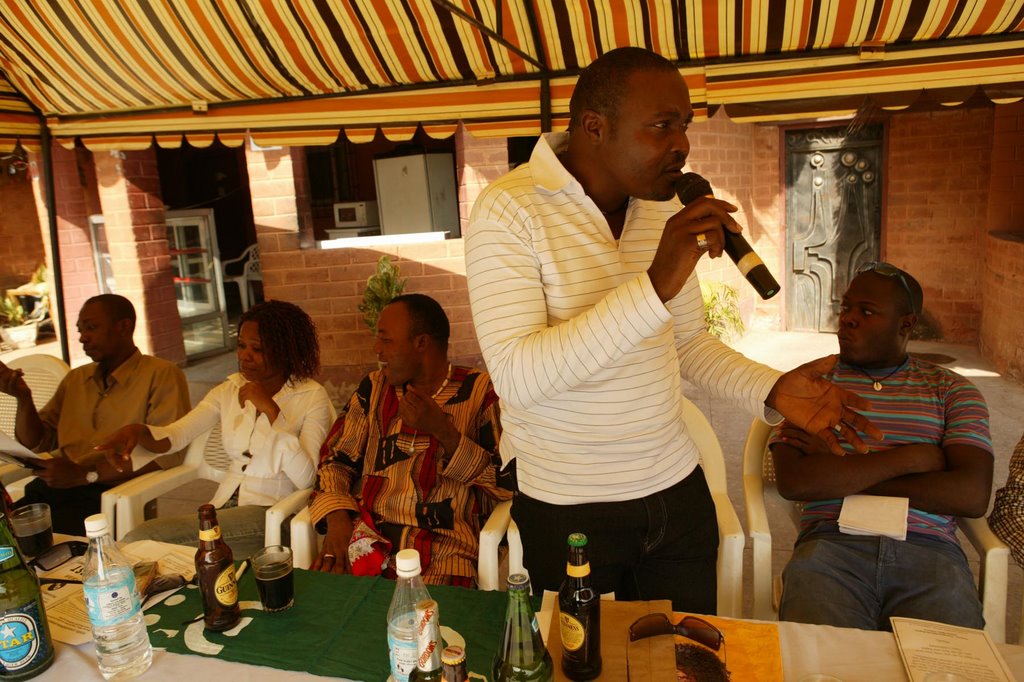
(photo lifted from Time article on Akinola)

Friday, April 28, 2006

 
Following the Money
(updated below)

Jim Naughton, the communications director of the Episcopal Diocese of Washington just published a two-part series of short articles on his investigations of the money trail in conservative Anglican cirles in the US.

You can find the series here. Thinking Anglicans has also posted on the article -- I'm sure the comments section there will be quite active over the weekend.

At the moment, I have no opinion, as I don't yet have time to read it (or write about it). Tomorrow ...

UPDATE: Political Cortex covers Jim Naughton's piece in The Washington Window.

Thursday, April 27, 2006

 
If anyone still had illusions about the political slant of the IRD ...
Mark Tooley, recently of White House Easter Egg Roll fame, and the director of the United Methodist Committee at the Institution on Religion and Democracy (a religious front group for Republican politicos), penned the following in FrontPage Magazine (emphasis mine):
The Episcopal Church, at its upcoming General Convention in June, will consider whether to endorse reparations for 250 years of American slavery.

The two-million member Episcopal Church is the embodiment of the declining and aging Protestant denominations whose elites prioritize left-wing politics. And, like the other "mainline" denominations, it is largely white and upper-middle class. To compensate for their failure to attract racial minorities, Religious Left prelates often adopt radical race-related causes. It is the perfect issue for anti-American religious elites. Obsess over a social sin of past centuries that will portray the United States and Western Civilization in the most sinister light. Meanwhile, ignore or minimize the personal sins and spiritual needs of leftists. Mainline prelates feel "prophetic" and "relevant" when they adopt causes such as reparations for slavery.

...

The Religious Left, on slavery reparations, as on most issues, misses the point. Slavery was endemic to every culture at some point. The universalization of the Jewish God through the Christian Church fueled to [sic] the slow but inexorable demise of slavery. Human equality before a sovereign and loving deity made slavery morally impossible.
"Slow but inexorable," my ass. It took at least 1700 years before the Church, in its official capacity, even brought it up, and we're still struggling with its aftermath to this day.

Two things I know for certain: that the issue of reparations deserves honest debate from both sides, and that this guy needs help.

 
Analysis from PINR on the Niger Delta
The Movement for the Emancipation of the Niger Delta (MEND) has scaled up attacks on oil facilities in the Delta in recent months. They have signaled their intention to continue their efforts to regain enough local control of the vast mineral under their feet. Their aim is to lift themselves (predominantly ethnic Ijaws) and others (such as the Ogoni further east) out of the poverty that has plagued the Delta for as long as anyone alive can remember, poverty that is effectively enforced by Nigerian government policy in its close financial relationship with oil companies such as Royal Dutch Shell, Chevron, and others.

The Power and Interest News Report (PINR) released a new "intelligence brief" on the crisis in the Delta that I found factually balanced and a good primer on the problems (although any serious student of the Delta should definitely get their hands on two books, "The Next Gulf" by Andrew Rowell, et al., and "This House Has Fallen: Nigeria in Crisis" by Karl Maier).

The risk, as I see it, is that the Delta's signficance in world oil production (crude prices have probably gone up $5 a barrel in the last month or so just because of violence there), its relative proximity to the US, and the new thinking spawned by the Bush Administration that all local conflicts are essentially terrorist, will all persuade big Oil Consumers, like the US and China, to enact the simplistic response of condoning, if not supporting, continued oppression -- or worse, seeing armed intervention in the Nigeria as a necessity without treating the basic injustices that led to the conflict in the first place.

As PINR puts it:
Security conditions in Nigeria show no sign of improvement. A new Ijaw tribe militant group in the Niger Delta, the Movement for the Emancipation of the Niger Delta (M.E.N.D.), is tallying up the number of successful attacks against government security forces and multinational oil companies. M.E.N.D. is a shadowy organization that first came to prominence on January 11, 2006 when it kidnapped oil workers based at Royal Dutch Shell's offshore EA oil rig. While the workers were released, M.E.N.D. has proven to be a capable, armed organization. For instance, since January, M.E.N.D. has killed at least 24 soldiers and police, kidnapped 13 oil workers and caused severe damage to several critical oil pipelines.
It's all too easy (and simple) to paint MEND as a just another terrorist group, lined up like ducks in a row in the Global War on Terror. But to those who are immersed in the Delta and its conflicts, it looks very different. On Democracy Now! (April 19), Amy Goodman interviewed Nigerian Nobel Laureate playwright Wole Soyinka about the conflict in the Delta (emphasis mine):

AMY GOODMAN: And the Niger Delta, we talked about it in our first part of the interview, but the level of militancy, the anger at the oil companies coming into the Niger Delta, this organization called MEND, Movement for the Emancipation of the Niger Delta, can you tell us who they are?

WOLE SOYINKA: They're very young, mostly, very highly motivated people who, however, have links with some of the elders, the progressive elders in the region, in Bayelsa, for instance, in Ijaw region, many belong to the Ijaw ethnic group, and from all indications, they're very articulate. The ones whom I’ve spoken to asked me to intervene in a number of ways in Nigeria, very articulate, and at the same time, they're reluctant rebels. Take, for instance, an email which one of them sent to me, said, "Prof, listen. We are people who would rather be with our families raising our children, sending them to school. We’re not happy sort of carrying out operations in the creeks. We want to be home. We want all this to be over so we can return to our families, but what future do our children have? There are no schools, there are no clinics. All the wealth in this region is going to Abuja, is going to sustain the rest of the nation, so it's about time that we took a stand. We want you to understand this." This is the kind of language which they use. It's not bravado; it’s not crude, thuggish kind of people, at least the ones whom I’ve spoken to.

AG: The way it's conveyed in the United States is kidnappers, thugs, people who blow up oil pipelines.

WS: Well, it's unfortunate that they have that image. I've discussed this with them also. I’ve tried to persuade them, for instance, that hostage-taking will be counterproductive and will actually alienate lots of supporters, that they should -- they must learn not to follow a particular pattern of condemnable violence. And I have a feeling that once the negotiations, which have yielded a certain result at the Yenagoa Accord, once the conditions, the conditions of those accords are fulfilled by the government, once the international community actually supervises and compels the federal government to, you know, abide by those agreements, I have a feeling that we will – and once a greater deal of autonomy is conceded to that region, in other words, the right to control their own resources, to pay a tax to the center and to determine the priorities of their own development, whether it’s education, health, to actually develop that entire degraded area. Once these just demands are met, I have a feeling that we'll see the end of unrest in the Delta region.

AG: And the responsibility of the oil companies, what do you see it as?

WS: Oh, that's part of the conditions also. The oil companies are expected to pay compensation for the damage they have done to the environment. Yes, that’s one of the conditions they’ve written there.

Should the crisis in the Delta escalate, we in the West must be very careful to avoid seeing our higher gas prices vis-a-vis Nigeria as a result of terrorism.

PINR is close to making this leap (emphasis mine):
These factors demonstrate why instability will continue in Nigeria, primarily in the country's Niger Delta region. The frequent instability has already cut Nigeria's oil exports down about 20 percent; on April 25, for example, ExxonMobil announced that it evacuated non-essential staff from Nigeria's Qua Iboe oil facility, the country's largest export terminal, over concerns that an attack was imminent.

...

Expect Ijaw militants to continue, and probably escalate, their attacks against government and multinational interests, and watch as energy companies, and government security forces, struggle to adapt to this pervasive threat.
No mention from PINR of how the Nigerian government and the oil companies might see a way forward through good old-fashioned conflict resolution.

Remember, our navy is already there.

 
China now has skin in the game
After his coming-out visit to the US, Chinese President Hu Jintao made the following deal with the Nigerians (Boston Globe):
Nigeria agreed to give China four oil exploration licenses in exchange for a commitment to invest about $4 billion in refining and power generation in Nigeria, in one of seven deals signed on Wednesday.

Hu also agreed to $500 million in export credits on concessionary terms to Nigeria.

Rising world oil prices, which hit a record $75 last week, have stoked fierce competition between Asia and the West over access to new reserves.

China and other Asian countries have snatched some valuable concessions away from Western multinationals by offering soft loans or combining oil deals with non-oil investments.

That's a guaranteed veto on any Security Council resolution on human rights in the Niger Delta.

Wednesday, April 26, 2006

 
Abstinence-only requirement hurting HIV/AIDS fight in Africa
(updated below)

Read it here. Money quote:

The United States Government Accountability Office recently concluded U.S. health field teams are less effective than they could be because they must heavily promote abstinence as a primary means to stop the spread of AIDS.

The guidelines—imposed by Congress and enforced by the Bush administration’s Global AIDS Coordinator—require that field teams spend 33 percent of their prevention funds on programs that advocate abstinence or monogamy within marriage. AIDS activists have long criticized such messages because marriage is not an option for gays.

Field teams interviewed for the GAO report dated April 4 said the requirement precludes them from using their prevention funds in more effective ways, like delivering comprehensive messages that include information about condom use.

According to the report, 17 of 20 country teams said the spending requirement challenges "their ability to respond to local prevention needs." The requirement also is impeding work in certain "focus countries," where the epidemic is most severe.

UPDATE: The original GAO report, dated April 4, 2006, can be found here (pdf, 93 pages).

 
Vatican flinches on condom use in fight against HIV/AIDS
According to the Washington Post (Tuesday), the Vatican has commissioned a study on whether "condoms can be condoned" in the effort to slow the spread of HIV/AIDS:
Cardinal Javier Lozano Barragan, who heads the Vatican office for health care, was quoted over the weekend in La Repubblica daily as saying his office was preparing a document on the question of condoms and AIDS, and that it would be released soon.

But on Tuesday, he clarified that his office was merely studying the issue at the request of Pope Benedict XVI as part of a broader "dialogue" with other Vatican departments.

...

While the Vatican has no specific policy concerning condoms and AIDS, the Roman Catholic Church opposes the use of condoms as part of its overall teaching against contraception. It advocates sexual abstinence as the best way to combat the spread of HIV, the virus that causes AIDS.

The issue was reignited last week when a one-time papal contender, retired Milan Cardinal Carlo Maria Martini, said in comments published in the news weekly L'Espresso that condoms were the "lesser evil" in combatting AIDS. [emphasis mine]

I can't speak to the theological question, but I can point the Pope to lessons learned in Uganda. After initiating a comprehensive "ABC" (Abstinence / Being Faithful / Condoms) HIV/AIDS prevention program in 1990, Uganda saw a massive drop in the HIV prevalence rate from nearly 31% in 1990 to just over 5% in 2004 (although a report by the NGO National Guidance and Empowerment Networt estimated the prevalence rate that year to be closer to 17%, showing just how difficult it can be assess prevalence in developing countries where not everyone has access to health care facilities). [Source Avert.org]

Whatever the actual rate, frustration is growing in Uganda over the insistence in Bush's PEPFAR program that 1/3 of its HIV/AIDS prevention budget go to abstinence-programs. According to Avert.org:

In 2004 the Ugandan government issued a nationwide recall of the condoms distributed free in health clinics, due to concerns about their quality. Although tests showed there was nothing at all wrong with the condoms, the government said that public confidence in the brand had been badly dented, so they would not redistribute them. By mid-2005 there was said to be a severe scarcity of condoms in Uganda, made worse by new taxes which made the remaining stocks too expensive for many people to afford.

Some have said the US is largely to blame for the shortages. According to Stephen Lewis, the UN Special Envoy for HIV/AIDS in Africa, "there is no question that the condom crisis in Uganda is being driven and exacerbated by PEPFAR and by the extreme policies that the administration in the United States is now pursuing".

Mr Lewis has also said that PEPFAR's emphasis on abstinence above condom distribution is a "distortion of the preventive apparatus and is resulting in great damage and undoubtedly will cause significant numbers of infections which should never have occurred".

However, speaking in August 2005, Uganda's coordinator of condom procurement at the Ministry of Health denied there was any shortage of condoms, and said that new stocks would be distributed soon. She also said the government was committed to promoting all three parts of the "ABC" strategy: Abstinence, Faithfulness and Condoms.

Lest you take what the Ministry of Health says at face value, consider that abstinence-only programs are growing in strengh in Uganda (Avert.org):

Uganda receives significant amounts of funding from America, and much of the PEPFAR money is being channelled through pro-abstinence and even anti-condom organisations which are faith-based, and which would like sexual abstinence to be the central pillar of the fight against HIV. This money is making a difference - some Ugandan teachers report being instructed by US contractors not to discuss condoms in schools because the new policy is "abstinence only".

Small community-based organisations are increasingly shifting the emphasis of their prevention programmes to comply with the agenda of PEPFAR's favoured donors. This change is also being encouraged by evangelical churches within Uganda, and by the First Lady, Janet Museveni. Around the country dozens of billboards have sprung up promoting only abstinence to prevent HIV infection, with no mention of condoms.

I'll leave it here, but if you want to read more, I suggest checking out Human Rights Watch's 2005 report on abstinence-only programs in Uganda, Planned Parenthood's short 2004 article on those programs, Avert.org's summary of the HIV/AIDS epidemic in the US, and Population Action International's fact sheet on the ABCs of HIV/AIDS prevention.

 
What public financing of elections in the US would cost me
Let's assume for the moment that permitting campaigns to be financed largely by donations from wealthy people leads to an agitated political economy, and that public financing of elections would alleviate much of that agitation.

How much would public financing cost?

Let's start with the amount of money raised by candidates for all federal elections in 2002 and 2004.

In 2002, Senate candidates raised $369.9 million, and House candidates raised $637.8 million. In 2004, the numbers were $542.7 million for the Senate, and $696.4 million for the House. Congressional races in 2002 and 2004 raised a total of $2.25 billion (source OpenSecrets.org).

In 2004, presidential candidates raised $880.5 million (source OpenSecrets.org).

Total receipts for 2002 and 2004 were, therefore, $3.13 billion.

This sounds like a lot of money, but consider that, in 2003, 88.9 million taxable returns were filed. Of these, 39.7 million were filed as "married, filing jointly", raising the total number of taxpayers represented by these returns to 128.7 million (source IRS). Divided among all taxpayers, the money raised in the 2002 and 2004 elections comes to $24.31 per taxpayer.

When split over the four years covered by the 2002 and 2004 elections, the cost of public financing would be on the order of $6.08 per person.

Now, consider that Medicare Part D will probably cost American taxpayers $200 billion. This comes out to $1555 per taxpayer over 10 years, or $156 per year over 10 years.

Which would you rather pay? $156 per year to have your elected officials make stupid decisions, or $6 per year to have them screw on their thinking caps?

 
Sullivan's decaying defense
I wrote on Monday about Andrew Sullivan's increasingly stretched rationale for having supported the Iraq War: that the War was a good idea, but those executing it were incompetent. This allows him to have been "academically" correct about the war's chances while being able to blame its outcome on the failure of our leaders to properly execute it.

A reader responded to his post, somewhat echoing my complaint:
I think you go too far -- the problem isn't only Rumsfeld, but the war itself. Pinning all the blame on one person is simply a way for people who supported the invasion from the beginning to get themselves off the hook for not anticipating the wars failures.
To which Sullivan responds (my emphasis):
Some good points. Iraq was always going to be extremely tough. We under-estimated the appalling damage Saddam had already wrought on Iraqi civil society (which makes removing him even more morally defensible). However brilliantly we conducted the war and occupation, the deep ethnic divisions would have emerged, and the psychic wounds of the past revived.
This is interesting. Not only is Sullivan admitting that Rumsfeld and Bush's execution of the war was incompetent, but that we always knew the war would be difficult.

He's given on every major point. He now admits that the war is going badly, that our leaders are incompetent, and that the war was always "going to be extremely tough." Now all he has to do is admit that it was a bad idea in the first place. Only fantasy bars this last admission.

Here's hoping for Mea Culpa #2.

UPDATE: Sullivan has just posted a quote from Joe Scarborough echoing his own rationale for support of the war / hatred of Rumsfeld that kind of made my stomach turn.

 
The question that ends the debate?
For some time now, the Church of Nigeria's (Anglican Communion) Communications Director, Canon AkinTunde Popoola, has participated in discussions in the comment sections of posts to Thinking Anglicans on the relationship between the Church and Changing Attitude Nigeria's Director, Davis Mac-Iyalla (see here, here, and most importantly here, for examples -- the Canon goes by Tunde). Answers to Canon Popoola's disclaimers regarding Mr. Mac-Iyalla, namely that he is a thief, not gay, not Anglican, and that his recent travel to Europe was to trick the UK members of Changing Attitude into helping him seek asylum in the EU, are answered on Changing Attitude's news page.

Davis is the gay Anglican Nigerian, and leader of the Nigerian branch of Changing Attitude, who in the last year bravely (some would say naively) challenged the Anglican Church in Nigeria to accept its homosexual congregants. For more on Davis, see one of my previous posts.

In the latest exchange on Thinking Anglicans, Canon Popoola inadvertently revealed that he did not know the content of the legislation (pdf) that his boss, Archbishop Peter Akinola, Primate of All Nigeria (Anglican Communion), had publicly endorsed in early March. The Nigerian bill, as many have pointed out, forbids not only public and private ceremonies of same-sex marriage in Nigeria, but also bans the participation of any party in those ceremonies -- the language fails to define "participation." Violators would be subject to five years' imprisonment. We in the US are having an ongoing debate about gay marriage that prevents us from making an unequivocal admonition of the exercise of this ban in Nigeria, but there are other provisions in the bill that are far more worrisome. Also subject to five years' imprisonment are speech, assembly, and the press in advocacy of gay marriage and homosexual relationships, as well as public show or procession of homosexual relationships.

In the comment's section of the April 19 post on Thinking Anglicans, entitled "Nigeria: latest developments," Canon Popoola made the following statement addressed to me:
In 46 years of independence, there had been laws in Nigeria that will punish a confirmed homosexual with either death or 14 years in jail. I am yet to be aware of anyone being so punished and wonder at Davis’ fear. A new law is being proposed to (as I personally see it) reduce the term to 5 years and also avoid imposition of a practice the Church terms to be sinful upon the unsuspecting populace. I am still amazed to read that the same church should kick against such a law.
In other words, a relatively mild jail sentence of 5 years in a prison such as this is necessary to prevent the spread of homosexuality. Yet, in an earlier comment, he said:
The Church of Nigeria is a God fearing body of believers. I repeat we disturb no intending worshipper, turn away no one, persecute no one, and unashamedly maintain the sanctity of the Holy Scriptures.
The contradiction between these statements is plain. On the one hand, he and the Church in Nigeria persecute no one; on the other, they advocate prison sentences for those to whom they wish to minister. Furthermore, the legislation does not reduce the sentence from 14 years' to 5 years', but rather adds 5 years' for show of homosexuality to any 14 year sentence for private homosexual acts.

The Canon does not appear to understand what implications such legislation would have, or what the legislation calls for. Several people, including myself, challenged the Canon to state plainly some variant on the following statement: that the Church in Nigeria does not support the imprisonment of gay men and women for their speech or for the organizations they establish. Colin Coward, Director of Changing Attitude UK, posted a press release challenging Canon Popoola to find his way back to the facts. A response is not yet forthcoming.

Monday, April 24, 2006

 
Sullivan's escape hatch
I know I'm not the only one out there to find Andrew Sullivan's ongoing discussion of the Iraq War tendentious. A long-time supporter of the effort, he still believes it was "noble"; but now, in what is all to easily interpreted as a face-saving measure, he has assumed, like so many others, the posture of the noble but wronged neocon, whose only error was to believe that Bush and Rumsfeld knew what they were doing.

To paraphrase Stephen Colbert, he did the right thing, but he was wrong to do it.

I can't fault him for no longer trusting Bush and Rumsfeld, or for thinking that the first step in regaining our composure in Iraq is to let Rumsfeld go, but I am frustrated that he has spent so little time re-analyzing why he thinks the war had the potential for success -- that it could have been what it was sold to be. His has always been a mission of idealism, holding that "a tipping point" really exists and that the Iraq War was it. In fact, this "reverse domino" theory of democracy has never been demonstrated.

His apology in early March reminds us of so many these days, no better than "I'm sorry if I offended anyone," or "I'm sorry, but I'm still right because ..."

So, as long as Sullivan continues to allow himself this escape hatch, it's going to be hard to take anything he says about Iraq seriously ever again.

 
Obasanjo's convoy stoned by crowd in Kano
From News24 in South Africa:

Obasanjo's convoy was pelted with stones by protesters as it passed through the northern city of Kano, a hotbed of opposition to his party's bid to change the constitution to allow him to run for a third term.

As the cars accelerated to escape at least three moped taxi riders were run over. Meanwhile, several of the vehicles in the convoy were damaged by sticks and stones thrown by a mob waving opposition placards and posters.

...

Monday's protest appeared to have been coordinated, and many demonstrators arrived at the scene in buses emblazoned with posters of Kano's Islamist state governor, Ibrahim Shekarau of the opposition All Nigeria People's Party (ANPP).

Members of the crowd shouted: "We don't support tenure elongation" and "Kano is an ANPP state, PDP has no place here".

...

International observers, including the US director of intelligence John Negroponte, have warned that any attempt by Obasanjo to cling to power could trigger widespread violence and destabilise Nigeria's fragile region.


Sunday, April 23, 2006

 
Nigeria clears its foreign debt
This as of Friday, April 21, from Reuters (emphasis mine):
Under an agreement reached last June, nations belonging to the Paris Club of creditors wrote off $18 billion they were owed by Nigeria, which is using windfall earnings from high oil prices to pay off $12.4 billion in arrears and debts.

...

Nigeria is the world's eighth biggest exporter of crude oil and its earnings have soared thanks to high prices on world markets, allowing it to build up $36 billion of foreign reserves.

But it is also one of the world's poorest countries, with the majority of its 140 million inhabitants getting by on less than $1 a day.

 
Offers of new highway jobs in Niger Delta not enough
According to CNN (read the whole thing):
Nigerian militants whose attacks on the oil industry have cut exports by a quarter said on Wednesday they were not satisfied with the government's proposals to speed development in the Niger Delta.

The Movement for the Emancipation of the Niger Delta (MEND) repeated a threat to launch further attacks against the world's eighth-largest oil exporter and told oil workers to leave the delta.
If we really want to help Nigerians and alleviate the pressure on the oil market from high demand at the same time, we must see to the Delta. But to do so, such that problems never arise again, will require more commitment from the US and UK governments than Royal Dutch Shell and Chevron are likely to allow.

 
Getting arrested for attending a meeting, or not?
The Globe and Mail has the following from Botswana (my emphasis):

It was the bimonthly meeting of Legabibo — Lesbians, Gays and Bisexuals of Botswana — and just attending this gathering, in a drab conference room on the edge of the city, was an act of courage. Homosexuality is illegal in Botswana, as it is in most other sub-Saharan African countries. And while no one could get arrested for attending a meeting (you'd have to be caught having sex for that), just showing up at Legabibo is enough to risk ostracism and family shame. The threat of physical violence is pervasive, too.

"People say things to us like, 'Are you crazy, do you think we have such people in Botswana?'" sighed Prisca Mogapi, 25, who heads the group. "They say, 'Being homosexual is something you adopt from people in European countries.' And I have to tell them that it has been in Botswana through history. That you have always had women forced into marriages, but they have had secret relationships. That it's nature and they have to accept these people."

When Ms. Mogapi and her partner invited friends to a party to celebrate their relationship a few months ago, a local newspaper reporter sneaked in with a camera, then published a lengthy exposé about how they danced, drank and ate cake. The word "disgusting" appeared in almost every paragraph. "I wasn't surprised someone could be so horrible," Ms. Mogapi said.

It's still legal to have these meetings in Botswana, whether they're "disgusting" or not. But in Nigeria? Well, not if the Church of Nigeria (Anglican Communion) has its way.

 
Dada and Max Ernst
Many of Ernst's works can be found in a special exhibit at the Smithsonian's National Gallery in DC. I visited the exhibit yesterday with my wife and parents. One of the pieces, energetically entitled The Gramineous Bicycle Garnished with Bells the Dappled Fire Damps and the Echinoderms Bending the Spine to Look for Caresses, is pictured below:


Dada sought to recast the rules of art, or to break them entirely -- in doing so, the movement revealed its artists' perception of the giddy unreality and inhumanity of the First World War and its aftermath. The obviously incomplete clockworks of Francis Picabia remind me of proto-Rube Golberg Machines, and The Gramineous Bicycle, above, puts me in mind of Ernst Haeckel's Kunstformen der Natur and its astounding drawings of microscopic organisms, here recast as cogs in what is merely a machine.

If you're in the DC area, visit this exhibit! You have until May 14.

 
3rd term agenda backfiring?
Reuters thinks so:
National Assembly lawmakers return to Abuja this week to debate a proposal by his supporters to rewrite the constitution allowing him to stand for a third term in elections next year.

This has prompted comparisons by critics with old-style African despots clinging to power.

Analysts say his foot soldiers are damaging his legacy of reform amid widening accusations of blackmail and bribery.

"One of the biggest problems with the third term is the perception that the government, which staked its reputation on anti-corruption, has become a big instrument of corruption to push the agenda," said John Adeleke, an independent analyst.

"It is a dangerous game that is backfiring."

Analysts and lawmakers say it is unlikely that the proposed amendment can attract the two-thirds majority it needs in the national and state assemblies to pass into law.

But even if it does get through, observers say the process has become so discredited that the resurgent opposition may not accept the outcome, leading Africa's most populous nation towards a violent implosion.

President Obasanjo himself has stayed quiet -- I would too if I weren't yet sure the constitution could be successfully changed -- although he has stated clearly that he would stand for a 3rd term if the constitution were in fact amended.

The plan by the President's supporters in his People's Democratic Party to extend his administration into a 3rd term has led to significant unrest in the Niger Delta, the source of a good chunk of our oil in the US, whose exports have been cut by 1/4 following violence over the economic and environmental injustice the Ijaw and Ogoni peoples have suffered in the Delta over the last 50 odd years, which has in turn led to a dramatic increase in the price of crude oil over the last two months, including a $5 jump just this week (see here also), and whose oil output I am quite convinced our country would be willing to send our military to protect.

No one from the Delta has ever held the presidency.

Friday, April 21, 2006

 
The CofE voice in the House of Lords
Same debate as before, now the Bishop of Coventry on Nigerian religious tensions and violence:

Eight years ago the diocese of Coventry set up a formal link with the diocese of Kaduna. Noble Lords will be aware that Kaduna is almost unique among Nigerian states in being a 50:50 split between Christians and Muslims. I first visited the city of Kaduna in 1999, just two days after a vicious attack on a Christian procession which left 600 Christians dead on the streets. Any sense of self-righteous anger on my part was very soon put into perspective when, a few weeks later, the Christians retaliated, leaving many more dead Muslims.

The presenting cause was, of course, the introduction of Sharia law, but it is rarely quite as simple as that. It has been well said that there is almost nothing one can say about a country as rich and diverse as Nigeria which does not end with the words, "But, of course, it is more complicated than that". Our history as a nation in bringing together the north and the south under Lord Lugard and our record of colonial rule—which, of course, included some exploitation of natural resources—suggest a need for us to have a certain care and humility in saying what ought to happen in Nigeria.

Much is made of the religious conflict in Nigeria. We in Coventry are well served in our International Centre for Reconciliation by a number of people who have committed themselves wholeheartedly, not only to working in the country but to researching it as well. ... They have concluded—and I think I share their conclusions—that religion is often used as a pretext to provide a simplistic hook on which to hang complex ethnic, social and economic problems. The difficulty, of course, is that if the hook is used frequently enough, it becomes the problem. [emphasis mine]
Indeed.

 
The "War on Terror" and Nigeria
This from Lord Lea of Crondall (Labour) about the Niger Delta (April 18, House of Lords):
I want to say only a few words about the Niger delta. Shell and the other companies are committed to making further investments, but I want to make the point that President Obasanjo has to become much more involved in the political economy of the delta region than he has been hitherto. The share made by the delta states, the pollution states, to national revenues is due to rise from 13 per cent to 18 per cent. It is important that we do not get into a situation where the Americans, who take half the oil, declare the Niger delta to be part of the war on terror. We do not want some crazy assistant in the White House defining it as being part of that war. However, that could be the direction in which things go. [emphasis mine]
I don't think it's quite that bad in the White House just yet, but don't think that Nigeria isn't emerging as a major nexus in the West's 21st Century oil economy.

 
Another Science-and-Policy car crash
A 1999 review by the Institute of Medicine at the National Academy of Sciences here in Washington found that the use of medical marijuana is "moderately well suited for particular conditions, such as chemotherapy-induced nausea and vomiting and AIDS wasting."

Today, the New York Times reports that the FDA, under pressure from a Republican Congress, the US "drug czar" and the Drug Enforcement Agency, report that there are "no sound scientific studies" to support the IM's findings.

John Benson, the co-chairman of the original IM study in 1999, says that the Federal government "loves to ignore our report." Dr. Jerry Avron, a medical professor at Harvard, says that "this is yet another example of the F.D.A. making pronouncements that seem to be driven more by ideology than by science." Rep. Maurice D. Hinchey (D-NY) called the F.D.A.'s statement a strong indication of how much influence the DEA has over national drug policy. Rep. Mark Souder (R-Ind.), thinks that attempts to legalize the use of marijuana for medical purposes are just a front for the legalization of all uses.

While the FDA says that state initiatives to legalize marijuana for medical use were "inconsistent with efforts to ensure that medications undergo the rigorous scientific scrutiny of the F.D.A. approval process," scientists who study the use of the drug for wasting disorders and other medical problems claim that they are actively discouraged from performing the necessary research.

Yet, the scientific community is unified in its support of the drug's use. When are we going to stop having these science-and-policy car crashes?

Thursday, April 20, 2006

 
Interview with Archbishop Akinola regarding violence in Onitsha
Christianity Today has the scoop.

 
3rd term fun from the AP
The AP has a good review today (read the whole thing) of the status of the 3rd term debate in Nigeria (via the New York Times). Here's the meat:
The United States is strongly opposed to a third term, while Britain has indicated support for the idea. Both are close to Africa's most prolific oil producer, the world's eighth-largest producer of crude and fifth-largest supplier to the United States.
The split in opinion between the US and the UK is interesting, and probably won't last for long. John Negroponte voiced concern over a 3rd term agenda some time ago, and according to the AP report the State Department said this week that "executive term limits should be respected in the interests of institutionalizing democracy and opening political space ... (through) a regular turnover of power." [I can't find the source for this quote.] But there are clearly mixed statements coming from Washington, prompting this analysis from Nigeria's Vanguard newspaper:

United States Ambassador to Nigeria, John Campbell, was recently quoted in a Nigerian daily as saying that President Olusegun Obasanjo had said nothing about seeking a third-term, and as such, this was not an issue. Falip-flop. Just a few weeks before Campbell’s earlier statement, angry voices were coming from Washington, denouncing Obasanjo’s third-term agenda. True, initial statements came from a former Under-Secretary at the State Department, but you don’t get to make such noises in Washington unless you have been cleared to do so.

On the other hand, the Brits, who are more savvy at these things, had Jack Straw saying that they do not get involved in issues like constitutional debates which were purely internal affairs, especially when it came to their relationship with friendly countries.

But the message from Parliament seemed to contradict the Vanguard's impression of Washington's equivocality. Lord Waverley, speaking on Tuesday in the House of Lords made a long statement on Nigeria. It's worth quoting this excerpt [emphasis mine]:
The intricacies of Nigeria's internal affairs require a more resolute appreciation by external decision-makers. Stability is paramount and the promotion of accountability is essential, but respecting parliamentary due process is in the best interests of Nigeria, the region and beyond. International pronouncements about constitutional change unleashing turmoil and conflict are somewhat premature. While international friends have a duty to ensure fair play, intervention would be neither useful nor welcome. It is exactly such interference, which derives from a dearth of nuanced cultural and political understanding, which encourages upheavals. The State Department and the White House in particular have recently signalled their acceptance of the proposed amendments, and it would be helpful if the Minister clarified the Government's position tonight. [what?] I can tell the House that senior representatives of the [Muslim] north and east, whom I called on two weeks ago, were far from critical of these amendments and now believe them to be in the best interests of Nigeria and the international community.
Are the US and UK for corrupting Nigeria's democratic institutions (remember, it is broadly believed that Obasanjo massively rigged the 2003 elections) or against it? The process of constitutional change in Nigeria occurs in the National Assembly, not in a referendum.

Lest you think this is a good-faith debate over the nature of constitutional democracy, it's important to remember that the headquarters of Royal Dutch Shell, the oil company with the longest standing in Nigeria, and the one to have initially developed Nigeria for oil export, is in London, across the Thames from Westminster.

 
Gas prices higher this week because of Nigeria
The financial news gets it, but so far the front pages of most US papers are too focused on Iran. I mean, hey, what with "All-Options-Are-On-The-Table" Bush in charge, with good reason, right? (nervous laughter)

The US price of light, sweet crude oil has just topped $72 a barrel, and has now set all-time records for three days in a row (though the inflation adjusted price of barrel of crude during the 70s oil crisis was $80). [See also a report from the BBC]

Unfortunately, Iran fetishism has diverted attention away from the source of the latest "rally" in the oil market: Nigeria.

According to Bloomberg:
Crude oil rose to a record after a car bomb exploded in the capital of Nigeria's oil-producing region, renewing concern of militant attacks on rigs and pipelines that will disrupt supplies from Africa's largest producer.

The Movement for the Emancipation of the Niger Delta, whose assaults have already shut down about a fifth of the country's output, said it detonated a car bomb yesterday at a barracks in Part Harcourt in the Rivers state. MEND struck Royal Dutch Shell Plc's facilities in February and yesterday called for oil workers to leave, threatening further sabotage.

"The car bomb news pushed the price up again,'' said Kevin Blemkin, a broker with Man Financial Plc in London. "The market is very nervous.''

...

The claim of a bombing at the Bori military barracks followed a statement yesterday by the militants rejecting a plan announced by the Nigerian government to boost development in the Niger River delta. That statement threatened new attacks on oil companies. About 500,000 barrels of day of Nigeria's output remain shut down, Oil Minister Edmund Daukoru said on April 18.
If you doubt that Nigeria has the potential to be the next "squirmish" in the "war on high oil prices," remember that the US Navy is already there (March 21, emphasis mine):
Admiral Ulrich arrived in Nigeria on Monday from Ghana, where he attended a conference between the Gulf of Guinea nations and the US on ways of securing the region, at the Kofi Annan Peacekeeping Institute in Accra.

...

Admiral Ulrich also confirmed that the US has two ships in the region - one in Accra, Ghana and the other in Congo - to help the region's navies in "terrorism training".

With the situation in the Middle East, the US is looking more and more to Africa - especially the Gulf Guinea - for its oil supply, necessitating increasing interest in the security of the area especially amid rising terrorism in the world.

And by "terrorism" he means the rather complex struggle for local autonomy in the Niger Delta. Obasanjo better work out something quick, and hope, next time, that the militants in the Delta don't reject it.


Wednesday, April 19, 2006

 
Things fall apart
Turning and turning in the widening gyre
The falcon cannot hear the falconer;
Things fall apart; the centre cannot hold;
Mere anarchy is loosed upon the world,
The blood-dimmed tide is loosed, and everywhere
The ceremony of innocence is drowned;
The best lack all conviction, while the worst
Are full of passionate intensity.
- excerpt from The Second Coming, William Butler Yeats

Peter Boyer's New Yorker article on the trouble brewing in the worldwide Anglican Communion is not online. (UPDATE -- actually, it now is, and it can be found here. That's what I get for taking too long to write this.)

This is a shame. Without actually going out and buying a copy (my wife and I get a subscription), the hopeful reader must rely on an online interview with the author by New Yorker staffer -- and website and softball team manager -- Matt Dellinger. Comments from conservative Anglicans in response to the article, though generally positive, have actually referenced the interview (see here, for example), not the article.

The article is significant, both for what it includes and for what it leaves out. While Boyer accurately and informatively describes the current crisis within the Anglican Communion over orthodoxy, he does not discuss one of the more interesting and frightening byproducts of that crisis -- the uncomfortable behavior of arguably the most powerful Anglican in the world, Nigerian Archbishop Peter Akinola.

Akinola has received criticism for a wide variety of activities within the Anglican Communion that are not really problems for anyone on the outside, such as myself. But when he endorsed a bill (pdf) last month that would have serious civil rights implications for homosexuals living in Nigeria, he effectively thrust the problems of the Anglican Communion into the public domain.

The legislation is itself curiously written. It is ostensibly a ban on gay marriage (the short title of the bill is the "Same Sex Marriage (Prohibition) Act 2006"). Without reading it, one might assume that it is similar in scope and intent to the Federal Marriage Amendment (FMA) proposed in the US House of Representatives in May of 2003 by Colorado congresswoman Marylin Musgrave, and re-introduced by Senator Allard (R-CO) in January of 2005, in response to the entrance of gay marriage into civil law in Massachusetts. The superficial similarity of the FMA and the Nigerian legislation makes it difficult to push our current leadership to do anything about it -- how can we call for the legislation to be withdrawn if we ourselves are having a similar debate?

However, banning gay marriage is moot in a country where there is already a far more strict anti-sodomy law (a colonial era law calls for 14 years' imprisonment). In fact, the real impact of the legislation is two-fold. First, by banning gay marriage, even in entirely private ceremonies, the legislation is an infringement on religious liberty, and possibly an effort to ban church organizations that support homosexual rights from operating within Nigeria's borders (discussed below).

But far more problematic is that the legislation calls for a penalty of five years' imprisonment for anyone who is involved in a gay marriage (whether that marriage occurs within or without Nigeria is not specified) or for anyone who "is involved in the registration of gay clubs, societies and organizations, sustenance, procession or meetings, publicity and public show of same sex amorous relationship directly or indirectly in public and in private" (Section 7c). In essence, the bill outlaws "being" gay in Nigeria, codifying the overwhelming taboo among Nigerians (and most Africans) against homosexuals in a law that would give license -- in a country with one of the most corrupt governments in the world -- to harrass, imprison, torture, and possibly kill members of a growing sector of Nigeria's population: the openly gay.

Akinola is not the only Nigerian cleric to support this legislation; it has broad support from Nigerian Muslims, Catholics, Protestants, and Pentecostals.

Prior to Nigerian President Olusegun Obasanjo's visit to the United States two and a half weeks ago, a variety of international human rights organizations called Obasanjo to withdraw the legislation. Since then, calls have been made by Obasanjo loyalists within his People's Democratic Party (PDP) to expedite the passage of the legislation through the Nigerian Federal Assembly.

The benefit of the doubt

Boyer's article is one part history, one part character study, and one part systems research. What appears to interest him most about the crisis in the Anglican Communion, as he says in his interview with Dellinger, is how this crisis has come about, and what structural elements within the Communion have made the crisis possible:
Unlike the Catholic Church, there is no Pope, no overriding single authority, and this is the source of the tension that is finally threatening to tear the whole thing apart.
Boyer's article closely follows this train of thought. In response to the consecration of openly gay Bishop V. Gene Robinson, of New Hampshire, he says in his interview with Dellinger, "You would think that the question would be 'What does the Church say about this?' But, in this particular church, because of its nature, it's a difficult question to answer. Liberals say that the Bible might seem as though it’s condemning homosexuality, but that it's not, really; the conservatives say that there's a plain meaning of the Bible when it says homosexuality's a sin."

Boyer leaves us with the strong impression that this is a religious struggle that will be fought in the courts, "jurisdiction by jurisdiction, and parish by parish", that the struggle within Anglicanism, the struggle between the Gospel of transformation and the Gospel of affirmation, the struggle between "reasserters and reappraisers" is a local struggle between conservative American Anglicans and politically charismatic Africans on one side who believe that acceptance of homosexuality violates the Gospel of transformation, and an aging Church with no center that has long accommodated members who hold that homosexuality is a facet of human sexuality, which, like heterosexuality, is sanctified only by marriage.

In other words, what do I care? Isn't this an Anglican issue?

I'm willing to give conservative Anglicans the benefit of the doubt. While I actually have the positive belief that homosexuality is just another facet of human sexuality, and that it is therefore perfectly normal and good for homosexual couples to want to marry (and therefore solemnify, sanctify, and stabilize their relationships with vows), it is not my place as a non-Anglican to have an opinion on what the Anglican Communion teaches or believes, even if there is, according to Boyer, "no overriding single authority" to tell me what those teachings might be. Ultimately, what Anglicans decide will have little if any impact on my life.

Of course, participants in this crisis within the Communion are not so sanguine. When Robinson was consecrated in 2003, the moderator of the conservative Anglican Communion Network, Bishop Robert Duncan, of Pittsburgh, was in shock (New Yorker article):
When Robinson was elected bishop, his seminary classmate Bob Duncan offered his prayers but not his congratulations. To Duncan, it was an occasion for grieving; his church had just taken a turn to heresy. "I was a seminary classmate of Gene Robinson's," he says. "I knew Gene. I knew his wife, his children. But that's what's so terrible, you know? What kind of church is this?"
At Robinson's affirmation at the 2003 General Convention (New Yorker article):
... twenty bishops, led by Robert Duncan, of Pittsburgh, rose in protest. "I will stand against the actions of this Convention with everything I have and everything I am," Duncan said. "I have not left, and will not leave, the Episcopal Church or my apostolic role as Episcopal Bishop of Pittsburgh. It is this Seventy-fourth General Convention that has left us, betrayed us, undone us. May our merciful Lord Jesus have pity on us, His broken bride." With that, Duncan and the others walked out.
Archbishop Akinola is equally clear (New Yorker article):
Peter Akinola, the Archbishop of Nigeria, has been outspoken on the issue declaring that the Western church has so assiduously accommodated trends in the secular culture that it has betrayed the faith. "What is written of God is for all time, for all people," he told me this winter. "But when you take what is convenient for you, and you hold on to that, and that which is not convenient for you, you throw it away -- then there is a problem."
And Dr. Henry Luke Orombi, Archbishop of Uganda, makes a similarly strong stand (New Yorker article):
They [the Africans] regard with dismay the progressive turn of the Western church, its willingness to rethink the fundamentals of the faith, and its apparent doubt about the plain meaning of Scripture. "The Bible doesn't make as much sense to them as it used to, to their ancestors," Henry Luke Orombi, the Archbishop of Uganda, says. "The interpretation of the Bible is no longer what it was before. And that's why the church life in America is anemic and feeble."
For conservative Anglicans, this is on the face of it a struggle over the nature of the Gospel. In broad terms, the death and resurrection of Jesus Christ signifies to the Christian, in Paul's words (Galatians 2:20), that "I have been crucified with Christ and I no longer live, but Christ lives in me." It is the Gospel of Transformation. Dr. Orombi's Easter Message (quoted on TitusOneNine) states the sentiment better than I can:
Death is the most destructive force in the world and no one else in the whole world except Jesus has overcome death by rising from the dead! That means that those who are “in Christ” can also overcome death and all the other destructive forces at work in the world today. In Christ, we can have victory over negative attitudes, over self-destructive behaviours and habits, over hurtful experiences, over damaging relationships, and over devastating circumstances. ... We are not powerless to deal with these issues in our lives! Jesus has conquered death; He is victorious. And, through Him, we too can be conquerors and victorious.
As Boyer tells it, the affirmation of Bishop Robinson at the 2003 General Convention was a denial of the Gospel of Transformation, for a Gospel of Affirmation -- or, as Canon Kendall Harmon has coined it, "reappraisal" of the Gospel message instead of "reassertion" (New Yorker article):
The consecration of Gene Robinson pains Duncan because of its implicit denial of the core elements of the Christian faith: sin and redemption. "If sin isn't sin, you don't need a Saviour," he says. Like many conservative Episcopalians, Duncan says that his battle is not with Gene Robinson, or even over the issue of homosexuality, but with what he considers a radical reinterpretation of the faith by the liberal church. "I'm not in a fight over sexuality, gracious sakes," he says. In his earlier career in campus ministries, he often ministered to young gay and lesbian people. "I loved them and cared for them," he says. "We brought them in and helped them understand that God loved them. And actually not all of them came out of their same-sex affection, but they grew a lot toward God. We just made it clear we can't bless the relationships. Everybody's a sinner; you've got to break yourself."
Duncan and most of his colleagues are quite clear that they welcome homosexuals in the church, but that they will not bless or condone homosexuality. I know this to be true from my own observation.

However, these statements constantly beg the question. Why was Robinson's consecration the tipping point? Wasn't there already plenty of "heresy" in the Anglican Church to make just cause? Indeed, Episcopal Bishop John Shelby Spong, retired of Newark, made his bones with the publication of the "12 Theses." I would have thought that these would be enough to signal to conservatives in the Communion that, provided it countenanced statements like these, ECUSA (the Episcopal Church USA) was long gone as an organization centered on the Gospel of Transformation. However, unlike the affirmation of Robinson, the "12 Theses" were never adopted at a General Convention. Conservative members of ECUSA were deeply unhappy with them, as well as with movements within the Church that trended in that direction, but they were willing to let Spong rant in his corner provided it did not become the official stance of the Church.

Robinson's consecration provided both a real crisis (in terms of the broad adoption of a position that strongly implies a non-Orthodox stance on the Gospel) and the opportunity for those within ECUSA who felt deeply uncomfortable with long-time trend toward "The Gospel of Affirmation" to take a stand.

The political wheels turned. Knowing that they had strong (in fact, majority) support within the broader Anglican Communion, conservative members of ECUSA chose to align themselves with Anglicans outside the US, casting liberal ECUSA as the splinter group. With that, they were in a position to pressure both ECUSA to "repent" and Archbishop of Canterbury Rowan Williams to keep the Anglican Communion together along orthodox lines.

Any political analyst will tell you that if you create a crisis, you create enemies, and political movements are won and lost by who those enemies are. Pick your crisis well, and you win -- at least in the short term. In the long term, the nature of the associations created in crisis is just as important as the fight itself. Republican Barry Goldwater's loss in the 1964 presidential election led to a dramatic realignment of the Republican party, with alliances formed of northeastern and western money interests and anti-civil rights southern Democrats. The realignment has been an incredible success, making possible such electoral college landslides as Nixon's 1972 and Reagan's 1984 victories. However, the realignment of the Republican Party in the 1960s galvanized the Left, made the Democratic Party the party of African Americans by a very large margin, and helped generate the broad sentiment that the Republican Party has no interest in civil rights (recent political developments in immigration and wiretapping have borne this out).

Boyer wishes to treat the crisis within the Anglican Communion as a slowly evolving explosion facilitated by a lack of ideological leadership at the top. But it's really a realignment precipitated by a crisis over homosexuality, and there are radical implications for how the different factions will be viewed from the outside. Should there be a serious schism within the Anglican Communion, with the Global South and their North American and UK allies eschewing all ties to ECUSA, the Anglican Communion will become -- in the eyes of the world -- an anti-gay (or "pro family") religious organization. And, by aligning themselves so tightly with Akinola, they cast their lot with his endorsement of Nigerian legislation that would essentially ban gay and lesbian Nigerians from "being" in Nigeria. The realignment makes conservative American Anglicans ethically responsible for that legislation -- but however tweaked their conscience might be, their need for political solidarity makes them unlikely to act until the realignment is complete and schism is already a fixture of the Anglican Communion.

Homosexuality and the African Church

While the motives of conservative Anglicans in this crisis may be as pure as those of Pilate's wife, one can't escape the conclusion that, at least in Africa, the realignment is to a very large extent about homosexuality.

As Boyer writes (New Yorker article -- man, I hope I don't get a phone call for all this quoting):
Akinola is the acknowledged leader of the church in the Global South, and as such he is possibly the most powerful figure in Anglicanism. He is, of course, subject to the prejudices of his own culture, in which homosexuality is taboo. Akinola has been quoted as saying that he cannot fathom the sexual union of two men, and that "even in the world of animals, dogs, cows, lions, we don't hear of such things." [this quote has been denied by Akinola]
I would add that many Westerners are similarly burdened by such prejudices. This needs no documentation.

That churchmen such as Akinola "hate" or "fear" gay people is a difficult thing to prove, and I hesitate to use the term "homophobia," since it implies that the kind of fear one has of homosexuals is of the same order that one might have of spiders or open spaces (I've never been "homophobic," so I don't know). Yet, it is not difficult to document the deep difficulties homosexuals face in Africa.

Nigeria and Uganda, two important centers of African Anglicanism, are on a top-ten list of the world's worst places to live if you're gay. Nigerians are deeply prejudiced against homosexuals, and are willing to forgo all pretense to civil and political rights to get rid of them. An editorial in the Tide Online (a Nigerian newspaper) makes my case (March 22):
For the society, the presence of the homosexuals -- some of whom are reportedly high profile citizens -- is a continued threat to moral rectitude and social re-engineering. It is also an enhancement to gross moral depravity on whose throes our society has tottered for too long.

In fact if the odd reports that homosexuals planned to constitute an association to protest against stigmatisation and denunciation, is anything to go by, then Nigeria is into another dimension of moral bankruptcy.

We seem to live in a society where unpredictable moral ills thrive succinctly in tandem with the spirit of free society, an euphemism for a bestial human setting, there is therefore a premonition of trouble that this monster, the so called "free society" has created could wax stronger in Nigeria.
The current Bishop of Okigwe South, David Onuoha, wrote the following on the Church of Nigeria (Anglican) website [all emphasis mine]:
Recently a group of social deviants claiming to be gays in Nigeria [Changing Attitude Nigeria] came together in order to attract recognition. There is no doubt that they were misguided and influenced into taking the action they took because asking for recognition to same sex relationships is clearly alien to our culture.

Those who have been affected by this religious virus should endeavour to channel their thoughts aright to things that are profitable and mutually edifying. Of a truth, both the apostles and disciples of this movement of those who have passion and lust for same sex union are perverts. Perversion is a psychological disorder that can be corrected.

There is no doubt that advocates of gay marriage are motivated by the need to preserve the rights of those who are inclined to live perversely. There is nothing wrong in preserving ones rights. Human rights ensure that man lives as he ought to and not as he likes to.
Leaving aside the Bishop's misunderstanding of the importance of human rights for the health of civil society, it is quite clear that the Nigerian Church is dead-set against the acceptance of homosexuality in Nigeria, on all levels.

On the Church of Nigeria website, Archbishop Akinola claims both that homosexuality is a sin, and that it is against nature. The latter is not an obvious argument (I'm a biologist, and while I could explain how it is that many species engage in homosexual mating, a conservative could simply argue that it's a Fallen World, and I lose the argument ... I guess). But by making the "against Nature" argument, Akinola is putting a philosophical veneer on what is otherwise just personal (or cultural) prejudice -- often times stated in terms of Africa's colonial past (New Yorker article):
To the Global South primates, such acts as the consecration of Gene Robinson without the broad assent of the whole church reflect an arrogant indifference to the consequences. "If you want to be very blunt about it," [Archbishop] Orombi says, "it's a form of neocolonialism."
Bishop Duncan, in a response to an op-ed in the Washington Post by the Bishop of the Episcopal Diocese of Washington, makes a similar point:
It is jarring, to say the least, to see church leaders, who claim to champion the primacy of local understanding and culture, demanding that foreign sister churches give up their own local understanding and culture and be judged by an American understanding of individual rights. There is a word for the one-way imposition of values -- colonialism.
Of course, in his op-ed, Bishop Chane was defending the rights of individuals in a free society, regardless of which Gospel he happens to preach -- if Duncan thinks that Chane was being inconsistent, then he misses the distinction between questions of orthodoxy and questions of human rights. Be that as it may, to use "colonialism" as a means of protecting conservative Anglicans in Africa from criticism serves not just the immediate end of defending a colleague, but further defines the African Church as a kind of de facto Anglican papacy -- infallible and authoritative, untainted by Western decadence -- something for which, according to Boyer, conservative Anglicans are desperate.

(It is ironic that conservatives use "postmodern" concepts of "local understanding and culture" to defend the "postmodern" invasion of liberal ideas in the church -- it is also ironic that Bishop Duncan should cry foul when Akinola himself calls for a "one-way imposition of values" on ECUSA. And I'm very disappointed to see that Duncan believes that our standards of human rights are simply "American" -- they have in fact been adopted by every international governing agency on the planet.)

African Anglicans are particularly sensitive to the flow of "values" from the West, not just because of old wounds, but also because of the way it makes them look to those to whom they wish to evangelize. Boyer writes (New Yorker article):
There is also a practical aspect informing the views of churchmen like Orombi and Akinola, whose churches are in competition with Islam. In the Islamic areas of Nigeria, for example, homosexuality is punishable by death, and Anglicanism's countenancing of gays complicates their evangelical mission. "Instead of proclaiming the grace of God, you have to justify that which God says should not be done," Akinola says. "Instead of putting your energy into the work of mission, you're spending your time defending the indefensible. It makes things much more difficult."
Are possible converts from Islam really balking at the thought that Nigerian Anglicans have some association with "gay" ECUSA? I don't know. Neither do I know how fast the Nigerian church is growing, or whence their converts come.

Nevertheless, it seems clear that if homosexuality has indeed become the albatross they say it has, then it would be very bad indeed if homosexuals turned up within their ranks.

Changing Attitude Nigeria
On September 1 of last year, Mr. Davis Mac-Iyalla (pictured left), a gay Nigerian, announced the launch of Changing Attitude Nigeria, a branch of the UK organization within the Anglican Communion devoted to reaching "the day when the Anglican Church fully accepts, welcomes and offers equality of opportunity to lesbian, gay and bisexual people."

On October 17, 2005, writing in the Nigerian paper, the Daily Sun, Mac-Iyalla called Archbishop Akinola's threat to sever ties with the Church of England over civil parternships "more political than religious," further arguing that:
Jesus’ teaching is about love and care. If Jesus treated the converts this way, he would not have converted Matthew, the tax collector and Mary the harlot. What the Archbishop should have done is to meet with us, know our feelings and appreciate us for whom we are. That way we can be well integrated into society. ... Let society change their attitudes towards gays and lesbians. You have them in every sector in Nigeria, even in government. It is just that they are hidden because of the contempt the society has for them and it is the church that can lead the campaign for the change of attitude towards us.
Five days later, Mac-Iyalla and eight associates in Changing Attitude Nigeria were arrested in Abuja (the national capital, and the location of the Anglican Church's headquarters) and held without food or water for three days.
They were stopped by night police who asked to check the nine of them. The police didn’t discover any guns or knives but picked an object that looked like a gun from the boot of the driver’s car. They asked who it belonged to and the driver said it was his. The police sent a radio message that they had caught criminals. More policemen came, beat Davis and the other eight and took them to Wuse police station. At the station they searched Davis’s pocket and discovered his identity card for Changing Attitude. They wanted to know if he was the author of the story in the previous week’s paper. He said that he was. They didn’t comment but took the nine to an open cell, beat Davis again, but never gave a reason. ... None of them was allow to communicate with anyone, including members of their families. No one knew where they were and there a lot of confusion outside. They were kept without food and water.
Undaunted, but with thinner wallets, Changing Attitude Nigeria held its first General Meeting on November 26, 2005 [emphasis mine]:
According to Davis, the Archbishop of All Nigeria, the Most Revd Peter Akinola, has been telling the other Primates and Provinces an untruth when he says that gays and lesbians do not exist in Nigeria and are not part of the Anglican Church. Davis said contrary to Archbishop Akinola’s claims, that most of the members at the meeting were born into the Anglican Church and that some of their parents held responsible positions in the Church.

Davis Mac-Iyalla said, "We are creating a group of lesbian and gay members of the Anglican Church in Nigeria, lay and ordained. We are also prepared to be open and visible within the Church with the aim of meeting together to develop ideas, aims and objectives. Gay, lesbian and bisexual people are called by God to express their sexuality in loving, faithful and committed relationships. Therefore the Church should stop colluding with cultural repression and discrimination against lesbian, gay and bisexual people in all parts of the world."

At this point, the interest of leaders within the Anglican Church of Nigeria had been sufficient peeked. In late December, 2005, the Church's communications director, Canon AkinTunde Popoola, released two disclaimers. One warned the general public of "fraudsters" who:
... exploit Christian love and the good name of the Church all in a bid to defraud unsuspecting people especially foreigners of money. ... We have even seen a situation where a supposed knight [of the Church, referring to Mac-Iyalla] collects money to organise homosexual meetings that only take place on sponsored news reports.
Of course, one need only turn to Lydia Polgreen's New York Times article on Mr. Mac-Iyalla's organization, dated December 18, 2005, to see that Popoola's claim that the meeting was a fabrication is pure nonsense (LexisNexis):
At one end of town on a fall Saturday morning, in a soaring cathedral nestled in a tidy suburb, dozens of Nigeria's most powerful citizens gathered, their Mercedes, Porsche and Range Rover sport utility vehicles gleaming in a packed parking lot. The well-heeled crowd was there to celebrate the Eucharist with the leader of Nigeria's Anglican Church, Archbishop Peter J. Akinola.

At the other end of town, in a small clubhouse behind a cultural center, a decidedly more downscale and secretive gathering of Anglicans got under way: the first national meeting of a group called Changing Attitudes Nigeria. Its unassuming name, and the secrecy accompanying its meeting -- the location was given to a visitor only after many assurances that it would not be revealed to anyone else -- underscored the radical nature of the group's mission: to fight for acceptance of homosexuals in the Anglican Church in Nigeria.

''We want to tell the bishop that it is our church, too,'' said Davis Mac-Iyalla, a 33-year-old former teacher who founded the group, which claims to have hundreds of members. ''They do not own the word of Jesus. It belongs to all of us.''
If that's not enough to make you worry that Akinola's sometimes less-than-straightforward communications director is being less than straightforward, read his even more important second disclaimer, which denies that Mr. Mac-Iyalla is even an Anglican:
The general public is hereby warned of the activities of a person who goes by the name of Davis (David) Mac Iyalla. He claims to be a homosexual member of the Anglican Church but extensive searches revealed that he is NOT registered in any of our over 10,000 local parishes as of the past two years. None of our over 6000 priests recognise him as an active member in any of their parishes.

He has finally been traced to be the same person who defrauded the then dying Bishop of Otukpo under the guise of marrying his daughter. Iyalla then closed down his own C & S church and took up an appointment with his then proposed father–in-law from whom he fraudulently obtained some church documents. On the death of the bishop mid 2003, Iyalla broke off the engagement and made away with large sums of money including salaries due to some staff. Since then, he has not been seen in Otukpo where he is wanted by the Police. He claims he was sacked and victimised for his homosexuality and uses that guise to further defraud unsuspecting foreigners.
Changing Attitude provides a thorough and credible defense of Mac-Iyalla's character (here, here, here, and here), answering all points made in Canon Popoola's statements.

Two weeks later, in mid-January, Justice Minister Oyo presented the legislation (pdf) in question to the Federal Assembly.

In a letter dated April 1, Mr. Mac-Iyalla claims that "Canon Popoola and Archbishop Akinola initiated the idea of the bill and persuaded the government to take it forward." It should be noted that while this claim is based on knowledge purportedly gained from Mac-Iyalla's contacts in the Church office in Abuja, it is totally unsubstantiated. However, it is not improbable. Akinola has shown himself to be an establishment figure, unused or unwilling to criticize the Nigerian President. Akinola has yet to voice opposition to Obasanjo's bid to gain a constitutionally barred third term in office, despite an earlier comment that he would voice an opinion "if the man comes out and asks Nigerians to give him another chance."

And I can say from what limited personal communication I have had with Canon Popoola that there is a great deal of unwillingness to discuss the contents of the legislation per se. He has never responded to the question of whether he thinks it would be appropriate for Nigerians to be locked up for five years for advocating gay marriage or homosexuality. And his boss, Archbishop Akinola, has unambiguously endorsed the legislation. Perhaps the Church office in Abuja is unclear about its contents -- if so, then they should clarify their position -- if not, then they are advocating a clear violation of every rational concept of civil rights ever voiced. Canon Popoola's own comments relating to this issue, along with responses from Mr. Mac-Iyalla and Colin Coward, the director of Changing Attitude UK, can be found in the comments sections of posts to ThinkingAnglicans on April 1.

It seems unlikely that they don't know what they're doing. Like Boyer points out, they have Islam on their backs, as well as the monkey of hypocrisy. Better to lance the boil now, by making that "boil" illegal under Nigerian Federal law, than have to deal with "schims" within their own Church later. Of course, the "threat of Islam" should never be an excuse to curtail civil rights.

[Another press release from Changing Attitude's Davis Mac-Iyalla dated April 17]

Anglican authority

Like it or not, the seemingly benign scuffle within the Anglican Communion over the status of homosexuality within Anglicanism has spilled over into an issue of civil and political rights. Paul Zahl, Dean of Trinity Episcopal School for Ministry, argues that the crisis, as it currently stands, is for want of clear leadership (New Yorker article):
This whole crisis has revealed a very serious deficiency in the character of Anglicanism. ... It's a severe deficiency in Anglicanism because there isn't really a church teaching in the same way that there is in the Church of Rome. ... I would say there is a constitutional weakness, which this crisis has revealed, which may in fact prove to be the death of the Anglican project -- the death, at least in formal terms, of Anglican Christianity. We've always said that we've had this great insight, and I used to think that we did. But I'm not quite sure whether we're not on very sandy ground. ... It's at the edge of the abyss. It's about to be extinguished, and that's not histrionic.
Deperate for a "falconer" and a "centre," conservative Anglicans have looked for "a voice of one calling in the desert," as Archbishop Orombi seems to argue (New Yorker article):
A hundred or so years ago, the fire was in the Western world, and many of their great people went over to the countries in the Southern Hemisphere, and reached out there, and planted seeds there. And then things changed in the Northern Hemisphere. ... It now looks like the Western world is tired and old. But, praise God, the Southern Hemisphere, which is a product of the missionary outreach, is young and vital and exuberant. So, in a way, I think what God has done is he took seeds and he planted them in the Southern Hemisphere, and now they're going to come back, right to the Northern Hemisphere. It is happening. It is happening.
It is indeed. Last year, Archbishop Akinola announced CANA (Convocation for Anglicans in North America), an ecclesiastical mission established within another Anglican province. Akinola writes:
We see this as a creative way to provide pastoral and episcopal care for those alienated by the actions of ECUSA. As we said in our letter of April 7th, 2005, "Our intention is not to challenge or intervene in the churches of ECUSA or the Anglican Church of Canada but to provide safe harbour for all those who can no longer find their spiritual home in those churches." While CANA is an initiative of the Church of Nigeria it is our desire to welcome all those who share our faith and vision for the Church.
During a recent visit to the US (late March, 2006), Akinola wrote the following to Bishop Iker, of Fort Worth:
As you know one consequence of this has been the isolation and alienation of a growing number of Nigerian and other Anglicans. In response to this the Church of Nigeria has established CANA (a Convocation for Anglicans in North America) to provide pastoral care for those Anglicans who are unable to find a spiritual home in the Episcopal Church during these difficult times. I was pleased to hear your enthusiastic support for this endeavor and especially gratified by your willingness to fully recognize and work in close partnership with the episcopal leadership that we expect to elect and consecrate in the coming months.
Coupled with his missionary effort in the US and Canada, Akinola has also strongly advocated the complete split of conservative parishes from ECUSA, regardless of the cost to property and benefits, taking a hard line against the creeping liberal threat (New Yorker article):
Akinola and others called on Rowan Williams to withhold a Lambeth invitation from the American church "unless they truly repent." The Global South primates, in short, did all that the American conservatives could have asked, and more. When several of the primates appeared at a network convention in Pittsburgh last November, they were greeted like rock stars by the twenty-five hundred attendees. Akinola betrayed a hint of impatience with the American conservatives when he said in sharp, clipped tones, "Many of you have one leg in ECUSA and one leg in the network. With that, my friends, comes disaster. While that remains, you can't have our support. Because, you see, as we speak here, we have all broken communion with ECUSA. If you want Global South to partner with you, you must let us know exactly where you stand. Are you ECUSA? Or are you network? Which one?"
Now, the realignment of conservative American Anglicans with the Global South has exposed a new question. Are you for civil and political rights, or against them? It seems entirely probable that the new, redrawn battlelines of orthodoxy versus inclusion has put most, if not all conservative Anglicans on the wrong side of that question.

Thursday, April 13, 2006

 
The clearest article yet on the "3rd Term"
Reuters' AlertNet has this:
Opposition to a third term is particularly strong in the predominantly Muslim north, which had expected to take over in 2007 after eight years of Obasanjo, a Christian from the southwest.

The campaign has also infuriated many ethnic Ijaw, the dominant ethnic group in the Niger Delta in the far south, because they have not produced a president in Nigeria's 46 years of independence despite being home to all the oil wealth.

Militant attacks on the oil industry there have cut exports by a quarter.
The move has been broadly denounced by religious groups throughout the country, even by Christian Association of Nigeria Vice-President Dr Mike Okonkwo. Yet, Obasanjo supporter, and President of the Christian Association of Nigeria, Archbishop Peter Akinola of the Church of Nigeria (Anglican Communion), has hedged his bets:
For me, that's an illusion. People are talking about third term but has the President ever said he was going for third term? He has even denied it several times both at home and abroad.

The Constitution does not allow it. And he is not just a Nigerian leader but a world leader. So, you think he will want to tarnish his own image? He is a force to be reckoned with in the affairs of the world today. Those who are talking about it are gaining from it. There are many Nigerians who specialize in fomenting trouble. And they feed fat in chaos. To me it's a non-issue. He has denied it several times. If the man comes out and asks Nigerians to give him another chance, that is when I can comment. For now, I have no comment about third term. Other than to warn those orchestrating it to be careful.
True, Obasanjo has, according to Reuters, "studiously avoided saying whether he wants to stand for election again next year," but some day the President will have to say something, and we will have Akinola's comments to look forward to.

But, of course, if the constitution is changed with no public urging from President Obasanjo, then Obasanjo will be eligible to run in the 2007 elections without being accused of exceeding his lawful powers. I kind of think that's what's going on.

In that case, if Akinola is the establishment figure I have come to believe him to be (I am becoming increasingly of the opinion that the Archbishop asked for the Gay Marriage legislation (pdf) to be drafted, as alleged by Davis Mac-Iyalla of Changing Attitude Nigeria), then he may make little more than a peep.

 
An Easter message from Archbishop Akinola
From the Primate of the Anglican Church of Nigeria:
... we must continue to pray for our nation that God will raise us up from the abyss of religious commercialisation and intolerance, economic and financial manipulations, all fraudulent practices as well as wicked political calculations and permutations. [emphasis mine]
Amen.

 
Breaking the first two Commandments
My wife points out this Sunday NYT op-ed from Gary Wills, emeritus professor of history at Northwestern, author of "Why I Am A Catholic," and very frequent contributor to the NY Review of Books.

Some excerpts:
Some people want to display and honor the Ten Commandments as a political commitment enjoined by the religion of Jesus. That very act is a violation of the First and Second Commandments. By erecting a false religion -- imposing a reign of Jesus in this order -- they are worshiping a false god. They commit idolatry. They also take the Lord's name in vain.

...

The Jesus of the Gospels is not a great ethical teacher like Socrates, our leading humanitarian. He is an apocalyptic figure who steps outside the boundaries of normal morality to signal that the Father's judgment is breaking into history. His miracles were not acts of charity but eschatological signs — accepting the unclean, promising heavenly rewards, making last things first.

...

The institutional Jesus of the Republicans has no similarity to the Gospel figure. Neither will any institutional Jesus of the Democrats. [emphasis mine]
Read the whole thing -- and then wonder if conservative evangelical leaders really know what they're doing when they let politicians trot Jesus out at every turn -- or if liberal religious leaders know what they're doing when they talk about an explicitly religious answer to fundamentalism.

(And for those of you who think I advocate silencing the religious, You're Wrong.)

TitusOneNine posted on the op-ed, eliciting the following comment:
It’s not a matter of keeping Christians out of politics. It’s a matter of Christians not letting their faith become a way for self-seeking politicians to manipulate them.
That's a start.

 
Bush's polling -- what happens if we are attacked again?
In early March, I asked:
... if the Administration guesses that terrorists pose a political as well as an economic and physical threat, can we now finally expect them to take national security seriously?
The question is more relevant than ever. The current political climate is probably such that the Bush Administration can no longer expect the American people to rally in the wake of a major terrorist attack, as they did all too trustingly in 2001. I'd be willing to bet that there is great concern within the political wing of the Administration (which is a very big wing) that Bush would instead find himself the subject of an even more severe crisis of confidence, leading his approval ratings to drop, not rise.

Bush is now polling in the mid to upper thirties (the 33% number in early March was a fluke), and has been since February. (Pollkatz provides the best graphic summary available for Bush's long term trends.) Safire's prognostication aside (in his 2006 office pool NYT op-ed, now unavailable), his numbers don't look like they are heading for any sort of rebound, at least not until the 2006 elections.

My greatest concern is that politics of "instability," which have served Bush so well until his reelection, have provided a disincentive to actually prevent the next attack. Based on the way they continue to talk about Iraq and global terrorism, the Administration still appears to be in the mindset that its political future is tied to the intensity of the polity's fear.

Their current posturing over the next Nazi Germany, Iran, supports this. It will be interesting to see this play out in the polls. Will American opinion on Bush's capacity to wage a Global War on Terror improve in the coming weeks, or is their confidence now too damaged to afford that? Will Americans swallow mentions of "credible nuclear threats" from Iran, or will they rebel against their leaders' history of perfidy in Iraq, even if their leaders are right about the threat?

Ultimately, it's a double-edged sword. Our real safety depends on the real strength of our leadership's national security policy -- we want them to keep us safe and tell us the truth. At the moment, neither seems particularly credible.

 
Nigerians on the 3rd Term
Just Thots has compiled a valuable list of Obasanjo / Atiku quotes on the 3rd term controversy.

 
Where'd it go?
The BBC reports on lost oil tax revenue to the Nigerian Government. We're talking hundreds of millions of dollars.

Of course, there's someone who knows exactly where the money went. While the Nigerian Extractive Industries Transparency Initiative (NEITI) looked at how much was lost, they stop short of saying where it might actually have gone.

 
More on the War on White House Easter Eggs
From the Washington Post:

"I don't think this is a protest. Showing up, participating fully in an American tradition, showing Americans that we do exist, that in our minds isn't a protest," said Jennifer Chrisler, executive director of the Family Pride Coalition, an advocacy group for gay, lesbian, bisexual and transgender parents based in Washington.

Critics have denounced the parents for politicizing such an iconic, American event.

"I think it's inappropriate to use a children's event to make a political statement," said Mark D. Tooley, who directs the United Methodist committee at the Institute on Religion and Democracy. He wrote a column earlier this year in the Weekly Standard saying gay civil rights groups were making "covert plans to crash the annual White House Easter egg roll."

Other critics have dubbed this year's Easter mobilization "Brokeback Bunny" in online message boards, a reference to "Brokeback Mountain," the Oscar-winning movie about two gay men.

Hilarious! I love Brokeback Mountain jokes!

(Chrisler/Jacques family photo)

 
Obasanjo loyalists move to fast-track 3rd-term authorization through Nigerian Senate
Read about it at South Africa's Independent Online.

The third-term push by President Obasanjo is a serious destabilizing influence on the country. Northern governors in Nigeria have warned against it; the vice-president of the Christian Association of Nigeria (CAN, of which Akinola is president), Dr Mike Okonkwo, has warned against it; an opposition political party, the Advanced Congress of Democrats, has warned against it; a Nigerian constitutional law professor has denounced it; the Anwar-UI-Islam Movement has denounced it; the Northern Christian Elders Forum has warned against it; the Abia State Government in SE Nigeria and the former governor of Kaduna State in northern Nigeria have written the US and UK governments, as well as the United Nations and Nelson Mandela, requesting intervention; and the US government has warned against it.

Meanwhile the President continues his public relations ploy (The Tide Online, I'm learning, is Obasanjo-friendly) of blaming all strife in the country on religious conflicts. (A letter published in The Daily Independent further links the intensity of February's violence to the third-term campaign. The letter's writer, an Obasanjo supporter, avoids blaming the violence on the third-term agenda.)

BTW, there's a hilarious article (in The Tide Online) defending Obasanjo's bid for a third term by analogy to our President Roosevelt's four terms in office. I don't mean to be condescending, but I hope no one in Nigeria takes this comparison seriously.

Indeed, the 22nd Amendment was passed (in 1951 and in accordance with rules set out in our Constitution and obeyed for over 150 years at the time) after FDR died (1945) to prevent future presidents from serving more than two elected four-year terms. The claim that FDR's third term somehow legitimizes Obasanjo's quest for one is utterly fantastic.

Wednesday, April 12, 2006

 
Progress on the Delta? continued
(updates below)

One of the demands of Niger Delta militants (their disruption of Nigeria's oil infrastructure led to a 26% drop in March in oil production, which is unlikely to recover soon) is the release of one of their leaders, Mujahid Dokubo-Asari, who has been behind bars since September.

Today, his trial was further delayed, though still no evidence or witnesses have been presented in the case against him:
"They are not ready to try him. They have no evidence. They just want to keep him in detention so that he's out of circulation," Festus Keyamo, Asari's lawyer, told Reuters after the case was adjourned to May 5.

Activists see the stalled trial as a sign that the government is not serious about tackling the delta's problems.

"It would be great if the government would abandon this litigious and time-wasting avenue and engage in dialogue," said Oronto Douglas, an activist named as mediator by militants of the Movement for the Emancipation of the Niger Delta (MEND). [emphasis mine]
Seriously. Especially when Barclay's predicts that "U.S. oil prices will average more than $70 a barrel by the end of 2006".

UPDATE: April 12, 2006, 2:42 PM. More on Dokubo-Asari's court appearance from Voice of America.

UPDATE: April 13, 2006, 8:49 AM. The Sun News has this from Dokubo's court appearance [emphasis mine]:

Dressed in his usual black T-Shirt with the inscription of Adaka Boro, a beret and black trouser to match, Dokubo took the absence of the presiding judge in the court room to berate the president amidst songs and prayers.

His words: "We are having a man (President Obasanjo) who is ready to devour everybody. I promise him that the Ijaws will follow him every inch and step. I will be alive to see him in chains, tried for crimes against humanity. The masses will then have freedom again.

"Freedom is not negotiable. These charlatans he gathered togethered as leaders of our people won’t be able to change the course of a revolution. He has not come to terms with the reality in the Niger-Delta. He will surely be brought down and be tried over the crimes he committed against the Odi People. Then, there will be no more Odi, no more Odioma.

"We know we are ready to meet him arms for arms, arsenal for arsenal. If all these did not work, we will use biological weapons. Let him not push us. I am not an Owu captive, my father was a king who fought the battles of his people. I challenged Obasanjo and I can tell you that the battle line is drawn."

He went into a muslim prayer and after counting the beads, he continued, "it is Allah that gives life and takes life. Obasanjo has already shot himself up and he shall surely be brought down."

At this stage, the NDPVF leader broke into a solidarity song as fury propelled him into another round of verbal attack, "Obasanjo has eaten more than he can chew. He thinks he can break my spirit and make me to beg him, it’s a lie. I won’t do that. Somebody who is fighting corruption is now buying arms to counter a revolution in the Niger-Delta. We are not afraid to pay the price for freedom. Do you know my name? I will face him face-to-face. When a hunter meets a lion, he tames it, I am a hunter, I will tame him."

Apparently not comfortable with Dokubo’s outpouring of invectives, the Director of Public Prosecution (DPP), Salihu Aliyu, invited Dokubo and his counsel, Festus Keyamo, outside the court room at about 9.35 am where he appealed against such conduct. The militant leader had earlier described the trial judge as a biased judge being imported from the Federal High Court, Benin Division, to nail him.
I guess when the truth comes too close to home, and that truth is recorded by a court stenographer ... Will Dokubo ever see trial?

 
The right to call someone a "faggot": intolerance as nobility
I happen to agree with only one of the many "principles" motivating Georgia Tech senior Ruth Malhotra, who is suing her school over its tolerance policies that she believes discriminate against her as a Christian -- she should be able to be as loud in her bigotry as she wants to be.

Outside of that, the law suit has to be the most vacuous bit of nonsense I've heard of in a long time. What she really wants is the right to harrass others while herself being free of harrassment.
... the Georgia Institute of Technology, where she's a senior, bans speech that puts down others because of their sexual orientation.

Malhotra sees that as an unacceptable infringement on her right to religious expression. So she's demanding that Georgia Tech revoke its tolerance policy.
What makes this so special is that young Ruth has the convenience of fighting discrimination by Georgia Tech -- an institution -- a form of discrimination that's on a different level than that of discrimination by an individual:
With her lawsuit, the 22-year-old student joins a growing campaign to force public schools, state colleges and private workplaces to eliminate policies protecting gays and lesbians from harassment. The religious right aims to overturn a broad range of common tolerance programs: diversity training that promotes acceptance of gays and lesbians, speech codes that ban harsh words against homosexuality, anti-discrimination policies that require college clubs to open their membership to all.

The Rev. Rick Scarborough, a leading evangelical, frames the movement as the civil rights struggle of the 21st century. "Christians," he said, "are going to have to take a stand for the right to be Christian."
Well, sign me up! I've never heard anything so inspirational! This Scarborough is right up there with the Rev. Martin Luther King and Nigerian Archbishop Peter Akinola.

Seriously, these people believe that they are going to win converts with this.

Does Malhotra's effort fail the Areopagus Test? At first glance, it doesn't. Malhotra wishes to be free to express her views. But on closer inspection, we see that her exertion is actually aimed at political marginalization -- by actively opposing tolerance training in a law suit, she hopes that others will be intolerant. As an (emotionally crippled) individual, she may choose to advance that marginalization, but to do so explicitly as a Christian means that her effort fails the test.

How could she pass the test? Say her peace and walk away.

Tuesday, April 11, 2006

 
What really caused the February riots in Nigeria?
Much has been said elsewhere and on this blog (here, here, here, here, and here) about the causes and conditions leading to the riots of late February that took over 100 lives.

The two leading theories are that (1) the Danish cartoons depicting the Prophet set off the riots in the Muslim North, followed by retaliatory violence in the Christian South, or (2) blame is laid at the feet of what could in some sense be called non-religious, political friction between Northern and Southern interests -- explicitly, the friction over the 3rd-term agenda of Nigerian President Olusegun Obasanjo.

The former -- that the riots were caused by religious tensions -- was the media favorite, stoked by a press release by Anglican Archbishop Peter Akinola saying, "may we at this stage remind our Muslim brothers that they do not have the monopoly of violence in this nation" and that the "[Christian Association of Nigeria] may no longer be able to contain our restive youths should this ugly trend continue." Akinola's press statement brought requests from various foreign volunteer groups operating in Nigeria that the Archbishop of Canterbury, Rowan Williams, censure Akinola for stoking the Christian-on-Muslim "retaliatory" violence in the southeastern city of Onitsha that followed his statement. Akinola was not censured (in fact, Williams appears to have defended Akinola in an interview the Guardian of London), and he later called for a 2-day period of national mourning, which conspicuously left out any mention of the deaths of Muslims at the hands of Christians which followed his statement.

An odd and sordid tale, to be sure, but it is not all that it appears to be.

According to The Financial Times, as reported yesterday, pro-3rd-term interests submitted constitutional revisions to the Nigerian Senate that would make a 3rd term for President Obasanjo constitutionally permissible (currently, a 3rd term would violate Sections 135 and 137 of their constitution):

The pro-third-term camp argues that the president needs an extra term to consolidate anti-corruptoin and free market reforms.

There are fears that widespread opposition to the third-term bid, particularly from Vice-President Atiku Abubakar, could spark a fresh round of political unrest in Nigeria, Africa’s most populous nation and its largest oil producer. The Vice-President recently announced that he would stand in the 2007 polls and has complained his supporters have been purged from the the ruling People’s Democratic Party leadership by Obasanjo.

Earlier this year, hearings by the committee drawing up the amendments sparked riots in northern Nigeria, contributing to a wave of tit-for-tat violence in which 130 people died.

Whaaaat?

There had been plenty of hearings on constitutional amendments before and after the riots -- this is the first I have heard that the riots were sparked by anger over Obasanjo's now declared 3rd-term agenda.

On February 24 (the last day of the rioting in the southern, predominantly Christian city of Onitsha), the Financial Times reported (LexisNexis) the following [emphasis mine]:
The violence has occurred at a time of heightened political tensions in Nigeria, whose population of130m people is roughly divided equally between Christians and Muslims, as it heads towards elections next year.

The violence has increased fears of reprisal killings across many of Nigeria's 36 states, where local politicians are jostling for prominence ahead of the poll.

Tension was already high following protests over Danish cartoons depicting the Prophet Mohammed.

But many northerners are also angry that President Olusegun Obasanjo, a Christian southerner, has not dispelled rumours that he will try to run for a third term. He is due to step down next year.

Constitutional hearings began on Wednesday [Feb 22, the day after Akinola's press release] that could result in Mr Obasanjo pursuing another term. The hearings have already led to protests. The violence has coincided with increasing instability in Nigeria's oil-producing Niger delta.
It's particularly odd that, despite the obvious unease among Nigerian Muslims over Obasanjo's bid for a 3rd term, Akinola does not mention it in his press release during the violence, nor does he mention it in his call for a 2-day period of national mourning. In fact, both explicitly blame the entire incident on the Danish cartoons. In the press release, Akinola says:
That an incident in far away Denmark which does not claim to be representing Christianity could elicit such an unfortunate reaction here in Nigeria, leading to the destruction of Christian Churches, is not only embarrassing, but also disturbing and unfortunate.

It is no longer a hidden fact that a long standing agenda to make this Nigeria an Islamic nation is being surreptitiously pursued. The willingness of Muslim Youth to descend with violence on the innocent Christians from time to time is from all intents and purposes a design to actualize their dream.

And in his call for mourning -- as I mentioned before -- he makes no mention of the violence in the south:
We have watched with sadness and utter dismay the recent crises in some States in Northern part of this country where many Christians were ruthlessly killed, and Churches and other property wantonly destroyed by some criminals – murderers and arsonists hiding under the guise of religion.
And let's not forget the Archbishop's only public statement on a 3rd term. I think it's time we begin to treat the Anglican Primate of Nigeria, Archbishop Akinola, as just another establishment figure.

 
Your gas costs more because of this
From Reuters:
An amendment to Nigeria's constitution that could extend President Olusegun Obasanjo's hold on power was presented to lawmakers on Tuesday amid signs it lacks the support needed to pass into law.

The proposal has fuelled violence in Africa's top oil exporter ahead of elections next year and raised fears among civil society groups that it could be sliding back towards dictatorship.
How much does a barrel of oil cost? Again, from Reuters:
U.S. oil powered towards its $70 a barrel record on Tuesday, fuelled by a mix of investment fund money, strong demand in the United States and China and threats to supply from OPEC producers Nigeria, Iran and Iraq.
Hmm.

Monday, April 10, 2006

 
Odd post from The Muslim News
The Muslim Times reports that Nigeria has already enacted the Same-Sex Marriage (Prohibition) Act 2006. I don't think that's yet the case -- I've seen no independent corroboration.

But these paragraphs from the article caught my attention [emphasis mine]:
Even though homosexuality is already illegal in Nigeria and in the north can be punishable by stoning the guilty party to death, a further bill was deemed necessary following developments abroad. Gay unions in Nigeria are now punishable by five years imprisonment without the option of a fine. Minister Ojo added that people who support or aid these gay unions could be liable for the same punishment. Furthermore, pro-gay protests and public displays of homosexuality have all been made punishable offences.

President Olusegun Obasanjo is a firm supporter of Archbishop Peter Akinola, the head of Nigeria's Anglican Church, which is strongly opposed to same-sex marriages and the inclusion of gay priests into the Church worldwide.
Make no mistake -- there is an Obasanjo-Akinola link at the center of all this:
  1. Homosexuality is already illegal -- all the legislation (pdf) would do is ban speech and other civil liberties in support of homosexuality.
  2. What does Archbishop Akinola get out of this? Changing Attitude Nigeria would be banned.
  3. What does President Obasanjo get out of this? He shores up support among Northern Muslims going into his bid to change the Nigerian constitution to allow him a Third Term.
Stay tuned.

 
Where "Schism" is right now
For those of you, like me, who find it difficult to follow the faultlines in the Anglican Communion, the latest Guardian (UK) article by Stephen Bates is helpful. Referring to proposals within the Episcopal Church USA (ECUSA) to head of the Diocese of California's election of another openly gay bishop, Bates writes:

Three of the six candidates for the see, including one woman cleric, are openly gay.

In the American Episcopal church, unlike most other parts of the world, bishops are elected by the parishioners of their dioceses, not chosen nationally, giving an extra element of local democratic control but also additional uncertainty about who is selected.

Choosing one of the three could precipitate the long-predicted split in the church, particularly if the choice was then endorsed at the general convention, as the election of Gene Robinson as bishop of New Hampshire was by the last convention, three years ago.

Regarding conservative Anglicans outside the US:

The proposals seem unlikely to mollify Anglican bishops in the developing world, particularly Africa, who continue to disparage gays and condemn the decadence of the American church for trying to accommodate them.

Archbishop Peter Akinola, leader of the church in Nigeria, who regularly visits the US as a guest of conservative factions there, recently ordered Nigerian priests working in the Episcopal church to "remove" themselves or face disciplinary action and threatened to start consecrating his own bishops to minister there.

That's right. The same leader of the largest Anglican province in Africa, Archbishop Akinola, who has endorsed legislation in Nigeria that would put those who speak out on behalf of homosexuals within Nigeria's borders in prison for five years, would be the nominal head of congregations in the United States.

How inspiring.

 
Oil prices have climbed back to $68 a barrel on Iran, Nigeria worries
From Reuters (all emphasis and external links mine):
IRAN NERVES

The United States said on Sunday its priority was to seek a diplomatic solution to the dispute with Iran, but it did not rebuff a report in New Yorker magazine that it had stepped up military planning.

The Washington Post reported the United States was studying options for strikes against Iran [but see here], the world's fourth biggest oil producer, as part of a broader strategy of coercive diplomacy.

"The statement fell short of an outright denial, leaving market fears free to grow," Kevin Norrish, an analyst at Barclays Capital, wrote in a report.

European foreign ministers were to review their options for possible restrictive measures against Iran on Monday, including eventual financial sanctions.

"The market had become a bit too comfortable, expecting a diplomatic solution in Iran," said Tobin Gorey, commodities strategist at the Commonwealth Bank of Australia in Sydney.

Iran says it wants nuclear technology for power generation while Washington believes it is trying to build an atomic bomb.

NIGERIAN UNCERTAINTY

Uncertainty about the return of around 500,000 barrels per day of high-quality Nigerian oil, shut since February by rebel attacks, is also supporting prices.

The loss of gasoline-rich Nigeria oil looks likely to extend into the U.S. summer driving season, the period of peak motor fuel demand in the world's top consumer. [Did you know that much of our gas comes from the Niger Delta?]

Royal Dutch Shell [...], operator of about 90 percent of the lost Nigerian output, was still unable on Monday to give timing for the restart of its 115,000 bpd, offshore EA field. Shell said it could begin assessing EA as early as this week.

More importantly for consumers, analysts say Shell's 340,000 Forcados onshore field and terminal is likely to be shut for some time amid militant threats of further violence.

"Even if EA comes back there will still be around 400,000 bpd of light sweet crude shut in. As refineries are ramping up and we're getting closer to the U.S. driving season, that has to be bullish," said Calyon's Wittner.

It may not seem like it now, but Nigeria is going to become a serious national security issue for the United States.

 
The New Yorker to cover Anglican schism
(update below)

The April 17 issue of The New Yorker will publish an article by Peter J. Boyer on the split within the Episcopal Church and the broader Anglican Communion. Online, The New Yorker has posted an interview with Boyer. Says Boyer:

The issue that has brought the worldwide Anglican Church into crisis right now is the ordination of an openly gay man named Gene Robinson as bishop of the Episcopal Church of New Hampshire. (The Anglican Church in the United States has been called the Episcopal Church since we separated from England.) The Episcopal Church chooses its leadership on the local level, before presenting its nominees to the national Church, which approved Robinson’s election in 2003.

The ordination of an openly homosexual man to bishop caused immediate outrage in much of the rest of the Anglican community worldwide, mainly in the very evangelical, very orthodox global South, and particularly in Africa. The most powerful Anglican cleric in the world is, nominally, the Archbishop of Canterbury, but in reality it is a man named Peter Akinola, who is the primate of Nigeria. Nigeria was Christianized by the evangelical wing of the Church of England, a very fervent, orthodox, evangelical, and literalist brand of the faith.

I'm very curious to see what else Boyer writes about Akinola -- probably nothing surprising, and probably nothing about how "the most powerful Anglican cleric in the world" has endorsed legislation that would lock someone up for five years just for defending homosexual relationships.

There is no reason to believe that someone like Davis Mac-Iyalla would not be immediately imprisoned if the law were passed, and given Nigeria's reputation, probably without trial.

UPDATE: April 10, 2006, 11:37 am. Prior Aelred over at ThinkingAnglicans has this to say about the Boyer interview:
Sadly, Boyer is stuck on the old canard that the more ridiculous the things that religions ask members to believe, the more people join.

In the US the denominational numbers are demographic -- the mainline numbers are congruent with their declining percentage of their demographic of the overall population (i.e., mainline Protestants parents have fewer children) -- FWIW, the Southern Baptists are no longer growing but are also declining (for the same reason) -- the number of Roman Catholics is increasing because of immigration (see all the furor about illegal immigration) -- the number of Mormons is increasing because they continue to have very large families.

Truth seems to have no bearing on denominational size.

Here is a link to a Baptist publication discussing the issue.
Following the link, one finds the following article, "Fertility, not theology, cause of decline":
The decline in membership of mainline churches over the last century had more to do with sex than theology, research by a trio of sociologists suggests.

The popular notion that conservative churches are growing because mainline churches are too liberal is being challenged by new research that offers a simpler cause for much of the mainline decline--the use of birth control. Differences in fertility rates account for 70 percent of the decline of mainline Protestant church membership from 1900 to 1975 and the simultaneous rise in conservative church membership, the sociologists said.

"For most of the 20th century, conservative women had more children than mainline women did," three sociologists--Michael Hout of the University of California-Berkley, Andrew Greeley of the University of Arizona and Melissa Wilde of Indiana University--wrote in Christian Century.

"It took most of the 20th century for conservative women to adopt family-planning practices that have become dominant in American society," the writers said. "Or to put the matter differently, the so-called decline of the mainline may ultimately be attributable to its earlier approval of contraception."

This is essentially the argument used by many liberals worried that in the long run they are facing a losing political battle in the United States against a growing conservative slice of the demographic pie, or by some conservatives who call this demographic trend the "Roe effect."

Sunday, April 09, 2006

 
The "Paul at the Areopagus" Test
Religious conservatives in the US and around the world have become very fond of exerting their explicitly religious interests in the public sphere. To some extent, there is nothing wrong with this. A healthy democracy must give air to all ideas, and if a majority decides that a particular action is warranted -- even if that action is based wholly or in part in a religious perspective -- then that action should be taken, provided, of course, that doing so would not violate certain basic principles of good governance, such as those outlined in the US Constitution or the UN International Covenant on Civil and Political Rights (CCPR).

But all too often, religious conservatives have chosen to go a step further. Believing, for instance, that homosexuality is as sin, they turn that argument toward the public sphere, arguing that children should not be raised by gay parents because it would harm their children. Or worse, they argue that the threat of homosexuality is so great that even speech on its behalf should be barred.

When does simple advocacy become domination of others? When do religious conservatives start to expand their denunciation of homosexuality to those outside their Church or Mosque? I don't exactly know where the boundary is, but I do know that the initiative's boldness is tied to majority status. The domination of the political landscape by one religion makes the enactment of explicitly religious policy as easy as pie. It is for this reason that we have a Bill of Rights -- sometimes the majority is wrong.

So how do we decide when a religious group, which may or may not be in the majority, is beginning to overstep the bounds of good governance? When, in the course of exercising their basic right to express their grave and resolute concerns over issues of good social policy have they gone too far?

Religious groups express these concerns all the time, and in different ways. The Institute on Religion and Democracy, in their Mission Statement, says this:

History suggests that widespread movements of church reform typically bring social revitalization as well. To the extent that the IRD is successful, we would anticipate beneficial results not only in U.S. churches, but also in the larger society and around the world.

We look toward churches that will re-center themselves on the Gospel of Jesus Christ. These churches will proclaim biblical and confessional teachings with authority, holding their leaders accountable to those teachings. At the same time, these churches will recognize that many difficult political questions do not have an authoritative answer. On such matters, our churches should be open to a diversity of Christian views. They should keep any conclusions tentative and open to correction.

Churches re-rooted in the Gospel will bring to bear the great Christian teachings that shape public life. They will fortify civil society against the trends that are eroding it. Such churches will contest all attempts to relegate religious and moral truths to the realm of the purely personal and private. They will teach and demonstrate personal and social responsibility. They will offer their own contributions to addressing social problems, rather than demanding that the state act alone. In particular, such churches will find practical ways to strengthen the vital institution of marriage.

Pope Benedict XVI, on March 30, attended a meeting of the center-right European Popular Party in Rome, where he declared his opposition to a number of social movements, but most importantly defended the Church's right to assert itself in those matters (this just 10 days prior to Italy's general elections, to be held tomorrow).

"Your support for Christian heritage more can contribute significantly to the defeat of a culture that is now fairly widespread in Europe, which relegates to the private and subjective sphere the manifestation of one's own religious convictions," said Pope Benedict.

Pope Benedict called on lawmakers to translate the values of Europe's Christian heritage into policies. By promoting its Christian roots, the pope said, Europe will be able to give a clear direction to the choices of its citizens and peoples, and this will reinforce the awareness of belonging to a common civilization.

Silvio Berluscone said, following Pope Benedicts speech:
"Those, who, in the European Union, refused to accept a reference to the continent's Christian roots in the European constitution did not do a wrong to Christianity and our fathers, but rather did a wrong to our children. ... We do not want them to grow up without a history, without values and without an identity."
Trying to curry favor with the electorate by shaking hands with the Pope, or with Jerry Falwell, is no suprise, but when does this democratically protected and healthy "speech" become unhealthy "policy"? When do our politics become too religious to still be considered unobtrusive on the civil liberties of everyone else?

I want to advance a "test" for that threshold. It's an obscure one, but one that will be familiar to religious conservatives and is interesting to the rest of us. It's exemplified by no greater study in contrasts than the Apostle Paul's visit to Athens. The visit is depicted in the 17th chapter of the Book of Acts, the book of the New Testament that details the actions of the disciples of Jesus after the promised arrival of the Holy Spirit.

Paul was essentially "dropped off" in Athens by his friends, and while he waited there to be joined by others, he preached the Gospel. Overheard by a group of Epicurean and Stoic philosophers, he was asked to join them at a meeting of the Areopagus (anciently a council of Athenian nobles who met on a hill dedicated to Ares).

The curious onlookers asked him to speak about this "foreign god" he preached. Luke notes in verse 21 that "all the Athenians and the foreigners who lived there spent their time doing nothing but talking about and listening to the latest ideas." I quote the relevant passage from the NIV translation (verses 22-34, emphasis mine):
Paul then stood up in the meeting of the Areopagus and said: "Men of Athens! I see that in every way you are very religious. For as I walked around and looked carefully at your objects of worship, I even found an altar with this inscription: TO AN UNKNOWN GOD. Now what you worship as something unknown I am going to proclaim to you.

"The God who made the world and everything in it is the Lord of heaven and earth and does not live in temples built by hands. And he is not served by human hands, as if he needed anything, because he himself gives all men life and breath and everything else. From one man he made every nation of men, that they should inhabit the whole earth; and he determined the times set for them and the exact places where they should live. God did this so that men would seek him and perhaps reach out for him and find him, though he is not far from each one of us. 'For in him we live and move and have our being.' As some of your own poets have said, 'We are his offspring.'

"Therefore since we are God's offspring, we should not think that the divine being is like gold or silver or stone—an image made by man's design and skill. In the past God overlooked such ignorance, but now he commands all people everywhere to repent. For he has set a day when he will judge the world with justice by the man he has appointed. He has given proof of this to all men by raising him from the dead."

When they heard about the resurrection of the dead, some of them sneered, but others said, "We want to hear you again on this subject." At that, Paul left the Council. A few men became followers of Paul and believed. Among them was Dionysius, a member of the Areopagus, also a woman named Damaris, and a number of others.
Here, Paul makes a clear and unabashed declaration of his faith, a faith that depends on an astounding event (the resurrection of Jesus), and that outlines the way to God to the exclusion of all others. He makes this declaration at the epicenter of ancient democracy, to a crowd accustomed to hearing an endless string of ideas but sticking to none.

But Paul never imposes his beliefs on the Athenian polity. He never forces them to believe, or to enact laws that would require them to do so (it took some time yet for Christianity to become official). Of course, he was in a severe minority at the time, but had he attempted to force them to conform, I guarantee that none would have followed. Yet by their actions many of today's American Christian conservatives -- and their allies elsewhere -- are like Paul going to the Areopagus to perform citizen's arrests. What these conservatives don't realize is that their public calls for conformity are just as impotent among non-believers as Paul's would have been in the Areopagus.

An expression of faith intended to inform the actions of others is well justified, but an expression of faith intended to control the actions of other is neither welcome nor capable of changing hearts and minds.

 
IRD is an anti-gay organization
Today's International Herald Tribune has Elizabeth Bumiller's latest White House Letter, covering the controversy over gay families attending the Whilte House Easter Roll, on Monday, April 17. Over 200 families with same-sex parents are planning to bring their children.

Predictably, religious conservatives are quite certain that the families are "crashing" the event solely to make a public statement, and that they are thereby exposing their children to a form of political exploitation (despite the lack of clear evidence that children are worse off in gay families, bringing up "the children" is a convenient way of elevating the debate out of the religious sphere among not-necessarily-religious "traditionalists"). Mark Tooley, the director of the United Methodist Action Volkssturm at the Intitute on Religion and Democracy (IRD), detailed the move by the Family Pride Coalition to organize the attendance of these law-abiding families in a January 17 article in the Weekly Standard. Relying on the obvious "deviancy" of these families to make his softball point to the Weekly Standard's readership, Tooley doesn't so much decry the desire of these families to make themselves publicly known as point out how secretive the Family Pride Coalition and its partner Soul Force had been in getting out the word to "LBGT" families. (Tooley likes to put "LGBT" in quotes -- I assume to suggest sarcasm.) Of course, Tooley's article provides the very reason for why they might have wanted to keep their plans under wraps. And, besides, the event is hardly secret anymore.

Says Tooley:
THE WHITE HOUSE EASTER EGG ROLL dates back to Rutherford Hayes, who opened up the South Lawn to children after the Easter egg roll at the Capitol was shut down. In typical fashion, a fusty Congress became concerned about damage to its lawn and turned the kiddies away. President Hayes and his successors have been glad to compensate for Congress' lack of hospitality. Besides thousands of children and parents, the roll often includes prominent entertainers, the Easter Bunny, and sometimes the president and first lady.

The Easter Egg Roll has remained non-controversial for too long, apparently. Soulforce, in cooperation with other homosexuality advocacy groups, such as Family Pride, wants same-sex couples and other non-traditional "sexual minorities" to bring their children to the White House so as to expose America to "LGBT" families.
Now, I ask you, as I ask myself everytime I have to think about the IRD or read any of their press releases, what part of "Institute on Religion and Democracy" don't you understand?

Saturday, April 08, 2006

 
More rights organizations come out against Nigerian bill
The World Organisation Against Torture (OMCT) and the International Federation for Human Rights (FIDH) have added their voices to the call for Nigerian President Obasanjo to withdraw legislation that would put homosexuals living in Nigeria in serious physical and civil jeopardy. The letter of OMCT and FIDH provides far more specific objections to the legislation (pdf) than can be found in the earlier letter cosigned by Human Rights Watch and 15 other human rights organizations.

... in its article 7 (1), the Bill prohibits the "registration of gay clubs, societies and organisations by whatever name they are called [...] by government agencies".

Furthermore, the Bill provides in its article 7(3) five years imprisonment for "any person involved in the registration of gay clubs, societies and organisations, sustenance, procession or meetings, publicity and public show of same sex amorous relationship directly or indirectly in public and in private". It also provides the same sentence to anyone who "goes through the ceremony of marriage with a person of the same sex, and "performs, witnesses, aids or abets the ceremony of same sex marriage" (article 8).

[OMCT and FIDH recall] that chapter 42, section 214 of Nigeria?s Criminal code already penalises consensual homosexual conduct between adults with fourteen years imprisonment.

The bill, if adopted, would blatantly violate the principle of non-discrimination, enshrined in all main international human rights instruments, and a corner stone of human rights law. It would also clearly restrict freedoms of expression and association of human rights defenders and members of civil society, when advocating the rights of gays and lesbians. This Bill would also potentially criminalise civil society groups engaged in fighting against HIV/AIDS through prevention programme.

Conservatives like to make this a debate about gay marriage and the post-modern defense of local traditional values -- liberals prefer to make this a debate about universal civil rights.

My suggestion is that we leave the "gay marriage" aspects of the bill aside for now. Instead, we should focus on what message is sent by conservative Anglicans in their endorsement of the bill. Do they know what they are endorsing? They better be sure.

Friday, April 07, 2006

 
Reciprocal resignations
What Anglican Archbishop Peter Akinola once called an "illusion" is now becoming a serious source of destabilization in Nigerian politics.

The Financial Times reports (Friday, April 7):
Nigeria’s president and vice- president have called for each other’s resignation in what is seen by diplomats as a significant threat to stability in the world’s eighth largest oil exporter.

...

Tensions are high among the political elite, who expect a geo-political reordering if and when Mr Obasanjo, a Christian southerner, steps down. Politicians from the Muslim-dominated north expect to see a Muslim northerner as the next president.

The tensions manifested themselves earlier this year in a bout of religious violence, which killed at least 130 people. The oil-producing Niger Delta has also been subject to militant attacks that have cut about a quarter of the oil output.

...

Legislators said Mr Obasanjo did not have the two-thirds majority in the national assembly to change the constitution, with both chambers evenly split.
And yet I suspect it may happen anyway, despite couching the bid in language that would suggest to the gullible that he is only waiting for permission from his legislature (March 30):
Asked whether he was planning to run for a third-term through an amendment to the constitution, Obasanjo said, "The plan I have now is to complete the term that I constitutionally have in my hand. But the amendment of the constitution is the legal and legitimate responsibility of the National Assembly. If the National Assembly want to do their job, nobody should prevent them or tell them not to do it…. But for me now, that is not on the card. What is on the card is moving Nigeria forward within the term and constitutional responsibility that I have now."
Here in the US, despite John Negroponte's warning of "disruption of oil supply, secessionist moves by regional governments, major refugee flows, and instability elsewhere in West Africa," President Bush apparently did not feel it was important to bring up the constitutional issue, this according to President Obasanjo himself, claiming that it was an internal Nigerian issue.

I guess moving naval groups off the Gulf of Guinea is sufficient warning.

 
Nigerian VP calls for Obasanjo resignation
From the BBC:
The row between Nigeria's leaders has intensified, with the vice-president urging President Olusegun Obasanjo to resign "for breaking the constitution".

Vice-President Atiku Abubakar opposes moves to let Mr Obasanjo seek a third term in office.

His comments come after he was told to step down by Mr Obasanjo's spokesman.

Mr Obasanjo has not publicly said whether he wants to remain in office but both men are believed to want to contest elections due next year.

They have been president and vice-president since the end of military rule in 1999.
(Photo credit AFP)

 
A common figure of speech in Nigeria?
I found this interesting tidbit in an editorial by leaders opposed to President Obasanjo's Third Term campaign:
...the country could be made ungovernable for anybody who insists on hoisting third term on Nigerians, warning that although there is need for peace in the country, it should be borne in mind that nobody has monopoly of violence. [emphasis mine]
If this isn't a threat of violence, then I don't know what is. And I now no longer know what to make of Archbishop Akinola's "reconciliatory" message to Nigerians in the wake of February's internecine violence, when he said:
May we at this stage remind our Muslim brothers that they do not have the monopoly of violence in this nation. [emphasis mine]
The Archbishop of Canterbury, Rowan Williams, defended this statement. Andrew Brown writes for the Church Times:
It is enormously refreshing to find an Archbishop who doesn't believe his own propaganda. But I think it's wrong of an Archbishop not to take advantage, at least intermittently, of the fact that other people do believe his propaganda, and want to. Equally, there is a danger that a man who does not believe his own propaganda will find himself repeating the propaganda of others. How else is one to interpret this exchange:

Rusbridger: "The Archbishop of Nigeria recently told Nigerian Muslims, in the aftermath of the Muhammad cartoon furore, that they did not have a monopoly on violence and that Christians might strike back. Coincidentally or not, the remark was followed within days by a spate of attacks on Muslims by Christians which left 80 dead."

Williams: Hmmm, I think that what he - what he meant was, so to speak, an abstract warning - you know, "Don't be provocative because in an unstable situation it's as likely the Christians will resort to violence as Muslims will."
I, for one, don't know what to think of Williams' response, but I'm starting to get a sense for what "monopoly of violence" might mean in Nigeria.

(See ThinkingAnglicans for a further discussion of Williams' Guardian interview)

 
Progress on the Delta?
Having US Naval vessels in the Gulf of Guinea, there to protect US oil interests in the region, must be highly motivating. A visit to the most oil-friendly White House ever must have a similar impact.

Late this Wednesday, Nigerian President Obasanjo held a meeting in the Nigerian capital of Abuja with representatives of the Niger Delta region to attempt to settle the differences that caused a locally led 26% drop in Delta oil production., which the oil corporations are unlikely to restart anytime soon (though they might want to).

But it is not clear that the meeting was anything more than "statement" or posturing. From the Voice of America:

The government called the meeting last week, a day after militants of the Movement for the Emancipation of the Niger Delta, or MEND, released the last three of nine hostages seized five weeks ago from an oil company's operations in the Delta.

Ledum Mitee, a leading Delta activist, says only a practical demonstration of the government's resolve to tackle the problems in the Delta will make any difference.

"I do not know about political will, what people in the Delta will want to see is not statement," said Mitee. "There is nothing that has been said that we have not heard before. What people want to see is what actions on the ground show a difference from what has been happening. So, it is not so much what has been said."

A number of prominent leaders from the Ijaw ethnic community, as well as radical Ijaw groups like MEND, dismissed the forum as a waste of time and resources, and stayed away. Instead, they are calling for direct talks with the government.

It is important to keep in mind that the Nigerian Government and the Obasanjo Administration's immediate issue is not peace in the Delta, but sufficient peace to guarantee the return of foreign oil companies to the oil fields abandoned in the wake of this year's violence:
The idea behind Wednesday's meeting was to negotiate a truce that could allow oil multi-nationals to resume pumping more than 500,000 additional barrels of oil from the Delta.

Shell and other oil companies say they have no plans to return to abandoned oil fields in the Delta until the government reaches an agreement with the militants.

The Nigerian elite sit on a lot of money. Historically, a drop in oil production means a drop in their share, not in the share of the rest of Nigeria's 120-150 million.

(Satellite image of Niger Delta from AAAS -- gas flare image from FOE)

 
What five years' imprisonment for a homosexual in Nigeria might look like
From the BBC, regarding prisons in Nigeria:
Inside prisons, conditions are squalid and disease is rife; tuberculosis is common.

Human rights groups say inmates often fall ill, some die from a lack of adequate medical treatment.

Many cells have no beds or mattresses, the inmates sleep on concrete floors. Securing a blanket or a mat to sleep on is a luxury.
I want to know the following from Archbishop Akinola and his people: were the bill (pdf) enacted, would you and the Archbishop support someone's imprisonment should he or she speak out in defense of homosexuality within Nigeria's borders? If you think "yes", then say "yes". If you think "no", then withdraw your endorsement.

No answer so far, but I'll keep you updated.

(Hat tip to Göran Koch-Swahne for the BBC story. Photo credit BBC.)

Wednesday, April 05, 2006

 
The NYT picks a side
(update below)

Today, the New York Times reports on a true transitional fossil (named Tiktaalik roseae) between fish and land tetrapods (or "fishapods"), stating unequivocally that "the fossils are widely seen by scientists as a powerful rebuttal to religious creationists, who hold a literal biblical view on the origins and development of life."

In last year's Intelligent Design flash-in-the-pan, the NYT attempted to give both sides "equal time," to the point of giving a deeply disproportionate amount of time to IDers.

In contrast, this article cites a creationist website, but only rhetorically to show how the "there are no transitional forms" argument becomes falser by the day.

This is a huge improvement. "Equal time" only gave the false impression that there was a true controversy. Thank you, John Noble Wilford.

(update)

An anonymous comment brought this University of Chicago video relating the story of the discovery of Tiktaalik roseae to my attention.

(photo credit Ted Daeschler, Nature Magazine)

 
Low profile visit
(updates below)

The Episcopal Diocese of Washington's Blog of Daniel notes the very un-publicized nature of Archbishop Peter Akinola's recent visit to Fort Worth, Texas. I'm not sure about the blog's conclusion that conservative Anglicans are starting to hide their association with Akinola, but the timing of the visit (March 28) is interesting. Not only did the Archbishop miss his own two-day period of national mourning in Nigeria, but he appears to have been in the US at the same time as President Olusegun "I Want a Third Term" Obasanjo. Did they travel together?

(update)

David Virtue at VirtueOnline posts on Akinola's US visit -- it was far more extensive than I had realized, including visits to Dallas, Chicago, Atlanta, New York and Los Angeles, and while in Chicago, meeting with members of the Convocation for Anglicans in North America (CANA), an organization of the Anglican Church of Nigeria established, in Akinola's words, to "provide pastoral care for those Anglicans who are unable to find a spiritual home in the Episcopal Church during these difficult times."

Virtue goes on:
The African Primate also met with Quincy Bishop Keith L. Ackerman. Akinola is accompanied by his U.S. escort the Rev. Martyn Minns of Truro Episcopal Church. His entourage includes Bishop Kattey of Niger Delta North diocese and Mr. Abraham Yisa the Chairman of CANA board of trustees and Registrar of the Church of Anglican Communion. Abraham N. Yisa, Esq., Registrar of the Church of Nigeria serves as chairman of the board of trustees, Chief Gboyega Delano of Chicago serves as secretary and Mrs. Patience Oruh of Maryland serves as treasurer. Mrs. Oruh was the only one not present for the visit.

Akinola gave no timetable for the consecration of CANA Bishops, but he has hinted that they would be elected soon. The Rev. Minns is thought to be on the short list. [emphasis mine]
I never cease to be amazed at the accuracy of Bishop Chane's Washington Post op-ed. Chane's oppononts called the op-ed a "personal attack." The IRD's Faith McDonnell called it a "conspiracy theory." But when Chane said that "the archbishop and his allies have talked of forming their own purified communion -- possibly with Archbishop Akinola at its head," how far off was he?

The Rev. Martyn Minns, in his March 4 letter posted on TitusOneNine, wrote:
[Chane] concludes his editorial by demanding to know the mind of the "archbishop's many high-profile supporters in this country" with regard to this situation. While I am not sure that I would qualify for such a list I am more than willing to share my views. [emphasis mine]
Indeed. And Indeed.

(update II)

As usual, Rev. Mark Harris at Preludium provides the church-political angle on the visit that I cannot. His is a very important blog post.

 
Vice President strongly denounces Third Term bid
It will be interesting to see what happens to opposition leaders in Nigeria in the coming months. After charges were brought against eight of their members yesterday in a Nigerian court, "Turaki Vanguard, the group advancing the cause of the presidential ambition of Vice President Atiku Abubakar has condemned in strong terms the much touted third term bid of President Olusegun Obasanjo which it said was being sought to 'consolidate on the regime of personal rule.'"

 
Nigerian VP's allies charged with "belonging to an unlawful society"
(update below)

Nigerian President Olusegun Obasanjo's increasingly autocratic government charged eight supporters of Vice President Atiku Abubakar (who will seek the Presidency) with belonging to an unlawful society:

The case is the latest in a series of actions by authorities against opposition groups, who say the government is becoming increasingly autocratic. Opposition figures have been arrested and labelled a threat to national security.

"You ... took membership of and managed an unlawful society known as Turaki Vanguard ... which is dangerous to the good government of Nigeria," said one of three charges read out in the Federal High Court in the capital Abuja.

Another charge said the accused gave a magazine interview "in which you described the current federal government administration as 'corrupt' which expression is expected to cause disaffection to the present government".

(update)

The arrests backfired in the press.

 
Third Term run confirmed for Obasanjo
...
[UPDATE: Obasanjo's bid for a third-term as president has failed -- updated here -- visitors from Preludium are directed to the top of the blog for more info on Nigeria]

I guess after his meeting with President Bush (Sen Barack Obama, D-Ill., suggested that Bush cancel his meeting when it was learned that Charles Taylor had disappeared, and Scott McClellan sure did seem nervous), the ultimately successful turnover of Taylor to the UN War Crimes Tribunal in Sierra Leone, and a meeting with at least some of the Niger Delta rebels scheduled for earlier today, I suppose Nigerian President Olusegun Obasanjo thinks he can do no wrong.

After months of speculation, Obasanjo, now in his constitutionally term-limited second four-year term in office, has finally revealed that he is indeed seeking a third term.

US über-intelligence chief, John Negroponte, commented on the possibility of a third term over a month ago, saying that the ensuing "chaos could lead to disruption of oil supply, secessionist moves by regional governments, major refugee flows, and instability elsewhere in West Africa."

It is these same secessionist moves that have led to disruptions in oil supply from the Niger Delta, with total output dropping by as much as 26% in some reports -- this from a region of the world that the US expects 25% of its oil imports by 2015 ( now 12%). A US Navy group is currently stationed off the Gulf of Guinea.

A third term bid also has a religious dimension. Obasanjo, a Christian who cited "divine intervention" for the recapture of Taylor while visiting Bush in the White House last week, would take a third term only after a change to the 1999 Nigerian Constitution (Sections 135 and 137), which limits a president's tenure to two four-year terms. A third term would require either a change in the constitution, or that Mr. Obasanjo and his majority support (53.7%) in the Federal Assembly simply ignore it.

Obasanjo's original popularity in the 1999 election was related to his high rank in the Army (General) and thus his close relationship to the northern Muslim dominated Nigerian military, and to the fact that he is a southern Christian. The Presidency prior to Obasanjo was dominated by Muslim strongmen. Maintaing this coalition (which some argue he did not do but fraudulently in 2003) in a 2007 re-election would at the very least require shoring up support among northern Muslims, or at least it would require buttressing his support among the governors of the northern states, who are in control of their states' elections.

How can this be done? Outright corruption is one solution, sure, but a far more effective tool is public relations.

Much has been said about Shar'iya and the simmering political conflicts between Christian and Muslim Nigerians, which have all too often erupted into violence. Conservative American Anglicans have cited this struggle as the primary justification for Anglican Archbishop Peter Akinola's endorsement of the Nigerian legislation (pdf) currently being pushed through the Federal Assembly that would ban gay marriage (meaninglessly in a country where "sodomy" is already illegal), as well as speech, assembly, press, and freedom of religious expression for all gay men and women living in Nigeria today. The legislation is probably quite popular among those in Nigeria who know it exists. We know that it has broad support in the religious community.

The Rev. Canon Martyn Minns, of Fairfax, Virginia, and a "close personal friend" of Archbishop Akinola, provided a justification of Akinola's endorsement of the legislation for him, when he said:
While I "reject homosexual practice as incompatible with Scripture" and sinful, I do believe that we are "to minister pastorally and sensitively to all persons irrespective of their sexual orientation". Having said this I am very much aware that even in the Commonwealth of Virginia there are still laws that deal with various "Crimes against Nature" and in particular homosexual practice and adultery. The continued existence of these laws is a reflection of our own society’s struggle to find a way to support and protect heterosexual marriage while at the same time acknowledging the human rights of all persons.

The situation in Nigeria is even more complex. There is a precarious balancing act between those regions that are under Muslim influence – where Sharia law calls for the stoning of homosexuals – and those that have a majority Christian population. The situation is volatile as demonstrated by the repercussions from the Danish cartoon saga that have already led to hundreds of Christian and Muslim deaths. Keeping the lid on this situation is a formidable task. In recent months homosexual activism sponsored in part by organizations from the UK and South Africa has threatened to add further instability. In response the President of Nigeria has proposed legislation that would restrict such activities. [BTW, I love the logical leap here from Christian-Muslim violence to homosexual activism.]

In other words, if Akinola and Obasanjo can prevent Anglican groups from advocating on behalf of Nigerian homosexuals within Nigeria's borders, then northern Muslim state governors will have political cover when they support Obasanjo for a third term early next year, and Obasanjo will sail through on another thoroughly corrupt election. How would this benefit Archbishop Akinola?

The Archbishop's only public statement on the Third Term that I can find is interesting. Under a tagline of "Obasanjo's Alleged Third Term Bid is an Illusion, says Akinola", the Archbishop had this to say in an interview with Nigeria's Sunday Guardian on Jan 29, 2006, posted on the Church of Nigeria's web page):
For me, [a third term bid is] an illusion. People are talking about third term but has the President ever said he was going for third term? He has even denied it several times both at home and abroad.

The Constitution does not allow it. And he is not just a Nigerian leader but a world leader. So, you think he will want to tarnish his own image? He is a force to be reckoned with in the affairs of the world today. Those who are talking about it are gaining from it. There are many Nigerians who specialize in fomenting trouble. And they feed fat in chaos. To me it's a non-issue. He has denied it several times. If the man comes out and asks Nigerians to give him another chance, that is when I can comment. For now, I have no comment about third term. Other than to warn those orchestrating it to be careful. [emphasis mine]
Well, I for one am very curious to see what Akinola has to say about today's news from the BBC (linked to above):
Nigerian President Olusegun Obasanjo will consider standing for a third term, his spokesman has confirmed.

Femi Fani Kayode was responding to a US newspaper report in which Mr Obasanjo said God would decide whether to extend his time as president after 2007.

Mr Kayode told the BBC this decision would not be decided by God alone and that there were other considerations, like amending the constitution.

The current constitution only allows presidents to stand for two terms.

Mr Obasanjo has not previously said in public that he wishes to stand for a third term.

The issue has divided [see here] the ruling People's Democratic Party and Nigerian public opinion.
The New York Times editorial page (LexisNexis -- I hate the NYT firewall) warned against this move before Obasanjo's visit to the US last Wednesday (Obasanjo's spokeswoman, Remi Oyo, denied a third-term agenda for the US visit):
Unfortunately, while Mr. Obasanjo deserves credit for good deeds outside of Nigeria, his own country is deteriorating fast and he is partly to blame. For one thing, by trying to change Nigeria's Constitution to allow himself to run for a third four-year term as president, Mr. Obasanjo is further enflaming political tensions among Nigeria's polarized ethnic groups, particularly the Muslims in the north and Christians in the south.

Nigeria lost more than 100 people in tit-for-tat sectarian rioting over Danish caricatures of the Prophet Muhammad. In the north, Muslims attacked and killed Christians. In the south, Christian mobs wielding machetes and knives set upon their Muslim neighbors in retaliation. And in the Niger River delta, militants seeking more local control over oil money have attacked pipelines and even captured oil workers.

...

In his two terms, Mr. Obasanjo has helped bring stability to a volatile region. But two terms is enough, and it is incumbent on President Bush to tell Mr. Obasanjo that changing his country's Constitution so that he can remain in office is foolhardy. Another four years is not worth a Nigerian civil war.
Is Akinola's endorsement of the Nigerian "gay-marriage ban" an effort to support President Obasanjo in a Third Term bid? There's no direct evidence to that effect. But Martyn Minns, who is a self-professed "close personal friend" of Archbishop Akinola, struck all the same notes as would be expected in Nigeria from Christians engaged in a religious battle with Nigerian Muslims. Obasanjo would clearly benefit from the passage of this legislation. And Akinola's position would be supported in Nigeria by a Christian president. One alternative, Muslim Vice President Vice-President Atiku Abubakar, might not be so supportive.

Or perhaps the reason for Akinola's endorsement is even more local than that. Perhaps, as Davis Mac-Iyalla, the director of Changing Attitude Nigeria has claimed, "Canon Popoola and Archbishop Akinola initiated the idea of the bill and persuaded the government to take it forward." The bill, as many have said, would prevent Changing Attitude Nigeria from operating in the country, protecting Nigerians, as Martyn Minns put it, from "homosexual activism sponsored in part by organizations from the UK and South Africa," and thus, by some logical principle as yet unknown to me, from the threat of Islamic extremism.

(photo credit BBC AP)

 
Sorry to have disappeared
I'm not one of those single issue bloggers who disappears after getting something off their chest. But I do have a scientific career to think about. I will pick up the Nigeria thread again shortly.