Not that my audience is any bigger than the one I have while singing in the shower, but I had to be at an all day meeting today, and I'll be in the same predicament tomorrow. Catch you Saturday night, or Sunday, at the latest.
There's still lots to say.
Friday, March 31, 2006


Like a prayer
The most rigorous and longest-running study of the power of prayer to date has just been published, according to the New York Times, and the results are earth-shattering: nothing happens.
Not so fast, says Bob Barth, the spiritual director of Silent Unity, the Missouri prayer ministry. "A person of faith would say that this study is interesting," he said, "but we've been praying a long time and we've seen prayer work, we know it works, and the research on prayer and spirituality is just getting started."
Without staking out a personal position on what prayer can and cannot do (really! isn't it a question of whether there is or isn't an active God?), the problem with the scientific study of prayer isn't, as the NYT article says, "the unknown amount of prayer each person received from friends, families, and congregations around the world who pray daily for the sick and dying," but the human tendency to misunderstand probability -- to interpret infrequent but personally and socially signficant aberrations from the "norm" as signs of an active God. If I pray for someone with a one in ten chance of surviving a disease, and that person happens to survive, am I really seeing "prayer at work," or am I erroneously elevating to the status of divine intervention what is actually an "inevitability"? That is, if there are 100 people in the world suffering from a disease with 10% survivorship, aren't the odds good that around 10 people will survive, no matter what? It's a big world -- something unusual is bound to happen to someone. That's why someone always seems to win the lottery, no matter what the odds.
The one clear result from the study was that if you know you're being prayed for, you are more likely to suffer complications, "perhaps because of the expectations the prayers created." The researchers agreed that, if anything, "the role of awareness of prayer should be studied further."
Not so fast, says Bob Barth, the spiritual director of Silent Unity, the Missouri prayer ministry. "A person of faith would say that this study is interesting," he said, "but we've been praying a long time and we've seen prayer work, we know it works, and the research on prayer and spirituality is just getting started."
Without staking out a personal position on what prayer can and cannot do (really! isn't it a question of whether there is or isn't an active God?), the problem with the scientific study of prayer isn't, as the NYT article says, "the unknown amount of prayer each person received from friends, families, and congregations around the world who pray daily for the sick and dying," but the human tendency to misunderstand probability -- to interpret infrequent but personally and socially signficant aberrations from the "norm" as signs of an active God. If I pray for someone with a one in ten chance of surviving a disease, and that person happens to survive, am I really seeing "prayer at work," or am I erroneously elevating to the status of divine intervention what is actually an "inevitability"? That is, if there are 100 people in the world suffering from a disease with 10% survivorship, aren't the odds good that around 10 people will survive, no matter what? It's a big world -- something unusual is bound to happen to someone. That's why someone always seems to win the lottery, no matter what the odds.
The one clear result from the study was that if you know you're being prayed for, you are more likely to suffer complications, "perhaps because of the expectations the prayers created." The researchers agreed that, if anything, "the role of awareness of prayer should be studied further."
Thursday, March 30, 2006
Hey! It's almost too late
Conservative American Anglicans are about lose all "civil rights" credibility.
The storm clouds have been looming on the horizon for some time, but today Nigerian President Olusegun Obasanjo urged the Nigerian Federal Assembly to expedite the passage of a two-month old bill (pdf) that would ban not only gay marriage (homosexual activity, i.e., "sodomy", is already illegal) but also speech in advocacy of homosexuality, or organizations that might petition their government (or their church) on matters relating to homosexuals.
Where do American Anglicans fit in this? -- because their powerful colleague in the Anglican Church of Nigeria, Archbishop Peter Akinola, has endorsed the legislation, and they have remained silent or, worse, defended the Archbishop.
It's one thing for American Anglicans to find common cause with Archbishop Akinola over the issue of human sexuality and whether the Church should bless same-sex unions or elevate non-celibate gay clergy. And who are we in the United States -- a people who are themselves in the midst of a debate over whether same-sex marriages or civil unions should receive recognition by the states -- to criticize Nigerians for passing a law that would express the majority Nigerian position on the issue?
But it's quite another thing for American Anglicans to support legislation that would ban speech, assembly and press, in order to silent opposition. I mean, why don't they just go ahead and strip they're citizenship while they're at it.
Here is the Daily Trust (Nigeria), today:
I wonder what punishment he has in mind.
Indeed, as Human Rights Watch put it:
The storm clouds have been looming on the horizon for some time, but today Nigerian President Olusegun Obasanjo urged the Nigerian Federal Assembly to expedite the passage of a two-month old bill (pdf) that would ban not only gay marriage (homosexual activity, i.e., "sodomy", is already illegal) but also speech in advocacy of homosexuality, or organizations that might petition their government (or their church) on matters relating to homosexuals.
Where do American Anglicans fit in this? -- because their powerful colleague in the Anglican Church of Nigeria, Archbishop Peter Akinola, has endorsed the legislation, and they have remained silent or, worse, defended the Archbishop.
It's one thing for American Anglicans to find common cause with Archbishop Akinola over the issue of human sexuality and whether the Church should bless same-sex unions or elevate non-celibate gay clergy. And who are we in the United States -- a people who are themselves in the midst of a debate over whether same-sex marriages or civil unions should receive recognition by the states -- to criticize Nigerians for passing a law that would express the majority Nigerian position on the issue?
But it's quite another thing for American Anglicans to support legislation that would ban speech, assembly and press, in order to silent opposition. I mean, why don't they just go ahead and strip they're citizenship while they're at it.
Here is the Daily Trust (Nigeria), today:
I need not remind anyone that once the legislation passes, clerics like Dr. Lateef Adegbite, secretary-general of Nigerian Supreme Council of Islamic Affairs (NSCIA), will have license to "[monitor] the lifestyles of our people and their relationships to ensure that such practices are exposed in Nigeria and that offenders get their due punishment."President Olusegun Obasanjo has written the National Assembly urging the parliament to ban same sex marriage or homosexuality in the country.
The President's letter was read on the floor of the House of Representatives by the Deputy Speaker of the House, Hon Austin Opara, who presided over yesterday's plenary session.
The letter introduced to the House an executive Bill seeking to ban same sex relationship in the country. It was entitled "Same Sex Marriage Prohibition Act, 2006".
Opara said while announcing the receipt of the letter to the members at the commencement of yesterday's proceedings that the President urges the National Assembly to give expeditious consideration and passage to the bill. "This is because the problem has become topical and embarrassing in recent times".
The leader of the House, Hon Abdul Ningi, said the problem of homosexuality has become very disturbing in view of the increasing number of gays and lesbians in the country.
Ningi called on the House to commence debate immediately on the matter considering its necessity, but the presiding officer, Austin Opara, asked that the debate be suspended because the Bill needed to be gazetted and sent through legislative processes before it is debated upon.
The Federal Executive Council (FEC), recently condemned the menace. This might have prompted the executive arm of the government to come up with the Bill to outlaw the social problem. [emphasis mine]
I wonder what punishment he has in mind.
Indeed, as Human Rights Watch put it:
Laws criminalizing homosexuality can also act as a licence to torture and ill treatment. By institutionalizing discrimination, they can act as an official incitement to violence against lesbians and gay men in the community as a whole, whether in custody, in prison, on the street or in the home. By stripping a sector of the population of their full rights, they also deprive lesbian and gay victims of human rights violations of access to redress while the abusers are allowed to continue abusing others with impunity.Are there any conservative Anglicans out there who plan to step up and do the right thing?
Wednesday, March 29, 2006
Individual versus collective
In the last post I alluded to an editorial in the Pittsburgh Post-Gazette (March 8) by the Rev. Luke Mbefo, an associate professor of theology at Duquesne, and a Nigerian (h/t David Virtue), in response to Bishop Chane's (2/26) op-ed in the Washington Post. What drew my attention to Mbefo's editorial was the broad theme he paints -- Nigerians are oriented toward community, while Westerners are oriented toward the individual. This theme underlies his argument that Western notions of individual liberties, especially as applied to homosexuality, are alien to Nigeria. He writes:
Then there are prohibitions against killing, stealing, rape and incest. Not all of these are culturally defined, and some are the result of our religious history. In fact, there are many instances (even in the US) where the state is allowed to kill, with or without the approval of the governed. There are cultures where killing is necessary to establish and maintain social standing. Multiple wives are called for by some religious traditions, and are permitted by some states. Not all cultures have viewed homosexuality to be wrong.
Rev. Mbefo is fortunate, given the historically downtrodden status of his faith, to have been brought up in a culture where faith and history are so congruent (though it is ironic that Christianity was brought to Nigeria by those intent on its exploitation -- as Tutu said: "When the missionaries came to Africa they had the Bible and we had the land. They said 'Let us pray.' We closed our eyes. When we opened them we had the Bible and they had the land"). What he is arguing is that individualism is Western and that it ought to be avoided in lieu of the communtiy and family-centered approach of the Nigerian Church, attuned as it is to the traditional values of Nigerian Society. Banned by both tradition and the Bible, Mbefo argues that homosexuality is not Nigerian.
However, by invoking "individualism" as the enemy, Mbefo is in effect arguing for an abrogation of personal liberties of all kinds. There are, in fact, a wide variety of "Western" imports that most Nigerians would probably be unwilling to do without (despite cynicism engendered by the election rigging that has soiled past efforts at pure democracy). Voting is one. I know that the Third Term push of Nigerian President Obasanjo is widely unpopular -- even his own party begins to admit that such a push is on the agenda, I don't imagine that Nigerians now wish to get rid of their civil rights.
Individualism allows individuals to have a voice in society. If there is a wrong that needs reform, even if a majority opposes that reform, a healthy society still allows the voice of reform to be heard. In doing so, the whole society -- the community -- accepts, rejects, or ignores that voice, and in doing so is strengthened. It is this lesson that Afghanis have never learned, or had long forgotten, in their indictment and incarceration of Abdul Rahman under Shar'iya for his conversion to Christianity nearly two decades ago. It is that lesson that we in the US have long understood (though we have recently grown foggy on why it is important), which led us to advocate on behalf of Abdul Rahman for his release (as of today, he has been granted asylum in Italy), and which led us, 217 years ago, to embed minority protections throughout our constitution.
Rev. Mbefo's letter is in response Bishop Chane's objection to Akinola's endorsement of the Nigerian gay marriage ban legislation (pdf). But it is important to realize that Chane's objection was not simply to the legislation's ban on gay marriage (in fact, he bends over backwards to avoid a blanket condemnation of that provision), but rather to the fact that the legislation would silence certain voices to the tune of 5 years' imprisonment.
The error in Rev. Mbefo's editorial is not his effort to protect his cultural traditions. In fact, as a civil libertarian, I must at least acquiesce to the Church of Nigeria's decision to prohibit the blessing of gay unions or the elevation of non-celibate gay clergy -- that's their choice and their right.
Rather, his error is to impose the teachings of the church -- even the "teachings" of his nation's cultural history -- on the right of individuals to at least speak their mind. To do so is equivalent to taking away the right to vote, and voting is an "individualism" that the "collective" cannot do without.
Africans live in two interpenetrating worlds at the same time. For them the individual, although endowed with those rights the Enlightenment considers sacred, is not recognized as the measure of all things. The African world of experience belongs to what writers on religious experience name "the primordial tradition." It is centered in the ubiquitous world of spirit which envelops and intermingles unceasingly with the world of peoples.Mbefo's vision of the African mind is probably more congruent with my vision of the Western mind than he might think. There isn't much of a distinction to make. We in the West (yes, even here in the US) are not simply rugged individualists, defined by our adherence to personal rights and freedoms. Our behaviors are circumscribed, if not by scripture then by tradition, by a set of morals that prevent us from, say, permitting men to sleep with boys, something that is not historically taboo in all cultures. We are loathe to enslave others (though it still effectively happens that we do -- see Saipan), despite our history, and despite the Bible's equivocation. We believe, at the very least, that a family is an important social unit for raising children -- it could be that a variety of familial configurations for raising kids work just as well as one father and one mother, but we would all agree that children need parents.
The decision of a section of African Anglicans to break with the U.S. Episcopal Church because of the consecration of a gay bishop, and to delete references to the mother church in Canterbury from the constitution, cannot be properly appreciated when separated from the role African traditional religion continues to play in African forms of Christianity.
The present generation of Anglican bishops in Africa are heirs of a two-fold tradition. Before many of them became Christians, they had been formed by the traditional religions of their ancestors.
The veneration of ancestral religious tradition is strongly embedded in them and their acceptance of Christianity is, in many ways, based on Christianity's congruence with that traditional heritage. They are opposed to the ordination of gay people because their reading of the Hebrew-Christian Bible and their traditional African piety have no sympathy with gay practice.
Homosexuality is, in their traditional heritage, seen as taboo and anybody seen to be so inclined was thought of as threatening the divinely ordained order of the community. In this tradition, the individual is free to the extent that he or she is at the service of the common good and not in so far as he or she is the center of sacred rights and privileges.
Then there are prohibitions against killing, stealing, rape and incest. Not all of these are culturally defined, and some are the result of our religious history. In fact, there are many instances (even in the US) where the state is allowed to kill, with or without the approval of the governed. There are cultures where killing is necessary to establish and maintain social standing. Multiple wives are called for by some religious traditions, and are permitted by some states. Not all cultures have viewed homosexuality to be wrong.
Rev. Mbefo is fortunate, given the historically downtrodden status of his faith, to have been brought up in a culture where faith and history are so congruent (though it is ironic that Christianity was brought to Nigeria by those intent on its exploitation -- as Tutu said: "When the missionaries came to Africa they had the Bible and we had the land. They said 'Let us pray.' We closed our eyes. When we opened them we had the Bible and they had the land"). What he is arguing is that individualism is Western and that it ought to be avoided in lieu of the communtiy and family-centered approach of the Nigerian Church, attuned as it is to the traditional values of Nigerian Society. Banned by both tradition and the Bible, Mbefo argues that homosexuality is not Nigerian.
However, by invoking "individualism" as the enemy, Mbefo is in effect arguing for an abrogation of personal liberties of all kinds. There are, in fact, a wide variety of "Western" imports that most Nigerians would probably be unwilling to do without (despite cynicism engendered by the election rigging that has soiled past efforts at pure democracy). Voting is one. I know that the Third Term push of Nigerian President Obasanjo is widely unpopular -- even his own party begins to admit that such a push is on the agenda, I don't imagine that Nigerians now wish to get rid of their civil rights.
Individualism allows individuals to have a voice in society. If there is a wrong that needs reform, even if a majority opposes that reform, a healthy society still allows the voice of reform to be heard. In doing so, the whole society -- the community -- accepts, rejects, or ignores that voice, and in doing so is strengthened. It is this lesson that Afghanis have never learned, or had long forgotten, in their indictment and incarceration of Abdul Rahman under Shar'iya for his conversion to Christianity nearly two decades ago. It is that lesson that we in the US have long understood (though we have recently grown foggy on why it is important), which led us to advocate on behalf of Abdul Rahman for his release (as of today, he has been granted asylum in Italy), and which led us, 217 years ago, to embed minority protections throughout our constitution.
Rev. Mbefo's letter is in response Bishop Chane's objection to Akinola's endorsement of the Nigerian gay marriage ban legislation (pdf). But it is important to realize that Chane's objection was not simply to the legislation's ban on gay marriage (in fact, he bends over backwards to avoid a blanket condemnation of that provision), but rather to the fact that the legislation would silence certain voices to the tune of 5 years' imprisonment.
The error in Rev. Mbefo's editorial is not his effort to protect his cultural traditions. In fact, as a civil libertarian, I must at least acquiesce to the Church of Nigeria's decision to prohibit the blessing of gay unions or the elevation of non-celibate gay clergy -- that's their choice and their right.
Rather, his error is to impose the teachings of the church -- even the "teachings" of his nation's cultural history -- on the right of individuals to at least speak their mind. To do so is equivalent to taking away the right to vote, and voting is an "individualism" that the "collective" cannot do without.
An eclipse to remember
(updates below)
An editorial in the Pittsburgh Post-Gazette (March 8) from a Nigerian clergyman working in Pittsburgh, which I will write about in a near-future post, got me to thinking about what Nigerians really think about their country, who they are, and where they are going.
 One question that I've had is what relationship Nigerians have to the Church, whether Anglican, Catholic, or Pentecostal. The relationship is important to understand -- Nigerian politicians and clergymen talk about what Nigerians want and what they believe, and people like me, who are most definitely not Nigerian and have never visited the country let alone the continent, have to trust them. But what if the way those politicians and clergymen talk about the world is so different from how we talk about it that their presentation of Nigerians and their needs is hopelessly distorted to our ears?
Today's total solar eclipse, which started in Brazil, crossed the Atlantic and then covered a swath of countries on the Gulf of Guinea and up into Niger and Libya (6 Nigerian states experienced total eclipse), provides a window into what a visit to Nigeria might be like, and what we might learn about the flock led by such organizations as the Anglican Church of Nigeria.
First, as the eclipse approached, some news organizations published warnings, in part to avoid the religiously motivated violence that followed the 2001 eclipse in Borno State. As This Day (Lagos) pointed out on March 27:
 did, by reveling in the grandeur they evoke; others, perhaps because of that same sense of smallness, make calls to God to save them from their sin.
So far, I've seen no reports of violence.
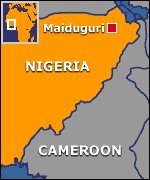
UPDATE: 3/29/2006, 6:46 PM. The BBC reported on the 2001 eclipse-induced violence here. The violence took place in Maiduguri, the town, along with Bauchi, in far northwestern Nigeria where Muslims attacked Christians, ostensibly because of the Danish cartoons, this February.
UPDATE 2: 3/29/2006, 7:02 PM. "The world isn't ending." Or so says the Nigerian Ministry of Information and National Orientation (?):
An editorial in the Pittsburgh Post-Gazette (March 8) from a Nigerian clergyman working in Pittsburgh, which I will write about in a near-future post, got me to thinking about what Nigerians really think about their country, who they are, and where they are going.
 One question that I've had is what relationship Nigerians have to the Church, whether Anglican, Catholic, or Pentecostal. The relationship is important to understand -- Nigerian politicians and clergymen talk about what Nigerians want and what they believe, and people like me, who are most definitely not Nigerian and have never visited the country let alone the continent, have to trust them. But what if the way those politicians and clergymen talk about the world is so different from how we talk about it that their presentation of Nigerians and their needs is hopelessly distorted to our ears?
Today's total solar eclipse, which started in Brazil, crossed the Atlantic and then covered a swath of countries on the Gulf of Guinea and up into Niger and Libya (6 Nigerian states experienced total eclipse), provides a window into what a visit to Nigeria might be like, and what we might learn about the flock led by such organizations as the Anglican Church of Nigeria.
First, as the eclipse approached, some news organizations published warnings, in part to avoid the religiously motivated violence that followed the 2001 eclipse in Borno State. As This Day (Lagos) pointed out on March 27:
Eclipse occurrence is not new in Nigeria. One occurred in 1898, another one in 1947 and that of 1959. The most recent was in 2001, the very particular case in Borno State that people did not understand. According to the Information and National Orientation Minister, Mr. Frank Nweke, government said it was nothing ominous in such occurrences. "The Federal Government once again reminded Nigerians about the impending solar eclipse, otherwise known as the eclipse of the sun. This incident occurs at new moon and only if the moon passes between the sun and the earth, which causes the brightness of the sun to be replaced, momentarily, by the black disk of the moon. This does not happen very often but it is expected to take place on March 29.Now, the Mail & Guardian Online (South Africa) reports on today's response to the eclipse:"I will like to inform Nigerians that solar eclipses are occurrences within the solar system, whereby the moon is directly between the sun and other planets, including the earth, our planet. Many of us would recall that in June 2001, some parts of the world including Nigeria experienced solar eclipse.
"I know it is natural for people to be frightened and react terribly to unusual incidents but I urge Nigerians and foreigners resident in Nigeria not to panic over the expected eclipse. It is not expected to have any real damaging effect, only on social and psychological discomforts are envisaged.
"However,, since eclipses are now of interest not only to scientists but also to the public, I passionately appeal to all Nigerians not to look at the sun directly because it may cause eye ailments that may lead to blindness in the long run. This is why scientists use a special type of glasses or other devices to view solar eclipses. I therefore strongly advise people to stay indoors for the period the eclipse is expected to last", the minister advised.
...
From a religious point of view, an eclipse has certain implications. Uluocha reiterated that when the lunar eclipse that occurred in 2001 at the Northern part of the country, it caused a lot of distractions in the sense that the Moslem communities, especially the Almajiris, went on rampage. They thought that the light of the moon was darkened because of the sins of the people.
"They went out to look for the infidels who were accused of being responsible for the darkening of the light of the moon. As far as they were concerned, it was unnatural for the light of the moon to be darkened when it was supposed to be shining very bright. So, they went out destroying properties, hotels, churches, killed non-Moslems, prostitutes, native doctors amongst other things. They felt that what happened was as a result of the sin of the people", he said.
...
[Dr. Ernest] Afiesimama advised that people should not regard the eclipse as if something has gone wrong in the universe or wanting to know if it is a bad omen, whether the gods are angry or it is diabolical and so many speculations that may be expected of people who are not sensitised in the atmospheric phenomenon. From his point of view, there is nothing to panic about the eclipse.
Shouts of "Allah Akbar!" (God is greatest) rent the air in parts of Kaduna, northern Nigeria on Wednesday as a four-minute eclipse turned daylight into darkness.I do not wish to make Nigerians look foolish. Far from it. When I saw my first solar eclipse (it was only partial), I was overwhelmed by a sense of smallness. Despite having known the true nature of a solar eclipse since I was a small child, I was still awestruck by the grand movements of these celestial bodies, so far away and out of our control. Some react to eclipses, as I
Many residents ran indoors before the eclipse started. Some did so for fear of looking at the phenomenon directly and damaging their eyes.
Others did so in the belief that that it was a satanic development. The eclipse was experienced in 11 of Nigeria's 36 states.
Musa Abubakar, a Kaduna resident, told the Deutsche Presse-Agentur that scientists' claims that it was a mere expression of nature were not sacrosanct.
"Why Nigeria? Why Kaduna, if not because our sins are legion?" he asked, even after he was told that other countries would also experience it.
Kabuna resident Amina Yusuf also believes the eclipse was God's way of warning Nigeria to turn away from sin. Another resident insisted it was conjured by witches and wizards.
"I did not allow my children to go to school today since we have been hearing on radio and television that there would be an eclipse," Fati Sale said.
Teacher Ezekiel Zubair said he deliberately stayed outdoors to see the eclipse "for a few seconds, because it may be a once-in-a-lifetime experience".
Muslim cleric Abu Thanni said the eclipse was Allah's way of showing that he is "omnipotent".
Pastor Joseph Aku quoted the Bible to buttress his view that the eclipse was a divine event. His text read: "The time is coming when I will make the sun go down at noon and the earth grow dark in daytime. I the Sovereign Lord have spoken."
An eclipse in 1989 led to rioting in Nigeria's predominantly Muslim north as gangs burnt and looted homes and hotels to "atone for the sins of infidels". [emphasis mine]
 did, by reveling in the grandeur they evoke; others, perhaps because of that same sense of smallness, make calls to God to save them from their sin.
So far, I've seen no reports of violence.
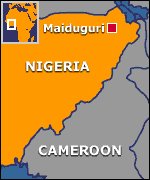
UPDATE: 3/29/2006, 6:46 PM. The BBC reported on the 2001 eclipse-induced violence here. The violence took place in Maiduguri, the town, along with Bauchi, in far northwestern Nigeria where Muslims attacked Christians, ostensibly because of the Danish cartoons, this February.
UPDATE 2: 3/29/2006, 7:02 PM. "The world isn't ending." Or so says the Nigerian Ministry of Information and National Orientation (?):
"The solar eclipse is not an evil occurrence. It is not the end of the world. There is no need to panic. It is a wonderful expression of Nature."
Never mind
(update below)
I guess today's meeting with Bush was too important for President Obasanjo to screw up.
Charles Taylor, after attempting escape on Monday night from extradition to Sierra Leone for 17 war crimes indictments, was just arrested as he tried to sneak into neighboring Cameroon.
Obasanjo had at first resisted surrendering Taylor, but bowed to the request of new Liberian president Ellen Johnson-Sirleaf, saying that Taylor was not a prisoner in Nigeria and that the Liberians could take him whenever they wanted.
UPDATE: 3/29/2006, 7:02 AM. The New York Times also gives front-(web)page coverage to the recapture. Lydia Polgreen, writing for the Times, notes that President Sirleaf of Liberia was "harassed" by Congress during her recent visit to the US to ensure that Taylor sat for war crimes in either Liberia or Sierra Leone. Knowing full well what havoc he could wreak if he returned to Liberia, she was reluctant.
Well, Nigerian security forces are first taking Taylor to Abuja, then directly to Liberia. Hopefully Taylor's supporters will make good on their pledge to let him sit for the prosecution of his indictments.
I guess today's meeting with Bush was too important for President Obasanjo to screw up.
Charles Taylor, after attempting escape on Monday night from extradition to Sierra Leone for 17 war crimes indictments, was just arrested as he tried to sneak into neighboring Cameroon.
Obasanjo had at first resisted surrendering Taylor, but bowed to the request of new Liberian president Ellen Johnson-Sirleaf, saying that Taylor was not a prisoner in Nigeria and that the Liberians could take him whenever they wanted.
UPDATE: 3/29/2006, 7:02 AM. The New York Times also gives front-(web)page coverage to the recapture. Lydia Polgreen, writing for the Times, notes that President Sirleaf of Liberia was "harassed" by Congress during her recent visit to the US to ensure that Taylor sat for war crimes in either Liberia or Sierra Leone. Knowing full well what havoc he could wreak if he returned to Liberia, she was reluctant.
Well, Nigerian security forces are first taking Taylor to Abuja, then directly to Liberia. Hopefully Taylor's supporters will make good on their pledge to let him sit for the prosecution of his indictments.
Tuesday, March 28, 2006
Mark Harris' response to Bishop Duncan
Serves me right for not surfing the web a bit more -- I had missed until now Mark Harris's 3/16 response to Bishop Duncan's 3/14 response to Bishop Chane's 2/26 Washington Post op-ed.
He made many of the same points I did on 3/15, and others I didn't.
I strongly recommend reading his response since he can speak to the religious and political implications within the Anglican Communion of Chane's op-ed in ways that I cannot.
He made many of the same points I did on 3/15, and others I didn't.
I strongly recommend reading his response since he can speak to the religious and political implications within the Anglican Communion of Chane's op-ed in ways that I cannot.
Whoops! Charles Taylor disappears
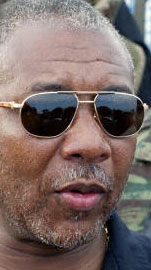 I was going to write something this morning about how lame Nigerian President Obasanjo's efforts have been to convince Nigerians at home that his visit to the US (right now) has nothing to do with seeking a Third Term. But this trumps it (AP via the New York Times):
Liberian warlord and former President Charles Taylor has disappeared from his haven in Nigeria, just as he was to have been handed over to stand trial on war crimes charges, Nigerian officials said Tuesday.The irony, of course, is that President Olusegun Obasanjo, who had agree on Saturday to hand over Taylor to a UN tribunal sitting in Sierra Leone after receiving repeated requests from Liberian President Ellen Johnson-Sirleaf, was probably relieved that Taylor would not be on the schedule when he arrived at the White House this Wednesday. It should be an interesting meeting.
Taylor vanished Monday night from his villa in the southern town of Calabar, the government said. Last week, Nigeria's government agreed reluctantly to surrender him to stand before a U.N. tribunal on charges related to civil war in his homeland and its neighbor Sierra Leone.
A government statement said that President Olusegun Obasanjo was creating a panel to investigate Taylor's disappearance on Monday night. The statement raised the possibility he might have been abducted, but did not elaborate.
A presidential spokeswoman said members of Taylor's Nigerian security detail had been arrested.
The presidential statement offered no details on how Taylor's disappearance was discovered or whether he was being hunted.
Nigeria's Guardian newspaper reported Tuesday that dozens of people who had been living with Taylor in the villa in a walled government compound had left Monday and were flying to Lagos en route to an unknown destination.
Monday, March 27, 2006
Conservative Anglicans are missing an opportunity
The White House is set to welcome him and Human Rights Watch has prepared their message for him.
But there's still no word from conservative Anglicans on whether they think a potentially major human rights violation, against professed Christians (who just happen to be gay), is worth speaking up about.
Nigerian President Olusegun Obasanjo visits the White House on Wednesday. The Presidents will discuss, among other things, "continuing cooperation in the areas of Darfur, regional security, energy security, fighting corruption, strengthening democratic institutions, and the need to bring Charles Taylor to justice."
Given Secretary Rice's vigorous lobbying for the release of Afghan Christian convert Abdul Rahman last week, and her numerous Sunday morning talk show appearances discussing that topic, I'm sure that she and leaders in the Anglican Communion will be eager to voice their concern that the same arguments applied toward the release of Rahman also be applied toward pressuring President Obasanjo to withdraw the so-called "Same Sex Marriage (Prohibition) Act 2006" (pdf), legislation that was endorsed by the head of the Anglican Church of Nigeria (the largest Anglican province in the world), Archbishop Peter Akinola.
I have argued previously that, given the coming schism within the Anglican Communion over the ordination of non-celibate gay priests and bishops, it is unlikely conservative Anglicans will attempt any kind of effort to pressure Akinola to withdraw his endorsement, or similiarly pressure the White House to get Obasanjo to withdraw the legislation (despite State Department condemnation). Akinola is too powerful an ally in the American conservative movement's desire to fight homosexuality here at home, and Obasanjo is too important for the US's national energy strategy for a President who is already weak on civil rights to insist too vigorously.
But this may be their only chance to take a stand on the side of those rights. If they let it go by, conservative Anglicans will have lost all credibility as a group with any interest in protecting democratic institutions (something Bush lost long ago). By association, the Institute on Religion and Democracy (IRD), which has provided at least in kind support to conservative Anglicans through the American Anglican Council, which has received considerable support from major Republican donors, and which has recently impeached its own self-declared mission to protect the human rights of oppressed Christians by prioritizing the human rights of some Christians over others, or of Christians over non-Christians, will have come to the point where it should seriously think about removing "Democracy" from its name.
IRD's new president is James Tonkowich, the former managing editor of BreakPoint, the newsletter of Chuck Colson's Prison Felloship. Now, I won't hold Tonkowich to Colson's words, but here's what Colson said in October, 2004, in Christianity Today (Hat tip Andrew Sullivan):
Maybe. Maybe not. But we'll know them by their deeds.
But there's still no word from conservative Anglicans on whether they think a potentially major human rights violation, against professed Christians (who just happen to be gay), is worth speaking up about.
Nigerian President Olusegun Obasanjo visits the White House on Wednesday. The Presidents will discuss, among other things, "continuing cooperation in the areas of Darfur, regional security, energy security, fighting corruption, strengthening democratic institutions, and the need to bring Charles Taylor to justice."
Given Secretary Rice's vigorous lobbying for the release of Afghan Christian convert Abdul Rahman last week, and her numerous Sunday morning talk show appearances discussing that topic, I'm sure that she and leaders in the Anglican Communion will be eager to voice their concern that the same arguments applied toward the release of Rahman also be applied toward pressuring President Obasanjo to withdraw the so-called "Same Sex Marriage (Prohibition) Act 2006" (pdf), legislation that was endorsed by the head of the Anglican Church of Nigeria (the largest Anglican province in the world), Archbishop Peter Akinola.
I have argued previously that, given the coming schism within the Anglican Communion over the ordination of non-celibate gay priests and bishops, it is unlikely conservative Anglicans will attempt any kind of effort to pressure Akinola to withdraw his endorsement, or similiarly pressure the White House to get Obasanjo to withdraw the legislation (despite State Department condemnation). Akinola is too powerful an ally in the American conservative movement's desire to fight homosexuality here at home, and Obasanjo is too important for the US's national energy strategy for a President who is already weak on civil rights to insist too vigorously.
But this may be their only chance to take a stand on the side of those rights. If they let it go by, conservative Anglicans will have lost all credibility as a group with any interest in protecting democratic institutions (something Bush lost long ago). By association, the Institute on Religion and Democracy (IRD), which has provided at least in kind support to conservative Anglicans through the American Anglican Council, which has received considerable support from major Republican donors, and which has recently impeached its own self-declared mission to protect the human rights of oppressed Christians by prioritizing the human rights of some Christians over others, or of Christians over non-Christians, will have come to the point where it should seriously think about removing "Democracy" from its name.
IRD's new president is James Tonkowich, the former managing editor of BreakPoint, the newsletter of Chuck Colson's Prison Felloship. Now, I won't hold Tonkowich to Colson's words, but here's what Colson said in October, 2004, in Christianity Today (Hat tip Andrew Sullivan):
Radical Islamists were surely watching in July when the Senate voted on procedural grounds to do away with the Federal Marriage Amendment. This is like handing moral weapons of mass destruction to those who use America's decadence to recruit more snipers and hijackers and suicide bombers.
One vital goal of the war in Iraq, and the war against terrorism, is to bring democracy to the heart of the Islamic world. Our hope is to make freedom so attractive that other Muslim countries will follow suit. But when radical Islamists see American women abusing Muslim men, as they did in the Abu Ghraib prison, and when they see news coverage of same-sex couples being "married" in U.S. towns, we make our kind of freedom abhorrent—the kind they see as a blot on Allah's creation.
Preserving traditional marriage in order to protect children is a crucially important goal by itself. But it's also about protecting the United States from those who would use our depravity to destroy us. We must not give up simply because the Senate voted down the FMA. It took William Wilberforce and his allies 20 years to shut down Britain's slave trade; it will take years to win the battle for traditional marriage.
By Colson's logic, the more vocal and violent Islamic extremists become, the more rights we must curtail here at home, especially if those rights are offensive to Islam.
Yikes.
I should point out that, in some sense, this is the same argument used by many conservative Anglicans to defend Akinola's endorsement of the legislation: David Virtue, the Rev. Martyn Minns (board member of the AAC), Faith McDonnell (Director of IRD's Religious Liberty Program), and the Rt. Rev. Robert Duncan (Episcopal Bishop of Pittsburgh and moderator of the Anglican Communion Network). And, of course, it's exactly the opposite argument used to advocate for the quick release of Abdul Rahman in Afghanistan.
Maybe. Maybe not. But we'll know them by their deeds.
Sunday, March 26, 2006
Perhaps Schism is the way forward?, cont'd
Providing additional reason to believe that conservative Anglican are -- at the moment -- constitutionally incapable of seeing a crisis of conscience for what it is, David Virtue has posted a now old letter (March 6) from the Rev. Dr. Paul Zahl, the dean and president of Trinity Episcopal School for Ministry in Ambridge, Pennsylvania. Zahl writes:
Yet, like Zahl's note, most of the responses to Chane's op-ed from conservatives have viewed it as a personal attack on Archbishop Akinola. Few, if any, have bothered to look more deeply at what the legislation actually calls for. To whit, popular orthodox Anglican websites, like VirtueOnline and TitusOneNine, have yet to even acknowledge that their associate in Nigeria, Archbishop Akinola, may have stepped over the line in endorsing legislation that explicitly curtails homosexuals or those advocating on behalf of homosexuals their rights to speech, assembly, press, and religious beliefs. Given recent events, I hope that conservative Christians (not just Anglicans) now would be familiar with the potential effects of denying those rights.
Camille Paglia says it well in this week's New York Times (6 March 2006). She says that faculties like Harvard's want diversity in all things except diversity of thought. She could have been speaking of the Episcopal Church.It's been a while since this letter was written, and I for one will give Zahl the benefit of the doubt -- he has probably carefully read the offending legislation (pdf), as well as the State Department's condemnation, and the letter written to President Olusegun Obasanjo from Human Rights Watch and 15 other organizations requesting that the President withdraw it, in the intervening period.
Paglia's point is apt to an editorial that has appeared in newspapers throughout the United States this past week, beginning with the Washington Post. It is an opinion piece by the Bishop of Washington, John Bryson Chane, accusing American traditionalist church people of backing figures such as Peter Akinola, the Primate of Nigeria, who is supporting a piece of repressive legislation in his homeland that criminalizes homosexual activity and is thus opposed to human rights. Bishop Chane wants the American "orthodox" to speak out against Archbishop Akinola's support of this legislation.
We certainly want to look at all things in the light of core Christianity. And if the Nigerian legislation is as bad as Bishop Chane says it is, then we are required to say something.
But I, for one, have become almost unable to "hear" anything that the power-people in the Episcopal Church have to say until they start acting with love toward those in the small minority over whom they have canonical power.
...
I cannot listen to what the majority has to say – and I would truly like to – until those who hold the cards just now, in a human sense, give a little. When they give us some real space, then I shall listen to what they have to say concerning our co-religionist Peter Akinola.
Yet, like Zahl's note, most of the responses to Chane's op-ed from conservatives have viewed it as a personal attack on Archbishop Akinola. Few, if any, have bothered to look more deeply at what the legislation actually calls for. To whit, popular orthodox Anglican websites, like VirtueOnline and TitusOneNine, have yet to even acknowledge that their associate in Nigeria, Archbishop Akinola, may have stepped over the line in endorsing legislation that explicitly curtails homosexuals or those advocating on behalf of homosexuals their rights to speech, assembly, press, and religious beliefs. Given recent events, I hope that conservative Christians (not just Anglicans) now would be familiar with the potential effects of denying those rights.
Saturday, March 25, 2006
Census extended amid violence
Reuters reports on a two-day extension of the census, announced today. The significance of this census, to all of us, is two fold: (1) it's the first in 15 years in a country that is Africa's most populous nation, but whose population is only very roughly defined (somewhere between 120 and 150 million); (2) questions of tribe and religion have been eliminated from the questionnaire, meaning that no one will no for sure how big a Muslim majority there actually is. Some in Nigeria believe that the size of the Muslim population has been vastly inflated, given the strongly northern-Muslim composition of Nigerian military.
More reaction to Human Rights Watch letter
Human Rights Watch (HRW) recently issued a press release calling for Nigerian President Olusegun Obasanjo to withdraw the legislation he recently presented to the Nigerian Federal Assembly that would ban not only gay marriage but also the right for anyone to publicly advocate or defend homosexuality. The legislation would further ban church groups that celebrate gay marriages or simply support their celebration, and could hamper HIV/AIDS prevention efforts in Nigeria, where over 3% of the population is infected with the virus. See below.
Here are three more press items following on the HRW press release:
Afrol News in Norway (March 24) discusses the content of the legislation and the objections of HRW.
SomaliNet (March 24) presents a very brief summary of the legislation and the HRW press release.
AllAfrica.com (March 24) publishes a short notice by the UN Integrated Regional Information Networks (IRIN) on the possibility that the legislation could hamper HIV/AIDS prevention efforts.
Here are three more press items following on the HRW press release:
Afrol News in Norway (March 24) discusses the content of the legislation and the objections of HRW.
SomaliNet (March 24) presents a very brief summary of the legislation and the HRW press release.
AllAfrica.com (March 24) publishes a short notice by the UN Integrated Regional Information Networks (IRIN) on the possibility that the legislation could hamper HIV/AIDS prevention efforts.
Perhaps Schism is the way forward?
A particularly odious biproduct of the current wrangle in the Anglican Communion over gay priests and bishops is the utter lack of focus within the communion of how purely political maneuvers may be adversely affecting the very subject of their disagreement: homosexuals.
We have seen this clearly in Nigeria over the last two months. President Olusegun Obasanjo presents a law to the Nigerian Federal Assembly which would meaninglessly ban gay marriage but, more importantly, also ban speech, press, and assembly in support or in advocacy of homosexuality and homosexuals. The legislation, which has not yet passed, would have wide-ranging implications, such as barring church groups, like Changing Attitude Nigera, run by Davis Mac-Iyalla, a gay Anglican Nigerian, from operating within the country.
The Primate of the Anglican Nigerian Church, Archbishop Peter Akinola, has endorsed this legislation. The Church has disavowed Davis Mac-Iyalla, claiming that he was never an Anglican, and that his activities and organization are an attempt to defraud foreign Anglicans wishing to support homosexuality in Nigeria.
Despite the obvious human rights violations implied in the legislation, despite the condemnation of the US State Department, and despite the protest of various international human rights organizations who have called for President Obasanjo to withdraw the legislation, conservative Anglicans in the United States, with whom Akinola is aligned both by doctrine and organizational commitment, have remained silent.
True, several conservative American Anglican leaders have mentioned the legislation. Alan Wisdom was the first (March 3). Speaking to the Washington Blade, this non-Anglican former interim director of the Institute on Religion and Democracy (recently replaced by Dr. James Tonkowich, the managing editor of BreakingPoint with Chuck Colson's Prison Fellowship, as the permanent director) said that there was a "legitimate concern about the Nigerian law relating to sexual expression ... we would oppose a law like that."
Yet, just a week later (March 9), the director of IRD's Religious Liberty program -- ironic name, huh? -- Faith McDonnell, said, "the proposed federal legislation is onerous to us ... but our society is not yet living in constant fear of the rule of Islamism." In other words, we "would" oppose a law like that, but we're not going to. Why? Because of Islamism. What we're left with, then, is Christianism versus Islamism. I've blogged on Faith McDonnell's IRD letter, and her similar letter to the Times Union of Albany, below. Both letters have led me to question whether the word "Democracy" really belongs in the IRD's moniker.
In the interim (March 4), the Rev Canon Martyn Minns of Fairfax, Virginia, and a member of the Anglican American Council's board (the Episcopal organization with strong historical ties to the Institute on Religion and Democracy), wrote a letter posted on TitusOneNine, that said that "while I find some of the language of the proposed Nigerian law too harsh and unacceptable in our context, sadly there are many other situations that I find even more unacceptable. For example, in Saudi Arabia there are death penalties for women convicted of adultery or for any citizen who converts to Christianity." He further said about Nigeria, "There is a precarious balancing act between those regions that are under Muslim influence -- where Sharia law calls for the stoning of homosexuals -- and those that have a majority Christian population. The situation is volatile as demonstrated by the repercussions from the Danish cartoon saga that have already led to hundreds of Christian and Muslim deaths. Keeping the lid on this situation is a formidable task." Minns argues, in essence, that the threat of Islam is great enough to justify sacrificing democratic principles. Intepreted more broadly, in the context of the recent incarceration and possible release of Abdul Rahman, what he is actually saying is that democratic principles matter more in some cases than in others; that is, only when Democracy protects interests of Christians.
On March 7, Washington-based trustees of the American Anglican Council wrote an open letter, embarrassing themselves by claiming that they could find no evidence that Archbishop Akinola had made any public claim of support for the legislation. Of course, he had. The letter goes on to claim that Chane's op-ed to the Washington Post was nothing more than a personal attack against Archbishop Akinola. They make no mention of whether they would support or condemn the Nigerian legislation. I blogged on this letter here.
On March 15, the Rt. Rev. Robert Duncan, Episcopal Bishop of Pittsburgh, and the moderator of the Anglican Communion Network (the only Anglican organization in the US with which Akinola will associate), published a letter on VirtueOnline, publicly defending Archbishop Akinola against Bishop Chane's op-ed. In it, he made the same kernel of an argument advanced by Rev. Minns and the IRD staff -- Akinola is facing a grave threat from Nigerian Islamists and the only way to stop their advance is to appease them. Duncan makes no mention of his endorsement or condemnation of the legislation. I blogged on Duncan's letter here.
The problem, of course, is that conservative American Anglicans find themselves unable to publicly condemn the Nigerian legislation. Even if they found it "onerous," they would be hard pressed to avoid criticism of a man who is, for all intents and purposes, a political ally in Africa, a man who represents a movement within Anglicanism that gives theirs far greater legitimacy than if they were alone.
Meanwhile, conservative American Anglicans who happen to agree with the spirit of the Nigerian legislation banning speech on behalf of homosexuality, such as readers of VirtueOnline (David Virtue is called the Rush Limbaugh of American Anglicans), can fight any mention of the "human rights" dimension of the legislation by saying that Chane's op-ed was just a personal attack against Archbishop Akinola.
Liberal Anglicans, of course, can do nothing substantive.
In the meantime, people like me (a non-Anglican) start to think that conservative American Anglicans are the devil. Fr. Jake echos that concern, when he says, "we also have to pay closer attention to the perspective of those who are outside the Church, who do not always trust our words, because our actions, our witness, is often viewed as being contrary to the message we claim to profess."
It has occurred to me, given what appears to be an imminent schism within the Anglican Communion, that that very same schism might, in fact, be the way forward. Freed from the political dimension of having to defend Akinola against liberal criticism, the civil libertarians among conservative American Anglicans (if there are any) would be able to cajole and pressure Akinola to withdraw his endorsement. Akinola will only listen to those within his "communion," anyway.
But let's be realistic. By the time conservative Anglicans find their conscience, the legislation will already have passed. And will they ever find their conscience, or will they just remain on the wrong side of a human rights debate?
We have seen this clearly in Nigeria over the last two months. President Olusegun Obasanjo presents a law to the Nigerian Federal Assembly which would meaninglessly ban gay marriage but, more importantly, also ban speech, press, and assembly in support or in advocacy of homosexuality and homosexuals. The legislation, which has not yet passed, would have wide-ranging implications, such as barring church groups, like Changing Attitude Nigera, run by Davis Mac-Iyalla, a gay Anglican Nigerian, from operating within the country.
The Primate of the Anglican Nigerian Church, Archbishop Peter Akinola, has endorsed this legislation. The Church has disavowed Davis Mac-Iyalla, claiming that he was never an Anglican, and that his activities and organization are an attempt to defraud foreign Anglicans wishing to support homosexuality in Nigeria.
Despite the obvious human rights violations implied in the legislation, despite the condemnation of the US State Department, and despite the protest of various international human rights organizations who have called for President Obasanjo to withdraw the legislation, conservative Anglicans in the United States, with whom Akinola is aligned both by doctrine and organizational commitment, have remained silent.
True, several conservative American Anglican leaders have mentioned the legislation. Alan Wisdom was the first (March 3). Speaking to the Washington Blade, this non-Anglican former interim director of the Institute on Religion and Democracy (recently replaced by Dr. James Tonkowich, the managing editor of BreakingPoint with Chuck Colson's Prison Fellowship, as the permanent director) said that there was a "legitimate concern about the Nigerian law relating to sexual expression ... we would oppose a law like that."
Yet, just a week later (March 9), the director of IRD's Religious Liberty program -- ironic name, huh? -- Faith McDonnell, said, "the proposed federal legislation is onerous to us ... but our society is not yet living in constant fear of the rule of Islamism." In other words, we "would" oppose a law like that, but we're not going to. Why? Because of Islamism. What we're left with, then, is Christianism versus Islamism. I've blogged on Faith McDonnell's IRD letter, and her similar letter to the Times Union of Albany, below. Both letters have led me to question whether the word "Democracy" really belongs in the IRD's moniker.
In the interim (March 4), the Rev Canon Martyn Minns of Fairfax, Virginia, and a member of the Anglican American Council's board (the Episcopal organization with strong historical ties to the Institute on Religion and Democracy), wrote a letter posted on TitusOneNine, that said that "while I find some of the language of the proposed Nigerian law too harsh and unacceptable in our context, sadly there are many other situations that I find even more unacceptable. For example, in Saudi Arabia there are death penalties for women convicted of adultery or for any citizen who converts to Christianity." He further said about Nigeria, "There is a precarious balancing act between those regions that are under Muslim influence -- where Sharia law calls for the stoning of homosexuals -- and those that have a majority Christian population. The situation is volatile as demonstrated by the repercussions from the Danish cartoon saga that have already led to hundreds of Christian and Muslim deaths. Keeping the lid on this situation is a formidable task." Minns argues, in essence, that the threat of Islam is great enough to justify sacrificing democratic principles. Intepreted more broadly, in the context of the recent incarceration and possible release of Abdul Rahman, what he is actually saying is that democratic principles matter more in some cases than in others; that is, only when Democracy protects interests of Christians.
On March 7, Washington-based trustees of the American Anglican Council wrote an open letter, embarrassing themselves by claiming that they could find no evidence that Archbishop Akinola had made any public claim of support for the legislation. Of course, he had. The letter goes on to claim that Chane's op-ed to the Washington Post was nothing more than a personal attack against Archbishop Akinola. They make no mention of whether they would support or condemn the Nigerian legislation. I blogged on this letter here.
On March 15, the Rt. Rev. Robert Duncan, Episcopal Bishop of Pittsburgh, and the moderator of the Anglican Communion Network (the only Anglican organization in the US with which Akinola will associate), published a letter on VirtueOnline, publicly defending Archbishop Akinola against Bishop Chane's op-ed. In it, he made the same kernel of an argument advanced by Rev. Minns and the IRD staff -- Akinola is facing a grave threat from Nigerian Islamists and the only way to stop their advance is to appease them. Duncan makes no mention of his endorsement or condemnation of the legislation. I blogged on Duncan's letter here.
The problem, of course, is that conservative American Anglicans find themselves unable to publicly condemn the Nigerian legislation. Even if they found it "onerous," they would be hard pressed to avoid criticism of a man who is, for all intents and purposes, a political ally in Africa, a man who represents a movement within Anglicanism that gives theirs far greater legitimacy than if they were alone.
Meanwhile, conservative American Anglicans who happen to agree with the spirit of the Nigerian legislation banning speech on behalf of homosexuality, such as readers of VirtueOnline (David Virtue is called the Rush Limbaugh of American Anglicans), can fight any mention of the "human rights" dimension of the legislation by saying that Chane's op-ed was just a personal attack against Archbishop Akinola.
Liberal Anglicans, of course, can do nothing substantive.
In the meantime, people like me (a non-Anglican) start to think that conservative American Anglicans are the devil. Fr. Jake echos that concern, when he says, "we also have to pay closer attention to the perspective of those who are outside the Church, who do not always trust our words, because our actions, our witness, is often viewed as being contrary to the message we claim to profess."
It has occurred to me, given what appears to be an imminent schism within the Anglican Communion, that that very same schism might, in fact, be the way forward. Freed from the political dimension of having to defend Akinola against liberal criticism, the civil libertarians among conservative American Anglicans (if there are any) would be able to cajole and pressure Akinola to withdraw his endorsement. Akinola will only listen to those within his "communion," anyway.
But let's be realistic. By the time conservative Anglicans find their conscience, the legislation will already have passed. And will they ever find their conscience, or will they just remain on the wrong side of a human rights debate?
Friday, March 24, 2006
Afghan Christian convert to be released soon
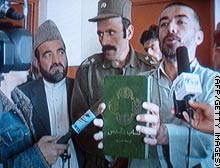 Condi Rice has been on the case:
Secretary of State Condoleezza Rice has contacted Afghan President Hamid Karzai by telephone and spoken in person with Afghan Foreign Minister Abdullah Abdullah to discuss legal proceedings against an Afghan citizen who converted to Christianity 16 years ago.... and now it looks like Abdul Rahman will be released:"She raised it in the strongest possible terms and she urged President Karzai's government to seek a favorable resolution to this case at the earliest possible moment. She underlined the fact that the United States stands forthrightly for principles of freedom of worship, freedom of expression and that these are bedrock principles of democracy around the world," said State Department spokesman Sean McCormack.
An Afghan man possibly facing execution for converting from Islam to Christianity is expected "to be released in the coming days," a source with detailed knowledge of the case said Friday.Readers of TitusOneNine will be relieved. I'm sure they'll also be relieved when Secretary Rice makes a similar call to Nigerian President Olusegun Obasanjo, perhaps when he visits (can anyone confirm this rumor that Obasanjo is coming to the US shortly?).
Word of Abdul Rahman's release comes after days of international pressure and the day before the Afghan Cabinet was scheduled to discuss the case of the 41-year-old father of two. On Thursday, top Afghan clerics urged Muslims to kill Rahman if the government freed him.
...
The U.S. government has stressed to Karzai the importance of freedom of religion in a democracy, Rice said, adding that Afghanistan now has a constitution that embraces democracy rather than the autocratic mandates of the Taliban.
A conversation between Bush and Obasanjo that I think is particularly relevant here is the one they had during Bush's visit to Abuja, Nigeria, on July 12, 2003. Here's Bush:
... Mr. President, I appreciate your honesty and openness and forthrightness when it comes to battling the pandemic of AIDS. You're truly an international leader on this issue. And the United States of America, when Congress acts, will stand side-by-side with leaders such as yourself to fight the pandemic of AIDS to save lives.It's that same commitment to AIDS prevention that Rice can invoke when she asks him why his government is worrying about further denying civil rights (and I'm talking about speech, press, and assembly) to an already repressed and closeted minority, when over 3 million of his citizens suffer from HIV/AIDS. Human Rights Watch (and those 15 other organizations) are concerned that:
While the prevailing pattern of HIV transmission in Nigeria, as elsewhere in the continent, is overwhelmingly heterosexual, the government will only damage its own prevention efforts by driving populations already suffering stigma for their sexual conduct still further underground—not only making it more difficult for outreach and education efforts to reach them, but potentially criminalizing civil society groups engaged in that vital work. Nigeria’s AIDS prevention programs have already been distinguished by their neglect of the particular risks facing men who have sex with men (MSM). This bill would put major barriers in the path of effective prevention efforts.I would add that if HIV/AIDS is perceived as a gay disease in Nigeria (which it is -- broadly), outside organizations that fight HIV/AIDS could be specifically targeted as "involved in the registration of gay clubs, societies and organizations, sustenance, procession or meetings, publicity and public show of same sex amorous relationship directly or indirectly in public and in private," and thus subject to 5 years' imprisonment.
Too bad Abdul Rahman isn't also a gay Anglican Nigerian.
Crashing the Gate
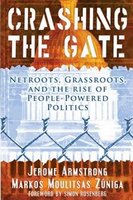 I can only reiterate what others have said. This is not a book for Democrats on how to retool their message; it's a book on how to generate innovation and stay close to the base. I highly recommend it.
I'm now starting a book on the oil conflict in the Niger Delta, called "The Next Gulf". (Yes, I shamelessly pirated the title for a recent blog post.) It's currently only available in the UK. So far, it's a great read, and indispensible for an outsider to Nigeria, such as myself. The book is convincing me that every problem in Nigeria ultimately comes down to oil and the (mal-)distribution of the wealth it brings to the various parts and classes of Nigerian society.
Violence in Niger Delta is costing Nigeria big time
From the Voice of America (March 24):
Oil Minister Edmund Daukoru, says Nigeria had lost about $1 billion since February when militants in the Niger Delta launched attacks on oil facilities and workers.Expect a serious crackdown really soon. Or Western military involvement.
Nigeria, Africa's largest oil producer had benefited tremendously from recent high crude oil prices. Its oil revenue reached a record $15 billion in 2005 and estimates for 2006 were even higher.
Daukuro says projected revenue for this year would be adversely affected by problems in the delta. It is estimated Nigeria had earned more than $400 billion since production commenced about 40 years ago.
But most Nigerians live on less than $1 a day and the people of the delta are some of the most impoverished.
Wunmi Bewaji, an opposition member of the House of Representatives, says corrupt officials benefit most from Nigeria's oil revenue and therefore any shortfall will not make a difference to ordinary Nigerians.
Something odd about the two-day mourning period
There's something that doesn't quite make sense about some recent comments by the Archbishop of Canterbury, Rowan Williams, in defense of Nigerian Primate Peter Akinola in his potentially inciting role in Christian violence against Muslims in the southern Nigerian city of Onitsha. Comments by Williams were reported on today (March 24) by the Church Times.
Archbishop Williams' comments came from a long interview he gave to the Guardian Unlimited. I posted briefly on that interview here. Williams:
But why should he criticize, anyway? Hasn't the Anglican Church of Nigeria, in cooperation with its Catholic sister, called for a two-day period of mourning for those who died in the violence in late February?
The problem is that nowhere in any press release or story about the violence or the two-day period of mourning does anyone mention the retaliatory violence by Christians against Muslims in Onitsha.
William: "I think I know him well enough to - to take his good faith on that, what he meant." Then why hasn't Akinola included those who died in Onitsha as worthy of mourning?
Archbishop Williams' comments came from a long interview he gave to the Guardian Unlimited. I posted briefly on that interview here. Williams:
[What Archbishop Akinola said] was taken by some as, you know, open provocation, encouragement, a threat. I think I know him well enough to - to take his good faith on that, what he meant. He did not mean to stir up the violence that happened. He's a man who will speak very directly and immediately into crises. I think he meant to issue a warning, which certainly has been taken as a threat, an act of provocation. Others in the Nigerian church have, I think, found other ways of saying that which have been more measured.Think what you like about Williams' language, I don't think it's a stretch to surmise that Williams does not feel like now is the time to be criticizing Akinola, given the impending schism in the Anglican Communion.
But why should he criticize, anyway? Hasn't the Anglican Church of Nigeria, in cooperation with its Catholic sister, called for a two-day period of mourning for those who died in the violence in late February?
The problem is that nowhere in any press release or story about the violence or the two-day period of mourning does anyone mention the retaliatory violence by Christians against Muslims in Onitsha.
William: "I think I know him well enough to - to take his good faith on that, what he meant." Then why hasn't Akinola included those who died in Onitsha as worthy of mourning?
Census chaos
The first census in Nigeria in 15 years is currently in its fourth day and it has brought the country to a halt. Given what's a stake in this massively corrupt and ethnically divided country, this is not surprising.
African News Dimenion writes (and I need to quote somewhat extensively given that the link will go behind a subscription firewall shortly):
Further stories on the census: here, here, and here.
African News Dimenion writes (and I need to quote somewhat extensively given that the link will go behind a subscription firewall shortly):
Cities and towns across the west African giant fell silent as Nigeria's population -- estimated between 120 and 150 million citizens -- observed a national holiday coupled with a stay-at-home order to be counted.So much for Archbishop Akinola's call for a two-day period of mourning for the Christians who died in February's violence. (See here for Living Church article on the two-day mourning.)
...
President Olusegun Obasanjo has made counting the citizenry a priority and the five-day exercise is due to end on Saturday, but those involved want more time.Obasanjo has insisted an accurate census is a vital tool in any development strategy for a nation where most people live in abject poverty despite the state's vast oil revenues.
But the exercise has led to street violence of a kind of clashes that has already seen 20,000 killed over the past seven years when its religious and ethnic fissures became very divisive.
Nine people -- three policemen and six vigilantes -- were killed in a shootout Monday in the southern market town of Nnewi when security forces tried to search a house for suspected 'Biafran' separatists, according to police.
A senior officer in nearby Onitsha blamed the clash on market vigilantes, but Information Minister Frank Nweke linked it to a campaign against the census by a separatist group seeking to recreate the breakaway "Republic of Biafra".
A secessionist attempt by ethnic Igbos in southeast to form a Republic of Biafra in 1967 plunged the nation into a 30-month long civil war in which more than one million people died.
Suspected separatists were also fingered for hacking a young census officer to death with machetes in the nearby market city of Onitsha and wounding five others by spraying them with acid.
In a separate incident Friday five people were injured after a boundry dispute on the borders of southwestern Edo and Ondo states while a census official was attacked, apparently by a disturbed man in Ondo state capital Akure.
Despite positive assessments by National Population Commission chief Samu'ila Danko Makama, in many places census officials are yet to get going.
The mammoth exercise has been hampered by the anti-census attacks, a lack of paperwork, census officials protesting over salaries and general logistical hiccups.
...
"I don't think we can finish this job by Saturday because there are a lot of areas we are yet to cover," census counter Abdulazeez Ahmed told AFP."I believe we will need at least three more days to count everyone," he said.
Further stories on the census: here, here, and here.
Reaction to Human Rights Watch letter
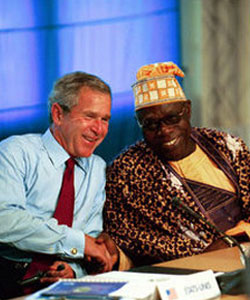 Here's a round up of the news in reaction to the letter from Human Rights Watch (HRW), and 15 other human rights organizations, including Amnesty International, to President Olusegun Obasanjo, asking him to withdraw the anti-gay marriage legislation currently before the Nigerian Federal Assembly. Given the broad public support in Nigeria, the bill will likely pass. Obasanjo plans a visit to the US shorty, where he plans to meet with President Bush.
Archbishop Peter Akinola, head of the Anglican Church of Nigeria, has endorsed the law.
So far, complete silence from conservative Anglicans.
AllAfrica.com (March 23) posts HRW's letter.
365Gay.com (March 23) reports on HRW's press release.
The Episcopal Diocese of Washington's blog (March 23) has commentary. Quote:
So to restate a recurring theme: It is okay for the Anglican Church of Nigeria, led by Archbishop Peter Akinola, to support what a bevy of human rights organizations call a "draconian measure" that "will only intensify prejudice and discrimination based on sexual orientation." As long as they don’t consecrate any gay bishops, their membership in the Anglican Communion is apparently safe. Because, you see, there is "consensus" within the Communion that gay bishops are a dodgy initiative that must be resisted until an overwhelming majority of the Communion is on board. Whereas advocating the imprisonment of gay people who kiss in public is not sufficient cause for reexamining the nature of that consensus.South Africa's Independent Online (March 24) draws attention to the bill in a short piece, emphasizing HRW's claim that the legislation could impede efforts to treat HIV/AIDS in Nigeria. They don't get it quite right when they say that the legislation (pdf) bans homosexual sex. That act is already banned in the Nigerian Penal Code, as indicated in HRW's letter, and is punishible by 14 years' imprisonment.
The Times of India (March 24) writes a nearly verbatim article to that in the Independent Online.
PinkNews (March 24) covers the basics. But then they publish another article that gets some facts wrong (though I have to credit them for the picture of Bush and Obasanjo above). The Nigerian legislation will not ban homosexual acts (that's already illegal and punishible by 14 years' imprisonment), but gay marriage and advocacy on behalf of homosexuality and homosexuals.
ThinkingAnglicans (March 24) posts their own roundup on the basics.
Gay.com (March 24) posts HRW's press release.
Member of a club that would have me as a member
It stands to reason that I should not feel welcome in any "club" that would argue about the legitimacy of my membership. The Church of England Newspaper has a brief report today on the spiritual hunger of homosexuals in the UK.
Thursday, March 23, 2006
It's a human rights issue!
Today, Human Rights Watch issued a press release for a letter calling for Nigerian President Olusegun to withdraw his legislation (pdf) banning not only gay marriage in Nigeria (even purely religious marriage ceremonies), but also the right to speak and assemble on behalf of homosexuality or homosexuals:
The letter itself is important reading:
Perhaps the possibility of violence against threatened minorities will draw conservative Anglicans in the US (dare I hope that the IRD, AAC, and Anglican Communion Network would join them?) to the right side of the debate. Perhaps they will stop shuffling their feet with Archbishop Akinola, stop complaining about the threat of Shar'iya, and start ending their complicity in overt discrimination. Or perhaps discrimination against Christian converts in Afghanistan is of far greater importance.
As Nigerian President Olusegun Obasanjo prepares to visit the United States, he should reaffirm his commitment to the human rights of all Nigerians and withdraw proposed legislation to introduce criminal penalties for same-sex relationships and marriage ceremonies, as well as for public advocacy or associations supporting the rights of lesbian and gay people.The press release mentions the fact that the bill bans gay marriage, but it places far greater emphasis on the limitations the legislation would place on basic civil rights and freedoms.
In a letter to President Obasanjo, a coalition of 16 human rights organizations urged him to disavow the bill, which contravenes international law and the African Charter on Human and Peoples’ Rights that ensure rights to freedom of expression, association, and assembly. The bill also undermines Nigeria’s struggle to combat the spread of HIV/AIDS, said the 16 groups which work in Nigeria and abroad.
"This draconian measure will only intensify prejudice and discrimination based on sexual orientation," said Scott Long, director of the Lesbian, Gay, Bisexual and Transgender Rights Program at Human Rights Watch. "The bill criminalizes public expressions of love and any defense of lesbian and gay rights, denying fundamental freedoms that should be enjoyed by all Nigerians." [emphasis mine]
The letter itself is important reading:
The broad and sweeping provisions of this proposed legislation could lead to the imprisonment of individuals solely for their actual or imputed sexual orientation in a number of ways, including for consensual sexual relations in private, advocacy of lesbian and gay rights, or public expression of their sexual identity. Anyone imprisoned under this law would be a prisoner of conscience. We urge you to disavow this proposal which contradicts fundamental freedoms under the Nigerian Constitution, international human rights law and standards, including the African Charter on Human and Peoples’ Rights.The physical threat to homosexuals in Nigeria is real. Davis Mac-Iyalla, the director of Changing Attitude Nigeria, a Nigerian Anglican LGBT organization, was arrested in October 2005 and held for two days, after publishing in article in Nigeria's Daily Sun bringing attention to gay Anglicans. Mac-Iyalla and eight of his colleagues had just attended a meeting of Changing Attitude when they were stopped in their car, brought to the Wuse district prison, beaten, and forced to bribe their way out:
...
Laws criminalizing homosexuality can also act as a licence to torture and ill treatment. By institutionalizing discrimination, they can act as an official incitement to violence against lesbians and gay men in the community as a whole, whether in custody, in prison, on the street or in the home. By stripping a sector of the population of their full rights, they also deprive lesbian and gay victims of human rights violations of access to redress while the abusers are allowed to continue abusing others with impunity.
My guess is that Mac-Iyalla and his colleagues would be considered lucky for being held for only two days if the same were to happen today.At the station they searched Davis’s pocket and discovered his identity card for Changing Attitude. They wanted to know if he was the author of the story in the previous week’s paper. He said that he was. They didn’t comment but took the nine to an open cell, beat Davis again, but never gave a reason.
None of them was allow to communicate with anyone, including members of their families. No one knew where they were and there a lot of confusion outside. They were kept without food and water.
Perhaps the possibility of violence against threatened minorities will draw conservative Anglicans in the US (dare I hope that the IRD, AAC, and Anglican Communion Network would join them?) to the right side of the debate. Perhaps they will stop shuffling their feet with Archbishop Akinola, stop complaining about the threat of Shar'iya, and start ending their complicity in overt discrimination. Or perhaps discrimination against Christian converts in Afghanistan is of far greater importance.
Wednesday, March 22, 2006
The Next Gulf
None of this is really very new, but it's important to keep it all in perspective. Nigeria provides 8% of US oil imports (it's the United States' 5th largest supplier) and is the largest oil producing nation in the Gulf of Guinea. Yet Nigeria's relationship to oil production rapidly careens toward disaster.
The Ogoni people of the Niger Delta, where virtually all of Nigeria's oil production is concentrated, have been in a long-term struggle with the oil companies (particularly Shell and it's Nigerian subsidiary) and with Nigeria's military and civilian governments to exert control over their ancestral land. Their demands have been relatively simple: ecosystem and mineral rights.
This struggle has become increasingly violent -- and sophisticated -- with a very large proportion of Nigeria's oil production lost either in spills or to bunkering (the siphoning of oil from pipelines for sale on the black market -- bunkering is a capital-intensive endeavor that would require the assistance of local and state government officials).
This Monday, the Italian oil group Agip confirmed an attack on its pipeline, leading to the loss of between 65,000 to 75,000 barrels per day. Forbes reports:
The Ogoni people of the Niger Delta, where virtually all of Nigeria's oil production is concentrated, have been in a long-term struggle with the oil companies (particularly Shell and it's Nigerian subsidiary) and with Nigeria's military and civilian governments to exert control over their ancestral land. Their demands have been relatively simple: ecosystem and mineral rights.
This struggle has become increasingly violent -- and sophisticated -- with a very large proportion of Nigeria's oil production lost either in spills or to bunkering (the siphoning of oil from pipelines for sale on the black market -- bunkering is a capital-intensive endeavor that would require the assistance of local and state government officials).
This Monday, the Italian oil group Agip confirmed an attack on its pipeline, leading to the loss of between 65,000 to 75,000 barrels per day. Forbes reports:
"Nigerian Agip Oil Company, a subsidiary of Italy's ENI in Nigeria, confirms that during the night of March 17, 2006 an act of sabotage occurred on the Tebidaba-Brass pipeline in the vicinity of Brass in the Niger Delta," the company said in an official statement.As of today (March 22), UPI was reporting the following:
"Production was immediately shut and the affected pipeline isolated. The situation is under control and operations have commenced to define the extent of the pipeline damage and contain any associated pollution," the text said.
World oil market prices climbed Monday on the news of the incident, but fell later as the markets sought to balance it against high crude stockpiles in the US.
The latest break in production will further dampen Nigeria's oil output, which has already seen a 20 pct slump since attacks started by Nigerian separatist rebels in the restive southern Delta, the country's oil producing heartland.
Ongoing unrest in Nigeria's Delta State has slashed oil production there by 26 percent.In 2005 the CIA ranked Nigeria as the world's 12th largest oil producer, pumping 2,451,000 barrels per day and with estimated reserves of 25 billion barrels.
Last weekend an explosion on the Tebidaba-Brass pipeline, owned by Italian multinational Nigeria Agip Oil Company, reduced the country's export capacity by 631,000 barrels a day.
The government subsequently deployed a number of gunboats to the Escravos naval base in Warri, Delta State. A multi-billion dollar Chevron Texaco natural gas project is situated in Escravos, along with a number of oil platforms and wells.
26% is a lot. And it's dangerous to US interests, given that it takes 3 weeks for Nigerian crude to ship to the US, and 8 weeks for it to ship from Saudi Arabia. Perhaps that's why I wasn't surprised to see this in Business in Africa Online:
The visiting Commander of the US Naval Forces in Europe, Admiral Henry "Harry" Ulrich, has pledged more "activity and visibility" by the US Navy in the Gulf of Guinea as a way of firming co-operation between America and nations of the region.Neither was I surprised when I saw that John Negroponte, the US Intelligence czar, had this to say about President Olusegun Obasanjo's efforts to insert the possibility of a 3rd term in the current round of constitutional reforms (Economist, February 25):
Admiral Ulrich arrived in Nigeria on Monday from Ghana, where he attended a conference between the Gulf of Guinea nations and the US on ways of securing the region, at the Kofi Annan Peacekeeping Institute in Accra.
...
"We aim to co-operate with the Gulf of Guinea nations on security. We have thousands of ships from the Gulf of Guinea to the US each year. We have interest in what they have and what they carry," Ulrich said.
"Also, a couple of thousands of ships come from the US to the Gulf of Guinea, and across to the Far East. So, all nations have vested interest in knowing the history of ships plying the region and what they carry. We have to work together to share information. We are looking forward to recommendations on the way forward," he added.
Admiral Ulrich also confirmed that the US has two ships in the region - one in Accra, Ghana and the other in Congo - to help the region's navies in "terrorism training". [emphasis mine]
Oil firms and western governments, including the Americans, are watching nervously. This month John Negroponte, the overall head of America's intelligence services, said that if Mr Obasanjo stayed on he might "unleash major turmoil and conflict" that could lead to a "disruption of oil supply, secessionist moves by regional governments, major refugee flows, and instability elsewhere in west Africa". Mr Obasanjo likes to parade himself abroad as a peace-loving democrat and yearns to inherit the mantle of Africa's leading elder statesman, Nelson Mandela. If so, he should promise not to run again.Authoritarian government, single commodity economy, US dependence on oil, massive local poverty, and the threat of religious extremism. Sounds promising.
A wonderully tolerant piece in The Tide, Nigeria
(update below)
I found this article delightful. Quote:
Akinola's allies in America have failed to denounce the legislation, or call for Akinola to withdraw his endorsement, despite the clear human rights and civil rights violations that legislation would generate. American Anglicans more concerned with the worldwide rift in the Anglican community over homosexuality, have lost sight of what their actions (or lack thereof) imply. Should someone like Davis Mac-Iyall, whose story I will write about shortly, be harmed as a result of a nexus of homophobic press, Church and State endorsement, and Western acquiescence, then there would be plenty of shame (and sin, if you like) to go around.
UPDATE: 3/22/2006, 3:25 pm. Igbiki Benibo is a reporter for the Tide. I have no evidence of any kind that he is associated with the Anglican Church in an official capacity.
I found this article delightful. Quote:
For the society, the presence of the homosexuals -- some of whom are reportedly high profile citizens -- is a continued threat to moral rectitude and social re-engineering. It is also an enhancement to gross moral depravity on whose throe, our society has tottered for too long.The article, by Igbiki Benibo, is utterly bereft of the trappings of evidence, and fatally burdened with erroneous stereotypes. But I don't point out the article to make fun -- Benibo here refers to the relatively new Changing Attitude Nigeria, run by Davis Mac-Iyalla, an Anglican LGBT organization advocating the legitimacy of homosexuality both in the church and in society. This organization is an implicit target of the new "anti-speech" gay marriage legislation in Nigeria, legislation that has been endorsed by the head of the Anglican Church in Nigeria, Archbishop Peter Akinola.
In fact if the odd reports that homosexuals planned to constitute an association to protest against stigmatisation and denunciation, is anything to go by, then Nigeria is into another dimension of moral bankruptcy.
We seem to live in a society where unpredictable moral ills thrive succinctly in tandem with the spirit of free society, an euphemism for a bestial human setting, there is therefore a premonition of trouble that this monster, the so called "free society" has created could wax stronger in Nigeria. [emphasis mine]
Akinola's allies in America have failed to denounce the legislation, or call for Akinola to withdraw his endorsement, despite the clear human rights and civil rights violations that legislation would generate. American Anglicans more concerned with the worldwide rift in the Anglican community over homosexuality, have lost sight of what their actions (or lack thereof) imply. Should someone like Davis Mac-Iyall, whose story I will write about shortly, be harmed as a result of a nexus of homophobic press, Church and State endorsement, and Western acquiescence, then there would be plenty of shame (and sin, if you like) to go around.
UPDATE: 3/22/2006, 3:25 pm. Igbiki Benibo is a reporter for the Tide. I have no evidence of any kind that he is associated with the Anglican Church in an official capacity.
Tuesday, March 21, 2006
Akinola's spokesman defends his boss's statement on Northern violence
On February 21, Archbishop Akinola released a statement to the Nigerian people in response to northern Muslim violence against Christians, which said, in part, "may we at this stage remind our Muslim brothers that they do not have the monopoly of violence in this nation" and that "[Christian Association of Nigeria] may no longer be able to contain our restive youths should this ugly trend continue."
Talking to the Living Church, Canon AkinTunde Popoola, the Archbishop's spokesperson and communications director, is backpedaling on that highly threatening language:
Second, is Popoola really suggesting that the language in the statement was just PR intended to harden his image among Christian youths, while at the same time claiming that that same language had nothing to do with the violence?
Talking to the Living Church, Canon AkinTunde Popoola, the Archbishop's spokesperson and communications director, is backpedaling on that highly threatening language:
A spokesman for Archbishop Akinola repudiated suggestions the Archbishop’s earlier call for restraint was a coded message of violence.First off, I have to agree that I have not seen much in the Nigerian press condemning Akinola's choice of words -- but I have also failed to see much in the press to mention the fact that more Muslims died in the south in response to the deaths of Christians in the north than actually died in the north. Indeed, Akinola's call for two days of national mourning makes no mention of the 80-100 deaths in Onitsha.
"The Church does not believe any true worshipper can go on to kill or maim another human being out of anger. It is a pity" that some in the West "are seeing incitement," Canon AkinTunde Popoola told The Living Church. The charge of inciting religious violence "has not been mentioned in Nigeria," he said.
Church leaders in Nigeria shape public attitudes and debate, Canon Popoola said, asserting that Archbishop Akinola "has to sound tough as it was becoming increasingly difficult to tell the youths to turn the other ear while they see him on TV smiling and talking with the Muslim leadership. The question on the streets was, 'are the Christians been sold out by their leadership'?" [emphasis mine]
Second, is Popoola really suggesting that the language in the statement was just PR intended to harden his image among Christian youths, while at the same time claiming that that same language had nothing to do with the violence?
Uganda and Nigeria among ten worst places to live if your gay
The Southern Voice published a list last Friday, following on the US State Department's recently released 2005 Country Reports on Human Rights Practices, on the ten worst places to live if your gay. Among them were Nigeria and Uganda, two strongholds of African and conservative American Anglican cooperation.
Faith McDonnell writes to Albany Episcopalians about Democracy
I commented extensively on the letter posted by Faith McDonnell of the Institute on Religion and Democracy in an earlier post. She's written again, this time to Episcopalians in the Albany, New York, area, whom she believes are being specifically targeted by Chane's Washington Post op-ed.
The new letter, published in the Times Union of Albany, is similar. It's not worthwhile to go over it all again, but it is helpful to review two important points. First, McDonnell emphasizes IRD's role in "mobilizing church members across the country to speak for international human rights and religious freedom." However, we are still waiting for the IRD to take a clear stance on human rights and religious freedoms for those outside the church. Thus far, it's a Christian-only club, or at worst a club for non-gay Anglicans -- so much for democracy.
Second, it is patently ridiculous to argue that Akinola's "duel challenge of rebutting such accusations [that Christians support Western immorality] while opposing Shari'a" has somehow forced him into the position of supporting legislation that would limit speach, assembly, religion, and the press. Such legislation would, in fact, lay the groundwork for granting Shar'iya greater legitimacy. Furthermore, it clearly indicates to Islamist extremists that democracy is a pushover. Good job, Institute on Religion and Democracy!
If the IRD were truly a serious player -- and it clearly isn't -- it would go much further than Faith McDonnell's statement that "IRD does not favor restrictions on free speech," and both condemn the Nigerian legislation and Akinola's support of it. Or do political alliances count more than principle? Or, worse, are some principles more important than others?
In which case, I wonder with Bishop Chane, whether "what we see in Nigeria today may well be on the agenda of the Christian right tomorrow."
The new letter, published in the Times Union of Albany, is similar. It's not worthwhile to go over it all again, but it is helpful to review two important points. First, McDonnell emphasizes IRD's role in "mobilizing church members across the country to speak for international human rights and religious freedom." However, we are still waiting for the IRD to take a clear stance on human rights and religious freedoms for those outside the church. Thus far, it's a Christian-only club, or at worst a club for non-gay Anglicans -- so much for democracy.
Second, it is patently ridiculous to argue that Akinola's "duel challenge of rebutting such accusations [that Christians support Western immorality] while opposing Shari'a" has somehow forced him into the position of supporting legislation that would limit speach, assembly, religion, and the press. Such legislation would, in fact, lay the groundwork for granting Shar'iya greater legitimacy. Furthermore, it clearly indicates to Islamist extremists that democracy is a pushover. Good job, Institute on Religion and Democracy!
If the IRD were truly a serious player -- and it clearly isn't -- it would go much further than Faith McDonnell's statement that "IRD does not favor restrictions on free speech," and both condemn the Nigerian legislation and Akinola's support of it. Or do political alliances count more than principle? Or, worse, are some principles more important than others?
In which case, I wonder with Bishop Chane, whether "what we see in Nigeria today may well be on the agenda of the Christian right tomorrow."
UN to be pushed for recognition of gay and lesbian rights
The UN does not grant gays and lesbians minority status. Some are pushing the UN to do so. I doubt Nigeria will hurry to sign on.
ABC Williams is a (spineless?) politician
(updated below)
This is what the Guardian Unlimited said today of Archbishop of Canterbury, Rowan Williams:
UPDATE: 3/22/2006, 10:33 am. Some UK gay and lesbian activists are unsurprisingly outraged by ABC Williams' failure to react to Archbishop Akinola's endorsement of anti-gay legislation in Nigeria. They call Williams spineless. I tend to agree. But I reiterate: don't expect anything until the split is over. Even then, criticism of Akinola will have to come from Western conservatives.
This is what the Guardian Unlimited said today of Archbishop of Canterbury, Rowan Williams:
Dr Williams also criticised Archbishop Peter Akinola, leader of the largest single national church in the Anglican communion, in Nigeria, who has been accused of encouraging violence against Muslims during recent rioting by warning that Christian youth could retaliate against them. Dr Williams claimed the African primate had not made himself sufficiently clear: "He did not mean to stir up the violence ... I think he meant to issue a warning which certainly has been taken as a threat, an act of provocation."Since when is an excuse for behavior called "criticism"? I don't know how the Guardian managed to squeeze "criticism" of Akinola out of Williams' interview, but from what I can tell, the Archbishop is actually covering for Akinola:
Well, it couldn't be more measured than Williams' own words. Don't expect censure of Akinola -- on any count -- from any meaningful figure anytime soon. That'll have to wait until after the split, and when it does it will have to come from Western conservatives.AR [Alan Rusbridger]: And what about Akinola and his troubling statements about Muslims (not being allowed to bear arms) which was followed by 80 people being macheted to death?
AC [Archbishop of Canterbury]: Hmmm. I think that what he - what he meant as, so to speak, an abstract warning, you know, "don't be provocative because in an unstable situation it's as likely the Christians will resort to violence as Muslims will." It was taken by some as, you know, open provocation, encouragement, a threat. I think I know him well enough to - to take his good faith on that, what he meant. He did not mean to stir up the violence that happened. He's a man who will speak very directly and immediately into crises. I think he meant to issue a warning, which certainly has been taken as a threat, an act of provocation. Others in the Nigerian church have, I think, found other ways of saying that which have been more measured.
UPDATE: 3/22/2006, 10:33 am. Some UK gay and lesbian activists are unsurprisingly outraged by ABC Williams' failure to react to Archbishop Akinola's endorsement of anti-gay legislation in Nigeria. They call Williams spineless. I tend to agree. But I reiterate: don't expect anything until the split is over. Even then, criticism of Akinola will have to come from Western conservatives.
Anglican split will not make civil rights issue disappear
The Anglican Communion has been behaving badly, and now it's headed for what looks to be an inevitable divorce. Says David Steinmetz for the Orlando Sentinel:
The stance taken by many conservative Americans on homosexuality puts them in a peculiar position. They believe that the behavior is sinful. But, by leaving ECUSA, are they unknowingly legitimizing discrimination -- even violence -- against Africans who practice that "sin"?
African Anglican bishops are against even the whiff of homosexuality among their ranks, as the Lake Malawi drama eloquently shows. But Archbishop Akinola's endorsement of the anti-speech, gay-marriage legislation goes further by banning non-Anglican religious organizations from celebrating gay marriage -- even if those ceremonies are performed outside the context of civil law.
Conservative American Anglicans: Isn't that a bridge too far?
Although the argument in Anglicanism centers on matters of principle, the atmosphere in which it has been conducted has been toxic from the start. Liberals and conservatives have all too often been eager to believe the worst about each other. They have frequently parodied and mocked each other's deeply held convictions, shown scant respect for consciences that differ from their own, and even attempted to impose unacceptable solutions from the top down on unwilling parishioners.As an outsider, I have no skin in the game, but as an American citizen, watching the actions of my compatriots, I do. This is because a split in the communion would not absolve American Anglicans, soon to be associated solely with far more conservative diocese in Africa, South America, and elsewhere, of their moral obligation to support and uphold civil rights in whichever diocese they find themselves.
The stance taken by many conservative Americans on homosexuality puts them in a peculiar position. They believe that the behavior is sinful. But, by leaving ECUSA, are they unknowingly legitimizing discrimination -- even violence -- against Africans who practice that "sin"?
African Anglican bishops are against even the whiff of homosexuality among their ranks, as the Lake Malawi drama eloquently shows. But Archbishop Akinola's endorsement of the anti-speech, gay-marriage legislation goes further by banning non-Anglican religious organizations from celebrating gay marriage -- even if those ceremonies are performed outside the context of civil law.
Conservative American Anglicans: Isn't that a bridge too far?
Friday, March 17, 2006
Poverty in Nigeria
It goes without saying that where there's poverty, there's strife. The latest issue (April 2006) of the Atlantic Monthly contains a short article on Nigeria, entitled "Worse than Iraq?", by Jeffrey Tayler, that lays out the situation nicely. Too bad it's behind a firewall. Quote:
As the journalist Karl Maier, whose This House Has Fallen stands as the authoritative work on modern Nigeria, has put it, Nigeria is a "criminally mismanaged corporation where the bosses are armed and have barricaded themselves inside the company safe." Nigeria's similarities to Saudi Arabia are manifold: corruption, oil wealth, a burgeoning Muslim population, and value to the United States as an energy supplier. Osama bin Laden has called Nigeria "ripe for liberation."The "ripening" began soon after what seemed the dawn of a new era: the sudden death, in 1998, of the military dictator Sani Abacha and the subsequent election to the presidency of the retired general Olusegun Obasanjo. Now sixty-nine and in his second term, Obasanjo had been imprisoned by Abacha in 1995 for allegedly plotting a coup; he emerged from prison in 1998 a national hero.
In a country where ethnicity trumps citizenship, religion trumps ethnicity, and power trumps religion, Obasanjo seemed the ideal compromise candidate. As a Yoruba, he would placate the most prominent and progressive ethnic group in the southwest. As a Christian, he would appeal to 40 percent of Nigerians (also largely in the south). As a professional soldier, he had clout in the north as well, and would be able to restrain the military and forestall any uprisings by out-of-power generals. And as a democrat of international repute (he is a former candidate for United Nations secretary-general and a friend of Nelson Mandela and Jimmy Carter), he would convert Nigeria from the pariah state left behind by Abacha into an internationally respected regional power.
Sixty-two percent of Nigerians voted for Obasanjo in 1999, giving him a hefty mandate and showing that he had indeed won support outside his own ethnic and religious groups. He immediately set about undoing, or appearing to undo, the legacy of nearly three decades of mostly military rule. Announcing that he was "fully committed to using all appropriate means and resources to ensure that every man, woman, and child will perceive and reap the benefits of democracy," he established a commission to investigate allegations of corruption. However, nothing substantive has resulted—except that the commission has accused Obasanjo himself of taking bribes.
And:
During his first term, Obasanjo established a development commission to distribute oil revenues among the country's indigenous peoples, but its efforts have come to naught; most of the windfall oil profits of the last few years have gone toward refurbishing mansions for the elite. Oil spills and gas flares blight the delta, ruining farmland and poisoning fishing grounds. Owing to the abysmal state of its few refineries, Nigeria remains an importer of gasoline. Officials divert gas from the pumps and sell it on the black market. Fuel shortages are endemic.
Obasanjo still talks of improving the lot of his people, but his rhetoric hardly sounds over the din of mayhem and rage. Nigeria appears to be de-developing, its hastily erected facade of modernity disintegrating and leaving city dwellers in particular struggling to survive in near-apocalyptic desolation. A drive across Lagos—the country's commercial capital and, with 13 million people, Africa's largest metropolis—reveals unmitigated chaos. The government has left roads to decay indefinitely. Thugs clear away the broken asphalt and then extract payments from drivers, using chunks of rubble to enforce their demands. Residents dig up the pavement to lay cables that tap illegally into state power lines. Armed robbers emerge from the slums to pillage cars stuck in gridlocks (aptly named "hold-ups" in regional slang) so impenetrable that the fourteen-mile trip from the airport to the city center can take four hours. Electricity blackouts of six to twelve hours a day are common. "Area boys" in loosely affiliated gangs dominate most of the city, extorting money from drivers and shop owners. Those who fail to pay up may be beaten or given a knife jab in the shoulder.
The U.N. Human Development Index ranks Nigeria as having one of the worst standards of living, below both Haiti and Bangladesh. For all its oil wealth, and after seven years of governance by one of Africa's most highly touted democrats, Nigeria has become the largest failed state on earth.
Thursday, March 16, 2006
Early reaction to the Nigerian legislation
Just to show what a late-comer I am, I'm linking to an early post (February 15) on ThinkingAnglicans responding to the "anti-speech, anti-assembly" Nigerian legislation.
The post includes a link to the respones of Changing Attitude Nigera, a gay and lesbian Anglican group in Nigeria, as well a couple of interesting articles in the Nigerian press. The comments to the post are interesting, as well.
My suspicion is that it is because of groups like Changing Attitude Nigeria that the Archbishop Akinola has lent his "prestige and resources" to the legislation. These groups have foreign support and are therefore considered to be outsiders -- it is because of Changing Attitude that words like "colonialism" are thrown about. I think it is because of Mobil Oil that the word "colonialism" should be used, but that's just me.
BTW, there is another press release from Changing Attitude Nigeria that is worth the read, written in response to a letter by the Rt. Rev. David Onuoha on the Church of Nigeria web site.
The post includes a link to the respones of Changing Attitude Nigera, a gay and lesbian Anglican group in Nigeria, as well a couple of interesting articles in the Nigerian press. The comments to the post are interesting, as well.
My suspicion is that it is because of groups like Changing Attitude Nigeria that the Archbishop Akinola has lent his "prestige and resources" to the legislation. These groups have foreign support and are therefore considered to be outsiders -- it is because of Changing Attitude that words like "colonialism" are thrown about. I think it is because of Mobil Oil that the word "colonialism" should be used, but that's just me.
BTW, there is another press release from Changing Attitude Nigeria that is worth the read, written in response to a letter by the Rt. Rev. David Onuoha on the Church of Nigeria web site.
Subscribe to:
Posts (Atom)